KEY TAKEAWAYS
- The use of performance-based long-term incentives (“LTI”) continues to be the prevailing practice, constituting more than 50% of the typical LTI program for Named Executive Officers (“NEO”)
- Companies have been re-examining the mix of components in their LTI program and actively increasing performance-based awards, while de-emphasizing stock options and time-based restricted stock
- While used to a lesser extent, stock options and time-based restricted stock continue to be part of the LTI program for many NEOs
- The most prevalent metrics used in performance-based LTI plans are return measures, such as ROI, Total Shareholder Return (“TSR”) and Earnings Per Share (“EPS”)
- Many companies have decided that the use of a two-pronged approach of measuring performance results against both internal goals and relative to the external market is a best practice
Compensation Advisory Partners (“CAP”) reviewed 2014 proxy disclosures for a 100 company subset of the Fortune 500 representing a cross-section of nine industry groups. The industry groups included: Automotive, Consumer Goods, Financial Services, Health Care, Insurance, Manufacturing, Pharmaceutical, Retail, and Technology. Our research examined changes in executive compensation practices in 2013, or indicated for 2014, and observations on current trends and pay program design. This CAPflash focuses on long-term incentive plan design and notable trends including changes made in 2013 or planned for 2014.
The companies included in this study have a median revenue size and market capitalization of $32B and $52B, respectively. The median total shareholder return was 43% for 2013.
TRENDS IN LONG-TERM INCENTIVE PLAN DESIGN
51% of companies in our study made changes to the LTI plan design in 2013 or for 2014. Companies continue to reduce the emphasis on time-based restricted stock and stock options and deliver a greater portion of LTI compensation in the form of performance-based equity or cash awards. Among companies that changed their LTI mix, most companies reduced the emphasis on stock options (71%) and/or increased the emphasis on performance-based LTI (67%). 33% of companies that changed the LTI mix reduced the emphasis on time-based restricted stock.
This continued shift towards performance-based LTI compensation reflects an effort by companies to respond to shareholder feedback and align executives’ pay with performance. Target Corporation, for example, responded to a number of shareholder comments calling for a greater link between pay and performance. In 2013, Target eliminated the use of stock options (which represented 75% of total LTI in 2012) in favor of a 100% performance-based LTI program.
The overarching priority for many companies is to use LTI vehicles that best align with their business strategy and unique shareholder value proposition. For example, Aetna, Inc. replaced performance-based market share units (“MSUs”) with time-based stock appreciation rights (“SARs”) in 2014. Aetna disclosed that the longer term nature (10 years) of SARs “…supports the Company’s long-term strategic focus to drive change in the healthcare industry and to create long-term shareholder value.” Another example is Pfizer, Inc. which grants 5- and 7-year Total Shareholder Return Units (“TSRUs”). Pfizer discloses that the value executives realize from TSRUs “…is consistent with the value received by Pfizer’s shareholders.”
The table below outlines the reported changes among companies in our study:
|
Type of Change Reported in CD&A |
2013 No. of Cos. |
% of Cos. |
|
|
2013 (n = 51) |
2012 (n = 55) |
||
|
Change in mix of LTI award vehicles |
21 |
41% |
44% |
|
Change in performance plan metric |
17 |
33% |
27% |
|
Add or eliminate LTI vehicle |
10 |
20% |
36% |
|
Change in LTI award target opportunity level |
7 |
14% |
13% |
|
Change in performance plan comparison/peer group |
2 |
4% |
5% |
|
Other |
10 |
20% |
20% |
Note: Percentages add to greater than 100% due to multiple changes by certain companies.
PREVALENCE OF LONG-TERM INCENTIVE VEHICLES
Over the past three years, the prevalence of stock options has declined slightly and the use of time-based restricted stock has been relatively flat. Companies tend to grant these vehicles as a supplement to performance-based LTI.
Below is the breakdown of the percentage of companies granting each LTI vehicle to NEOs from 2011-2013:
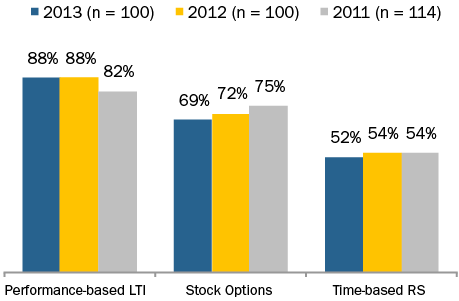
Note: Percentages add to greater than 100% because most companies grant a variety of vehicles.
Companies continue to use multiple vehicles to deliver LTI to executives. 51% of companies in our study deliver LTI in the form of two vehicles, 29% use three vehicles and 20% use only one vehicle. Among the companies that deliver LTI compensation through one vehicle, 60% grant only performance-based LTI.
LONG-TERM AWARD MIX
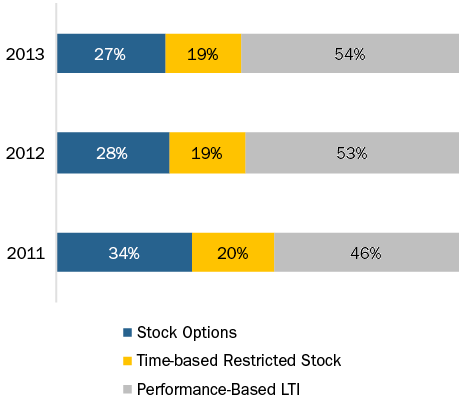
The average LTI mix in 2013 is generally consistent with 2012. Performance-based LTI continues to represent more than half of the LTI mix (approximately 55% of total LTI) while stock options represent approximately 25% and time-based restricted stock represents 20%.
The chart below depicts the average LTI mix for NEOs as disclosed in the CD&A:
PERFORMANCE-BASED LTI METRICS
Companies routinely reassess their LTI plan design, including the performance metrics used, to ensure that the design reflects the company’s business strategy and objectives to attract, incentivize and retain executives. Among performance-based LTI plans, the use of a return measure increased to 49% in 2013 (up from 41% in 2011) indicating that companies are trying to encourage operational efficiency, along with profitability and growth. Among the companies that use return measures, 47% use ROI or ROIC, 37% use ROE and 16% use ROA. TSR and EPS are also prevalent long-term incentive metrics, used by 42% and 36% of companies, respectively. In our study, most companies with performance-based LTI plans use two metrics.
Companies are also more likely to use LTI metrics that reflect key measures of success in their industry. The Automotive industry frequently uses Cash Flow as a metric, focusing executives on liquidity to manage the significant cash requirements associated with the industry. In the Pharmaceutical and Technology industries, where the success of a company’s pipeline and current product offerings is reflected in their stock price, TSR is used more frequently as a metric.
Overall, 49% of companies in our study measure performance relative to the external market (typically using TSR) and 89% measure performance against pre-established goals (typically internal financial metrics). Although the use of relative TSR has increased slightly since 2011, the use of absolute internal financial metrics is most prevalent. Approximately 92% of companies that use TSR, measure performance relative to a defined comparator group (54% use a defined peer group, 40% use a broader industry index and 6% use both) while nearly 95% of companies measure financial performance against pre-established goals based on the business plan.
In recent years, companies have moved away from using only absolute or relative performance measures and instead frequently use a two-pronged approach. In 2013, 37% of companies used both absolute and relative performance measures compared with 24% in 2011. The use of both absolute and relative performance measures allows companies to evaluate performance from a balanced perspective, considering both internal and external results.
The chart below displays the prevalence of LTI metrics for performance-based awards in 2011-2013:
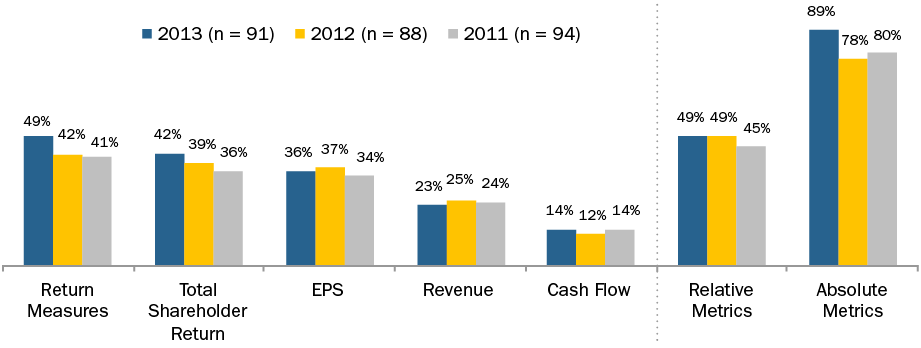
Note: Percentages add to greater than 100% due to multiple responses. Return measures reflect ROE, ROIC and ROA
CONCLUSIONS
The role played by performance-based LTI within LTI programs continues to grow. Performance-based LTI constitutes 54% of total LTI, on average, for NEOs. As performance-based LTI grows, the use of stock options and time-based restricted stock has been declining; however, these vehicles often have a role in a well-designed LTI program since stock option value depends on longer-term stock price appreciation and time-based restricted stock serves as an excellent retention vehicle.
The most commonly used metrics are return measures, such as ROI, as well as TSR and EPS. These metrics demonstrate that companies are attempting to use LTI to incentivize operational efficiency, profitability and growth. While most companies evaluate financial performance against internal goals, a growing number of companies have adopted a two-pronged approach to long-term performance measurement. These companies use internal financial goals and also incorporate a relative goal (typically TSR) to measure company performance in the context of the external market.
While most companies have already implemented changes that provide for a stronger link between executive pay and company performance, we expect to see companies continue to refine their performance-based LTI plans to support their business strategy. Additionally, we expect that setting meaningful long-term financial goals will continue to be a challenge for many companies leading some to incorporate relative performance metrics in the LTI program.
Partner Susan Schroeder and Principal Bonnie Schindler are interviewed on their 2014 survey private company incentive pay practices.
Underlying the Fed’s input to financial institutions is a legitimate concern about the potential for incentives to encourage excessive risk taking. The Fed has stated that: “risk-taking incentives provided by incentive compensation arrangements in the financial services industry were a contributing factor to the financial crisis that began in 2007” and “Before the crisis, large banking organizations did not pay adequate attention to risk when designing and operating their incentive compensation systems.” Agree or disagree with these points, over the past several years compensation-related risk management processes have vastly improved.
In this CAPflash, we provide an overview of how compensation practices have evolved following the Fed’s guidance, what (in our view) the Fed has got “right” and where they may have gone too far, and what we expect to see from banks and regulators in the near future.
Where We Are Now
The Final Guidance was principles-based, leaving leeway for implementation to consider differences among the institutions subject to this new level of oversight. For example, companies with significant differences in their businesses, such as select investment banks, custody banks, regional banks, and credit card companies were all subject to the same guidance. In its October 2011 publication, the Federal Reserve noted, “The interagency guidance helps to avoid the potential hazards or unintended consequences that would be associated with rigid, one-size-fits-all supervisory limits or formulas.” In our experience, banks devoted considerable time and resources to demonstrate substantial conformance with the new requirements, but went about responding and demonstrating conformance to regulators in different ways.
The Interagency Guidance was founded on three key principles:
- Balance between risks and results. Incentive compensation arrangements should balance risk and financial results in a manner that does not encourage employees to expose their organizations to imprudent risks;
- Processes and controls that reinforce balance. A banking organization’s risk-management processes and internal controls should reinforce and support the development and maintenance of balanced incentive compensation arrangements; and
- Effective corporate governance. Banking organizations should have strong and effective corporate governance to help ensure sound incentive compensation practices, including active and effective oversight by the board of directors.
Improved Risk Management
In our experience, companies have come a long way in addressing all three key principles. Most banks have greatly strengthened their risk management processes and ensured that the risk function has a defined role in reviewing compensation design, as well as performance outcomes and their impact on compensation payments. Where the risk function seldom had any role in the incentive compensation process in the past, they are now integrated into the process. Similarly, great strides have been made to ensure that Compensation Committees are informed about risk-taking within the organization and how incentive compensation designs across the company address risk. Many banks have also formed internal committees responsible for maintaining controls and risk oversight of incentive compensation plans across their organizations.
Prescribing Plan Design
The Fed and other agencies have become more prescriptive in their “guidance” to banks, at times almost to the point of allowing for limited leeway in compensation practices. The table below provides a summary of the methods for linking compensation and risk outcomes described in the Final Guidance, and select examples of how current compensation design practices have evolved based on input from regulators.
|
Areas of Principles- based Interagency Guidance |
Select Examples of Design Practices Reacting to Fed Direction |
|
Deferred Incentive Compensation |
Significant Changes Reduced upside leverage in long-term performance plans (from 200% to 125%-150% of target) Elimination of stock options (or significant reduction to modest percentage of total long-term) |
|
Risk Adjustment of Incentives |
Significant Changes Risk-adjusting incentive pools Performance-based adjustments that apply to deferrals/long-term incentives over the full vesting period with ability to reduce awards to zero based on risk outcomes |
|
Other Methods that Promote Balanced Risk-Taking Incentives |
Modest Changes Discretionary annual incentives most common (some shifts where formula-based payouts had existed) Reduced upside leverage in annual incentive plans, at times with corresponding increases to fixed pay (salaries) Some reduction in the use of relative performance measures in annual and/or long-term incentive plans |
|
Enhanced Control Functions |
Modest Changes Risk management and internal control functions involved in designing, implementing, and evaluating incentive arrangements to ensure proper risk-balancing in a more formal way |
|
Strong Corporate Governance |
Modest Changes Increased Board/Committee oversight of incentive compensation arrangements below senior executive level, for other covered employees (including non-executives) Mechanisms to facilitate communication between the Compensation Committee and Risk and Audit Committees |
In our view, the area where the Federal Reserve has had the most positive impact on incentive compensation design is in requiring deferrals to be subject to performance adjustment, before and after grant, based on risk outcomes (generally not the case before the guidance). Other changes encouraged by the Fed (e.g., eliminating/reducing stock options, reducing upside incentive plan leverage to 125%-150% of target, reducing the use of relative measures, etc.) seem to be less well founded in the principles of risk balancing and more arbitrary. It is difficult to identify the role that these incentive design features played in the financial crisis and it seems to us that Fed input on these areas is based more on theoretical objections than any empirical data supporting the hypothesis that these incentive design features encouraged excessive risk-taking among executives at financial institutions.
Future Concerns and Expectations
U.S. regulators should be commended for maintaining a largely hands off approach thus far with respect to pay levels, focusing primarily on incentive compensation design and control features. This approach provides a strong focus on risk balancing of incentive compensation, while recognizing the need for the industry to maintain competitive compensation programs. In contrast, in the European Union, CRD-IV places caps on the level of incentive pay that may be delivered (as a ratio of fixed pay). This type of regulation severely limits the ability to implement a pay-for-performance compensation design and, in response, has led many companies to increase fixed pay. As a result, CRD-IV has potentially harmed shareholders by weakening the pay-for-performance relationship. Thankfully, to-date, the Fed has avoided this kind of heavy-handed approach in addressing compensation in U.S. financial institutions.
Still, we may have unanticipated consequences in the U.S. Many shareholders and shareholder advisory groups prefer formulaic performance-based incentive arrangements to discretionary incentives, as they fear that discretion will be used for the benefit of management. However, because regulators have discouraged formulaic, performance-based upside in incentive compensation plans, many financial institutions have moved to more discretionary incentive arrangements to allow for greater flexibility to compensate executives. Another potential response to the Fed’s input is that, over time, financial institutions may increase pay levels to address concerns that executive talent will depart for other industries (e.g., hedge funds, private equity, asset management) where there are no restrictions on incentive design.
Going forward, we expect regulators to provide more guidance on monitoring and validation processes and results. Many companies developed approaches to retrospectively review risk outcomes and the corresponding impact on compensation decisions, but communicating these processes and results for all covered employees to regulators is still, generally, in early stages. Regarding incentive plan upside leverage, regulators have started to state more and more directly a belief that 125% is most appropriate, but many banks have held their ground at 150%. Some of the banks that moved to 125% may start to re-evaluate their program and consider moving back to 150% to remain competitive.
As companies and Committees try to “live with” the restrictions of the guidance, we expect to see a continued move away from formal targets and increased use of discretion, increases in pay levels to recognize decreased incentive plan upside leverage, and challenges in applying risk adjustments and clawbacks.
Conclusion
Incentive compensation processes and designs among financial institutions have changed a great deal over the past four years, to a large degree driven by regulatory input. If we look back at the principles (Final Guidance), most banks have come a long way in addressing them. At this point, we hope that regulators can step back and consider how much progress has been made and consider taking a pause to begin to evaluate what changes were necessary and effective and what changes may have been excessive.
Appendix – Summary Market Data
[company-by-company data available upon request]
Methodology
CAP reviewed 2012, 2013, and 2014 proxy statements and the most recent equity award agreements of the 23 large publicly-traded banks1 that were included as part of the Federal Reserve’s horizontal review of incentive compensation. Our analysis looked for year-over-year changes in compensation structure, annual and long-term incentive design, performance-based vesting, recoupment policies and stock ownership guidelines/retention requirements.
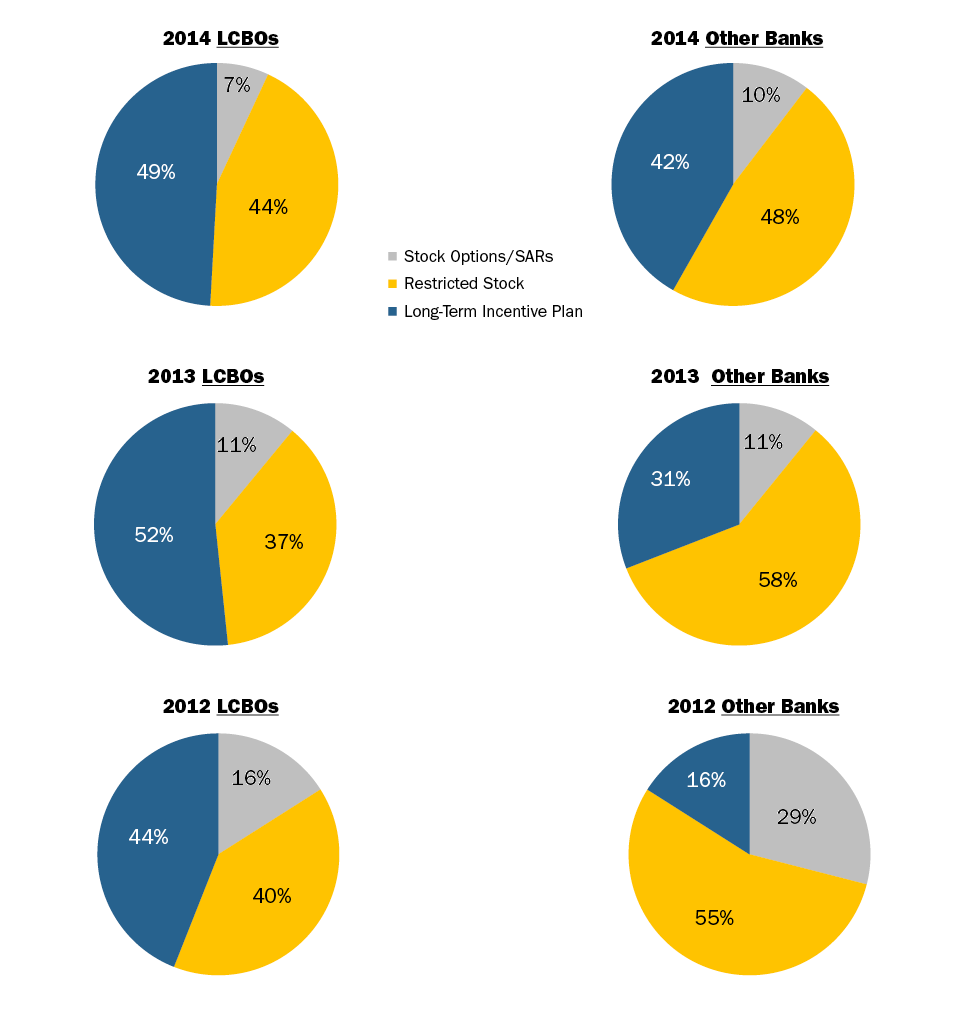
Select summary data is shown below. Findings have been divided into two data sets, large complex banking organizations (LCBOs) and other large banks with assets exceeds $50 billion. LCBOs are one year ahead of the other large banks in terms of their interaction with the Fed, and the related implications on compensation program design.
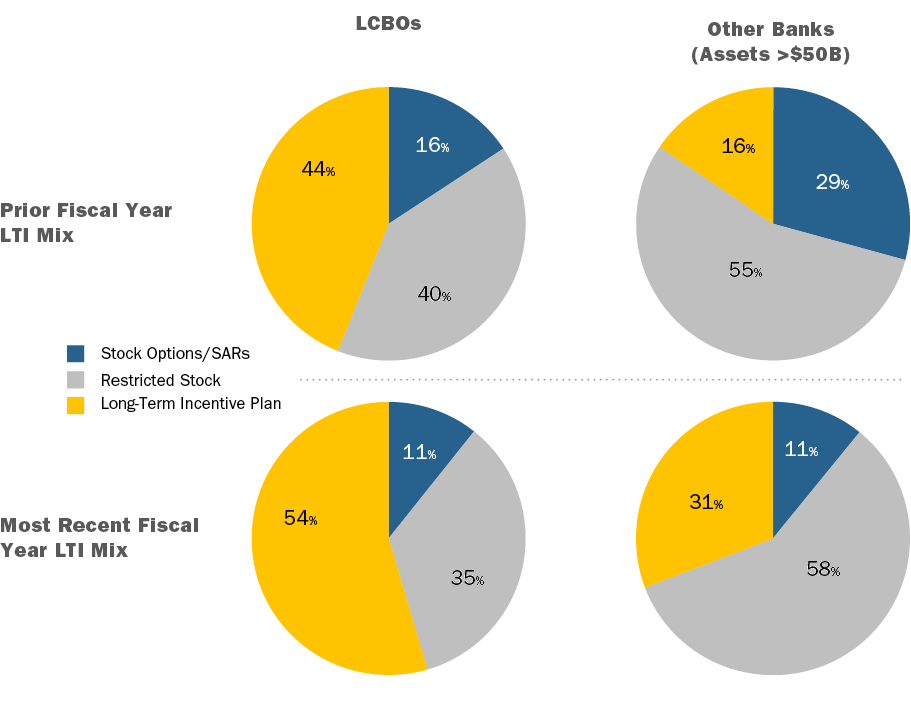
Long-term Incentive Mix, 2012-2014
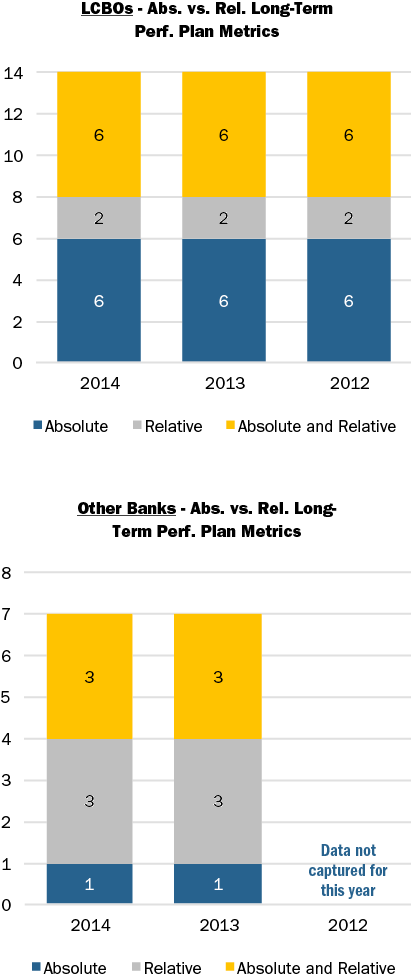
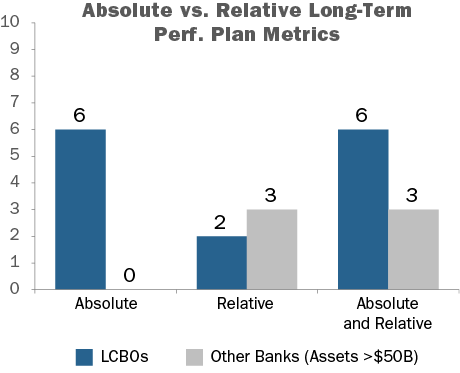
Long-term Incentive Absolute vs. Relative Performance Metrics, 2012-2014
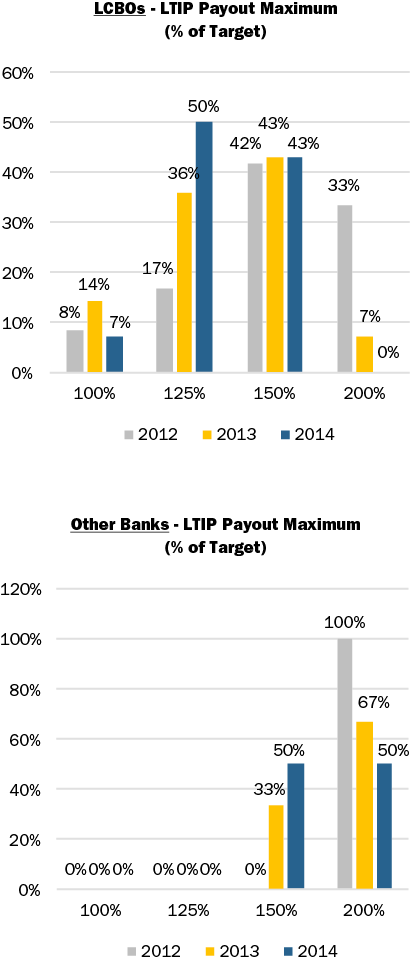
Long-term Performance Plan Maximum Upside Leverage, 2012-2014
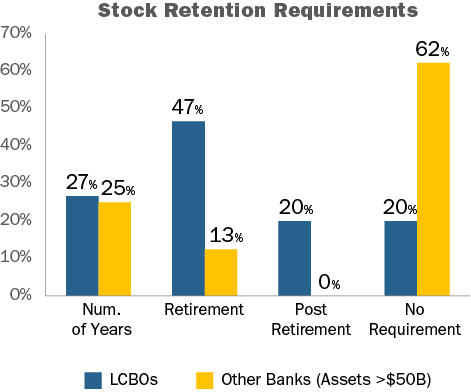
Stock Ownership Requirements
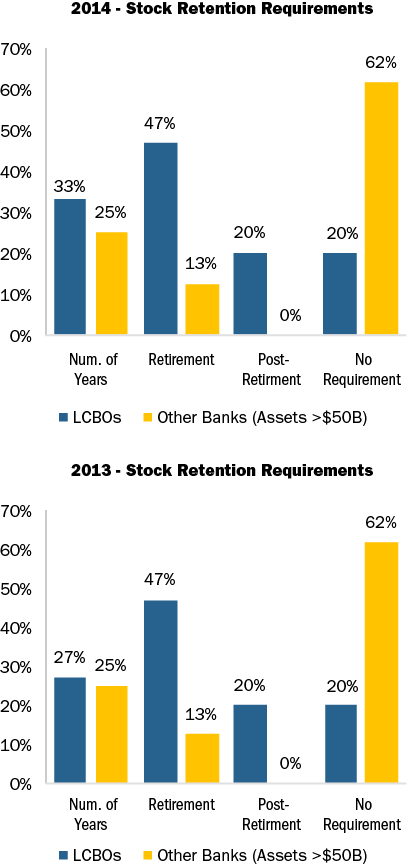
Some companies differentiate stock retention requirements for the CEO versus Other NEOs. Therefore in some instances the prevalence shown is greater than 100 percent.
Research assistance was provided by: Myron Lising, Roman Beleuta, Michael Biagi, Michael Bonner, Rachael Holland, and Jasmine Yanes.
1 Companies reviewed include American Express, Bank of America, BNY Mellon, Citigroup, Capital One Financial, Discover Financial Services, Goldman Sachs, JPMorgan Chase, Morgan Stanley, Northern Trust, PNC, State Street, SunTrust Bank, US Bancorp, Wells Fargo, BB&T, Comerica, Fifth Third, Huntington Bancshares, KeyCorp, M&T Bank, Regions and Zions Bancorp.
Do incentive-pay practices differ between publicly traded and privately held companies? If so, how? Research released this year by WorldatWork, Deloitte Consulting and Vivient Consulting set out to answer these questions.
Incentive-pay practices do differ between public and private companies. Short-term incentives (STIs), including annual incentive plans, are structured similarly across both organizational types. However, public companies are much more likely than their private counterparts to offer STIs to the broader employee population. In contrast, private companies place greater emphasis on STIs in their total rewards programs, as STIs are the companies’ most effective compensation tool for attracting and retaining talent. However, private companies tend to reserve short-term rewards for exempt employees and above.
On the long-term side, publicly traded companies rely heavily on long-term incentives (LTIs), such as restricted stock and stock options. Restricted stock has surpassed stock options as the LTI vehicle of choice for public companies. In contrast, private companies favor cash LTI plans, such as bonus plans with goals and payouts tied to multiyear performance, over real equity. Public companies are more likely to make broad-based equity grants to the larger employee population, while private companies concentrate LTI awards on top executives.
The survey, based on 2013 survey data, provides a rare look at how non-profit/government organizations attract, motivate and incentivize their employees. Data includes hard-to-find statistics on the size and nature of short-term and long-term incentive pay practices, including the types of plans and vehicles used. More than 175 participants from nonprofit and government organizations responded to the survey.
Previously conducted in 2007 and 2011, this year’s incentive pay compensation surveys represent our third collaboration with WorldatWork. With this longitudinal data, we provide insight on the key compensation trends and explain the reasons behind them.
Compensation Trends: Nonprofit/Government Organizations:
- In 2013, 78% of nonprofit and government organizations reported using short-term incentive plans, while 16% reported using cash long-term incentive plans.
- Nonprofit and government organizations favor simplicity by operating a limited number of short-term incentive plans. Of the respondents, 68% report having three or fewer short-term incentive plans in place.
- The majority of organizations (62%) rely on 4 to 6 performance measures in their Annual Incentive Plans in order to reward performance across several different dimensions.
The survey, based on 2013 survey data, provides a rare look at how private companies attract, motivate and incentivize their employees. Data includes hard-to-find statistics on the size and nature of short-term and long-term incentive pay practices, including the types of plans and vehicles used, as well as private company equity sharing ratios, liquidity, and valuation provisions. More than 190 participants from private, for-profit organizations responded to the survey.
Previously conducted in 2007 and 2011, this year’s incentive pay compensation surveys represent our third collaboration with WorldatWork. With this longitudinal data, we provide insight on the key compensation trends and explain the reasons behind them.
Compensation Trends: Privately Held Organizations:
- More than 75% of companies with a short-term incentive plan offer more than one program, with 39% of respondents reporting four or more short-term incentive plans.
- Annual Incentive Plans, the most prevalent short-term incentive plan at private companies, are offered to employees at the exempt, salaried level and above at most organizations.
- In 2013, 56% of companies offered long-term incentive plans, down from 61% in 2011. Long-term cash plans are the most prevalent long-term incentive vehicle with 51% prevalence in 2013.
Underlying the Federal Reserve’s input to financial institutions is a legitimate concern about the potential for incentives to take on excessive risk. From our interactions with clients and observing the practices of the industry as a whole, there is no doubt that financial services firms have made significant progress addressing risk in a much more comprehensive way, with cross-functional teams addressing a wide variety/forms of organizational risk. Much of the work that financial services firms have done initially has less to do with compensation and has been primarily focused on understanding the nature of the risks in their organizations and developing robust processes to effectively control and monitor risk.
While financial services companies have made great strides in improving risk management, they have not been let off the hook by regulators when it comes to compensation design. Instead, over the past three years, as risk management processes have vastly improved, the Federal Reserve has become progressively more detailed in the compensation-related input they provide to regulated institutions. The Federal Reserve has provided guidance to companies on specific areas of executive compensation calling for some of the following types of changes, beyond the mandated deferral of compensation for the most senior executives (Tier 1 covered employees):
- Include Risk Review in Annual Incentive Design: Pressure to include some form of a formal risk review at the individual and company-wide level in annual incentive decisions [Early Principle]. This has been accomplished through the development of enterprise risk frameworks that monitor company-wide risk and individual evaluations that heavily weight individual activities that could promote negative risk outcomes in the assessment.
- Performance-Based Vesting of Long-term Incentives: The Federal Reserve expects companies to be able to affect the initial grant size, and even more importantly, the amount that ultimately vests (even down to zero) based on these risk assessments of the individual and/or the company.
- Reduce Use of Stock Options: The Federal Reserve has long been concerned that the asymmetrical nature of stock options can create incentives for employees to take on excessive risk and therefore has encouraged companies to eliminate, or at a minimum, reduce stock options as a percentage of total incentive compensation.
- Reduce Incentive Plan Upside Leverage (Annual and Long-term Incentive Plans): Companies with plans that stipulate a specified maximum award have been directed to reduce incentive plan leverage from the historical industry and broader market standard maximum incentive opportunity of 200% of target to 125%-150% of target.
- Reduce or Eliminate Relative Performance Measures: The Federal Reserve is concerned that relative measures may reward companies for under-performance and could lead companies to take on excessive risk to “chase after” leading performers. They prefer absolute performance objectives that are more easily communicated to executives.
Methodology and Findings
CAP reviewed the 2012 and 2013 proxy statements of the 23 publicly-traded financial services companies1 that were included as part of the Federal Reserve’s horizontal review of incentive compensation. Our analysis looked for year-over-year changes in compensation structure, annual and long-term incentive design, performance-based vesting, recoupment policies, stock ownership guidelines, and retention requirements.
It should be noted that not all banks with assets >$50 billion have fully disclosed the changes to their compensation programs, because some of these institutions are in an earlier stage of the process of interaction with the Federal Reserve. For them, 2013 will be an active year for the evolution of their executive compensation programs.
The most significant findings are among the LCBOs since they have been undergoing the review process for a longer period of time. Among these companies, we have seen a great deal of year-over-year change, with many adopting the features discussed above; however, management and Compensation Committees also recognize that the Federal Reserve is one of multiple constituencies that they need to address in compensation design. While the Federal Reserve is actively involved, shareholders also have expectations and an ability to express these views through Say on Pay votes and other constituencies who are active as well (e.g., employees, retirees, shareholder advisory groups). As a result, companies are more adamant about retaining aspects of the compensation program design (e.g., relative performance metrics in performance share plans, stock options, incentive plan upside opportunity at or above 150% of target) to address the views of these groups.
Compensation Structure
Financial services firms generally operate under two main types of compensation structures. The first approach is an “investment banking” style of compensation model (e.g., Bank of America, Goldman Sachs, JPMorgan Chase). Under this approach, each year a total incentive is determined based on a review of the prior year’s performance. The total incentive is delivered to executives as a mix of annual cash incentive and long-term incentives. In the past the long-term incentive piece was often delivered as time-vested restricted stock and potentially stock options, but this mix has changed over time.
The second approach is a more traditional compensation model common across most other industries, where the annual incentive is based on the prior year’s performance and the long-term incentive grant is viewed as a separate decision, with the target long-term compensation opportunity based on future performance and the grant value is independent of prior year performance.
A recent development over the past two years is that companies that have historically used either the investment banking structure or the more traditional structure have moved to adopt a hybrid approach where the annual incentive is determined based on prior year performance and delivered in a mix of current cash and/or deferred equity/cash and a separate long-term incentive is also provided:
- Morgan Stanley: Moved from an investment banking style to have two separate incentives: 1) annual incentive delivered through a mix of deferred cash and stock options, 2) long-term incentive delivered as a performance LTIP
- Citigroup: Maintains an investment banking structure, but this year added a performance scorecard approach to determine size of incentive compensation and changed delivery to 40% annual cash, 30% deferred stock, 30% performance share units
- BNY Mellon: Historically used a more traditional pay model approach and has shifted its performance scorecard to determine a larger portion of overall incentive compensation. Seventy percent of the total incentive is delivered in a mix of cash and restricted stock, with the remaining thirty percent of total incentive in a performance share plan.
Risk Adjustment in Annual Incentive
All companies now include corporate and individual risk assessments in the process for determining the size of annual incentive pools and individual awards. Frequently these adjustments are intended to provide an ability for the Compensation Committee to apply negative discretion to reduce or eliminate the annual incentive payout if the company or an executive is found to have incurred a material negative risk event or to cover any individual who has failed to demonstrate adequate sensitivity to risk or the firm as a whole had subpar risk results. Both recoupment and/or clawback policies are now widespread.
Incentive Plan Upside Leverage
An area where the Federal Reserve appears to be surprisingly prescriptive is in encouraging companies to reduce incentive plan upside opportunities. From a compensation perspective, this runs counter to designs that are preferred by shareholders who expect a strong pay-for-performance program. The Federal Reserve is opposed to formulaic plans that can lead to substantial payouts when performance is strong, but does not necessarily understand that discretionary plans can lead to comparable payouts. A potentially unintended consequence of this point of view is to encourage companies to reduce the transparency of incentive plan design leading to reduced line-of-sight for executives. An important tenet of compensation theory is that executives have a clear understanding of the process and approach that will be used to determine their incentive. Given the Federal Reserve’s preference for discretion, the relationship between performance results and incentive payouts may be weakened, particularly at higher performance levels. Again, regulatory guidance may lead to a major misalignment with shareholders.
Shareholders also prefer incentive plans with direct linkage between payouts and pre-established performance objectives. They are concerned that discretion is frequently used to the advantage of executives and at the expense of shareholders. However, recognizing the concerns of the Federal Reserve, firms have reduced the maximum opportunity from 200% of target (a broad industry company standard) to 150% or 125% of target so they can continue to address shareholder desires for a more formulaic structure while mitigating Federal Reserve concerns about leverage.
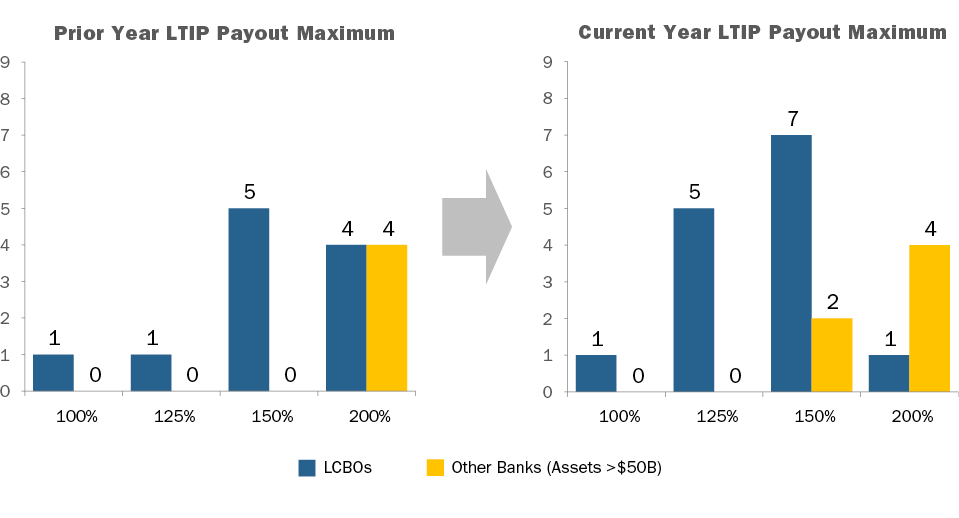
Other potential unintended consequences we may see in the future are: 1) an increase in the value assigned to target incentive opportunities to provide more motivation (and compensation) to executives, thereby increasing pay at lower performance levels, or 2) a move toward a more discretionary determination of incentive payouts to avoid the need to establish a target/maximum incentive opportunity. Neither of these approaches is particularly attractive from a shareholder perspective since both are less performance-based.
Reduce/Eliminate Use of Relative Measures
The Federal Reserve believes that relative performance measures may provide the wrong incentives to management teams. The rationale appears to be based on three concerns:
- Relative performance measures do not communicate a clear goal to management teams, as the performance objective is a moving target, based not only on the firm’s performance, but also on the performance of its peers
- Performance can be strong on a relative basis, but be poor on an absolute basis (for example, the best performing banks in 2008 and 2009 were still poor performers on an absolute basis)
- If a firm falls behind its peers, they may have incentives to take on excessive risk in an attempt to “catch up” with the competition
Benchmarking/indexing is common in many business areas (e.g., investment performance, financial performance, etc.) that do not relate, necessarily, to pay. Historically, shareholders and other external constituents have pushed for more companies to use relative performance measures as they are viewed as a “truer” measure of company performance that is less subject to “sandbagging” by management or the influence of market or other external factors (all boats rise…). In addition, shareholder advisors rely heavily on relative performance comparisons in making Say on Pay vote recommendations.
Based on our analysis, this is an area where companies have been reluctant to make a shift. About 60% of the companies that we analyzed continue to use relative performance measures as part of their long-term incentive design. It is a fairly even mix between relative TSR and relative Return on Equity, with a few companies using other financial metrics. The majority of companies now combine the relative measures with an absolute financial performance measure, most typically Return on Equity to provide the appropriate risk-balancing the Federal Reserve has been seeking.
Reduced Use of Stock Options
To state it plainly, the Federal Reserve does not like stock options as an incentive vehicle. Its concerns are similar to those raised by other critics of stock options in the past. Stock options may encourage executives to take on additional risk to increase the stock price, but do not focus management on avoiding decreases in the stock price. From a shareholder perspective, stock options have historically been an attractive vehicle because executives only receive value when the stock price appreciates. Many Compensation Committee members also like that stock options do not require the negotiation of goal setting associated with long-term performance plans. When used in combination with ownership guidelines and post-exercise holding requirements, many of the concerns with options can be addressed.
Most companies in the financial services industry have recently reduced or eliminated the use of stock options (eliminated by Bank of America, BNY Mellon, Citigroup, Discover Financial, Goldman Sachs, PNC, Regions, and Wells Fargo; reduced by BB&T, Comerica, Fifth Third, Huntington Bancshares, KeyCorp, Northern Trust, and US Bancorp). We expect this trend to continue. Stock options have largely been replaced by performance shares. While the Federal Reserve tends to like time-vested restricted stock, shareholders are not enamored by the vehicle as it is often viewed as a form of semi-guaranteed (i.e., non-performance-based) compensation.
Performance–Based Vesting of Long-term Incentives
As part of the Federal Reserve’s original guidance, they required deferral of at least 50% of incentive compensation for Tier 1 executives, and strongly encouraged that deferred compensation be subject to potential reduction (company-wide or individually) if performance was poor in subsequent periods. This is an area where substantially all banks have responded with recoupment and clawback policies effective in 2012 or 2013.
Companies have added adjustments to long-term incentives in a few ways:
- Added a risk-based vesting measure to what would otherwise be a time-vested award of stock options or restricted stock. Typically a threshold level of performance is required for each year of the vesting period. Measures include a threshold level of Return on Equity, Tier 1 Capital, Return on Assets, Credit Rating, or avoiding a loss
- Added a discretionary assessment of whether or not executives took inappropriate risks that could potentially lead to a material loss for the company and subject deferred compensation to a potential reduction or elimination based on this assessment
- A combination of a quantitative threshold (e.g., a loss, or a return below a threshold level) that triggers a qualitative review that could lead to a reduction or elimination of outstanding deferred awards
Stock Ownership Guidelines and Retention
While the Federal Reserve has not mandated ownership guidelines or requirements for executives to hold on to shares post-exercise of stock options or post-vesting of other vehicles, a number of companies within the financial services industry have implemented rigorous share retention requirements. Shareholder advisory groups and shareholder activists have been pushing the idea of requiring that shares be held to retirement or post-retirement. In most industries, there has been little movement in response. Among the financial services firms we reviewed, several require holding for at least one year post-vesting of shares or exercise of stock options, and nearly 50% of LCBOs have a requirement that executives hold a portion (typically 50%) of net after-tax shares to retirement. A few firms require that shares be held post-vest or exercise for one year following retirement.
Though this is not a specific requirement of the Federal Reserve, we suspect that companies feel that required share retention to retirement encourages executives to focus on preserving the long-term value of shares and provides a strong “risk-balancing” feature sought by the Federal Reserve to the overall program.
Conclusions
For financial institutions subject to review by the Federal Reserve, compensation programs will continue to evolve over the coming years. It has taken some time for the regulators to develop points of view on compensation programs, and we anticipate that their perspective of what constitutes “substantial conformance” with their guidelines will continue to evolve. One area of concern is ensuring that in addressing appropriate and important concerns about risk, companies are not forced to dilute their pay-for-performance relationship and alignment of executive compensation with shareholder outcomes.
We believe companies will continue to engage with the Federal Reserve in dialogue around pay-for-performance, shareholder expectations and the “overall” structure of their plans vs. any single design feature. It is possible that with ongoing engagement with the regional Federal Reserve Banks and the Federal Reserve Board that the banks (collectively) will be able to share some of their perspectives and use their actual experience, sensitivity analysis and back-testing to provide a better understanding of the risks and the mitigating features underlying their compensation programs. It is our hope that this engagement will allow companies to strike the appropriate balance between pay-for-performance, alignment with shareholders and the Federal Reserve’s valid concerns about managing and averting unnecessary risk.
1 Companies reviewed include American Express, Bank of America, BNY Mellon, Citigroup, Capital One Financial, Discover Financial Services, Goldman Sachs, JPMorgan Chase, Morgan Stanley, Northern Trust, PNC, State Street, SunTrust Bank, US Bancorp, Wells Fargo, BB&T, Comerica, Fifth Third, Huntington Bancshares, KeyCorp, M&T Bank, Regions and Zions Bancorp.