In our experience, “activist investors” were more vocal and influential in boardrooms during 2015 than during other recent years. As a result, Compensation Advisory Partners (“CAP”) analyzed circumstances at nine companies that had proxy contests in 20151 where in each case, one area of activist focus was executive compensation. We found that executive compensation issues were often supportive and complimentary to other, larger internal issues at the target companies. While these activists may have targeted executive compensation, this was not the main driver in engaging with the company. Activist complaints tend be more focused on strategic/financial issues and they use compensation as a point of discussion to identify where their views differ. For example, if return on capital is not a utilized metric in incentive plans and the company has completed several low return acquisitions, the activist may use this as support that strategy is flawed and that compensation reinforces that flaw.
“Activist investors” are individuals (i.e. hedge fund managers) or groups (i.e. alternative investment companies) who purchase a stake in a target company’s outstanding equity shares with the end-goal of influencing company decision making by acquiring seats on the Board of Directors. Once on the Board, activists will try to effect changes (i.e., by divesting or acquiring a business segment, cutting expenses, increasing distributions to shareholders, etc.) that ultimately increase the company’s value and the value of the activist’s investment.
What We Found
Compared to prior years, 2015 saw an increase in proxy contests. Among companies in the Russell 3000 Index, there were 20 proxy contests initiated by activist investors during 2015. This compares to 14 proxy contests in 2014 and 16 in 2013.
Of the 20 proxy contests initiated by activist investors in 2015, nine (45 percent) specifically took issue with the executive compensation program at the target company. In each case, “issues” with executive compensation were a part of the supporting statements for the dissident slate of directors. This is a stark contrast to 2014 and 2013, where 4 (29 percent) and 1 (6 percent) proxy contests took issue with executive compensation, respectively.
Specific compensation practices highlighted in 2015 include:
|
Executive Compensation Issue |
Number of Companies (n=9) |
Percentage of Companies |
|
Pay for Performance Misalignment |
7 |
78% |
|
High CEO Compensation |
4 |
44% |
|
Choice of / Adjustments to Performance Metrics |
4 |
44% |
|
Weak Corporate Governance Structure |
3 |
33% |
|
High / Increase to Board of Director Compensation |
3 |
33% |
|
Awards of Special Grants to Executives |
2 |
22% |
|
Outsized Peers |
1 |
11% |
Ultimately, we found that activist investors frequently use executive compensation and pay for performance disconnect as levers to bolster their argument for receiving seats on the target company’s Board of Directors.
Target Companies
Of the nine activist campaigns which specifically took issue with executive compensation practices, the companies that were being targeted generally had lagging TSR performance, both in absolute terms and relative to competitors. Further, low Say on Pay results in 2014 also provided activists with an additional reason for targeting certain companies.
As the below table demonstrates, where activists were successful in securing Board seats, the most recent Say on Pay support was generally low and either the company’s 1-year TSR, 3-year TSR, or both were relatively low.
Successful Activist Campaigns
Of the nine proxy contests that specifically targeted aspects of executive compensation, four ultimately resulted in the activist investor gaining Board seats at the target company. The four companies, which are noted in the chart below, include: Myers Industries, Imation Corp., The Children’s Place2 and Shutterfly, Inc.
The main common denominator, from a compensation perspective, among the successful activist campaigns was a perceived disconnect between executive pay and financial performance at the target company. More specifically, at Myers, Imation and The Children’s Place, the activists were able to show that, despite poor TSR (in both absolute and relative terms), the executives at these companies were still being rewarded either through salary increases, above target annual incentive payouts or equity grants.
|
Company Name |
Say on Pay Results |
Total Shareholder Return |
|||
|
2013 |
2014 |
2015 (Year of Proxy Contest) |
1 Year * |
3 Year CAGR * |
|
|
Activist Gained Board Seat (n=4) |
|||||
|
Myers Industries Inc. |
75% |
75% |
60% |
-17.8% |
12.6% |
|
Imation Corp. |
95% |
50% |
34% |
-17.8% |
-12.9% |
|
The Children's Place, Inc. |
17% |
61% |
94% |
13.8% |
6.3% |
|
Shutterfly, Inc. |
55% |
50% |
22% |
-18.3% |
22.4% |
|
Activist Did Not Gain Board Seat (n=5) |
|||||
|
Hill International, Inc. |
n/a (triennial) |
54% |
n/a (triennial) |
-0.3% |
-9.3% |
|
Ethan Allen Interiors Inc. |
86% |
92% |
80% |
-14.1% |
5.1% |
|
E. I. du Pont de Nemours and Company |
95% |
98% |
96% |
14.4% |
17.3% |
|
Biglari Holdings Inc. |
33% |
31% |
50% |
-21.7% |
2.8% |
|
Select Comfort Corporation |
98% |
93% |
96% |
26.9% |
6.7% |
* As of Fiscal Year End
Further, with regard to Shutterfly’s executive compensation program, activists made the case that executives were being rewarded for performance against metrics that were not “shareholder friendly” (i.e. metrics focusing on top line growth as opposed to earnings growth). In response to the activist criticism, Shutterfly’s Compensation Committee established several changes to their 2015 and 2016 executive compensation program performance targets to “further reflect shareholders views”. However, the lead activist investor (Marathon Partners) ultimately deemed these changes inadequate and requested further, more fundamental, adjustments to the entirety of the compensation program, namely, to begin prioritizing profit over scale.
It is not surprising that activist investors are most successful at winning Board seats at their target companies when they can tie executive compensation to the poor financial performance of the company. If shareholders are not realizing a desired return on their investment in any given company, it is reasonable to expect that they would show more support for an activist investor hoping to gain access to the target’s Board if it could potentially lead to financial improvement. When executive compensation can be tied to poor financial results, it simply provides activists, and shareholders alike, with another reason as to why a shift in leadership could be desirable or change in strategy could be advisable (e.g. CEO change).
ISS also tends to influence the outcome of these proxy contests. ISS supported at least one of the nominees on the dissident slate of directors at each of the four companies that lost at least one Board seat to the activist investor.
Ultimately, of the four companies who lost Board seats to activist investors, three companies (Imation Corp., Myers Industry and Shutterfly) have made changes to their executive leadership teams as these CEOs have stepped down. Further, while DuPont was able to win its proxy contest and keep dissident nominees off of its Board, five months after the Annual Meeting, the CEO announced her retirement.
Conclusion
We are seeing increased activity where activist investors are accumulating stakes in companies with the intention of agitating for change. Their hope is to make changes that will enhance the company’s value. While our analysis reflected proxy contests specifically focusing on executive pay (e.g. pay for performance misalignment), there are a number of circumstances where companies settle with the activist investors, avoiding a contentious public battle, and allow the activist a seat or multiple seats on the Board. Some examples include Baxter International settling with Third Point LLC, Freeport McMoRan settling with Icahn Enterprises and Citrix Systems settling with Elliott Management.
In order to be well positioned, Boards and Compensation Committees should be proactive:
- Ensure the Company and Board have a clear strategic focus and stick to it
- Make sure the metrics used in incentive plans align with the company’s strategic vision
- Confirm the Board has a game plan for shareholder and activist engagement
- Encourage the Company and Board to use external advisors to provide guidance
- Highlight company performance against goals
- Emphasize pay for performance relationship through the validation of relative performance and pay positioning
- Proactively seek feedback from shareholders throughout the year
- Assess program features which may not have a lot of value to executives but are viewed as problematic pay practices (i.e., eliminate excise tax gross-up, eliminate / reduce perquisites, move from single to double trigger equity vesting in the event of a change in control)
It is critical for the Board to work with management to ensure pay practices are defensible and supportable in light of company performance and good governance standards.
Appendix
Summary of Activist Campaigns
|
Company |
Activist |
Executive Compensation Issue Highlighted By Activist |
Contest Result |
|
Hill International, Inc. Program and project management company |
Bulldog Investors, LLC ISS supported both dissident director nominees |
|
No dissident nominees elected to the Board |
|
Ethan Allen Interiors International interior design and manufacturing company |
Sandell Asset Management Corp ISS supported 3 of 6 dissident director nominees |
|
No dissident nominees elected to the Board |
|
E.I. Du Pont International science and technology company |
Trian Fund Management ISS supported 2 of 4 dissident director nominees |
|
No dissident nominees elected to the Board CEO stepped down 5 months after the conclusion of the contest |
|
Biglari Holdings Owns and operates Steak N’ Shake |
Groveland Capital ISS did not support dissident director nominees |
|
No dissident nominees elected to the Board |
|
Myers Industries International manufacturing and distribution company |
GAMCO Asset Management ISS supported 1 of 3 dissident director nominees |
|
Three dissident nominees elected to the Board CEO stepped down |
|
Imation Corp. Data storage and information security company |
Clinton Group ISS supported all dissident director nominees |
|
Three dissident nominees elected to the Board CEO stepped down |
|
Select Comfort Corporation Designer, manufacturer, retailer and services of a Sleep Number beds |
Blue Clay Capital ISS did not support dissident director nominees |
|
Activist dropped proxy contest before it went to shareholder vote |
|
The Children’s Place (settled proxy fights prior to Annual Meeting) Children’s specialty apparel retailer |
Macellum Advisors GP and Barington Capital Group ISS supported 1 of 2 dissident director nominees |
|
Settled prior to contest – activist received one Board seat |
|
Shutterfly, Inc. Manufacturer and retailer of photo-based products |
Marathon Partners ISS supported 2 of 3 dissident director nominees |
|
Two dissident nominees elected to the Board CEO stepped down |
Note: The comments in the above chart are paraphrased or direct quotes from activist investors’ proxy contest materials/filings and do not reflect the view of CAP.
ISS released their finalized 2016 policy changes, which are consistent with the proposed changes previously announced. The changes are relatively minor and the key changes are related to
- Director Overboarding
- Negative director election vote recommendations for directors that have taken unilateral board actions
- Proxy Access
- Compensation-related votes at externally-managed issuers and Shareholder Proposals related to equity retention
- Shareholder Proposals: Hold Equity Past Retirement or for a Significant Period of Time
The changes are as follows:
- Director Overboarding
- Previously, ISS recommended an “Against” or “Withhold” for a director if the director sits on more than 6 public company boards or 2 public company boards for the CEO (besides their own for CEOs)
- ISS changed the threshold to 5 for a regular board member and made no changes for CEOs, though they did propose reducing the CEO threshold to 1 in the draft guidelines
- This change will be in effect for meetings on or after Feb. 1, 2017
- Negative director election vote recommendations for directors that have taken unilateral board actions
- ISS clarified that it will generally issue “Against” vote recommendations for directors, committee members or entire board for bylaws amendments, without shareholder approval, calling to classify the board or introducing supermajority vote requirements (policy will also apply if directors amended the bylaws immediately prior to an IPO)
- Negative vote recommendations will be issued until the unilateral reduction is reversed or approved by a shareholders vote
- Proxy Access
- ISS clarified current policy that vote recommendations for directors nominated using proxy access will be evaluated using similar criteria to those used in proxy contests
- Compensation-related votes at externally-managed issuers
- ISS will generally recommend “Against” say-on-pay proposals if there is insufficient disclosure for ISS to perform a comprehensive pay-for-performance analysis [limited situations and often impacts externally managed issuers like REITs]
- Sharholder Proposals: Hold Equity Past Retirement or for a Significant Period of Time
- ISS has broadened the policy to encompass executive retention proposals more generally, eliminating the need for a separate policy covering the proposals seeking retention of 75% of net shares
- The proposed retention ratio and required duration of retention are just some of the several factors that ISS will consider in its case-by-case analysis
For further details on the updated policies for 2016, please visit https://www.issgovernance.com/file/policy/2016-americas-policy-updates.pdf
Key CAP Findings
Board Compensation. little/no change
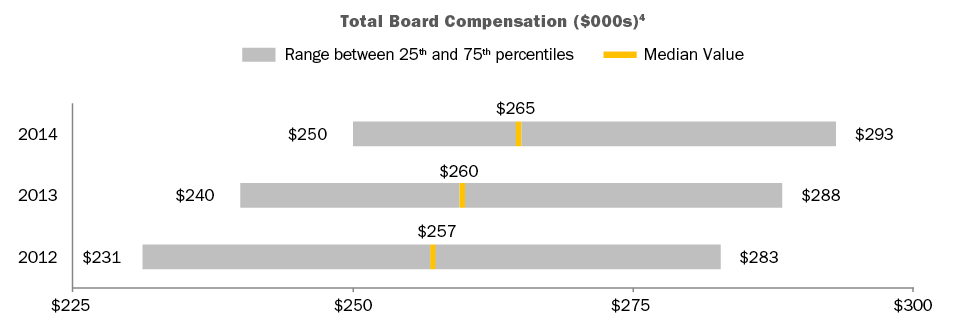
- Total Fees. Generally flat year-over-year (median is $265K, versus $260K in prior year).
- Retainers. Large companies rely on annual retainers (cash and equity) to compensate directors. Pay programs are typically simple and viewed more as an “advisory fee” than an “attendance fee.”
- Meeting fees. Provided by only 12 percent of companies (versus 15 percent in prior year). In general, companies have moved to a fixed retainer pay structure, with a component in cash and a component in equity.
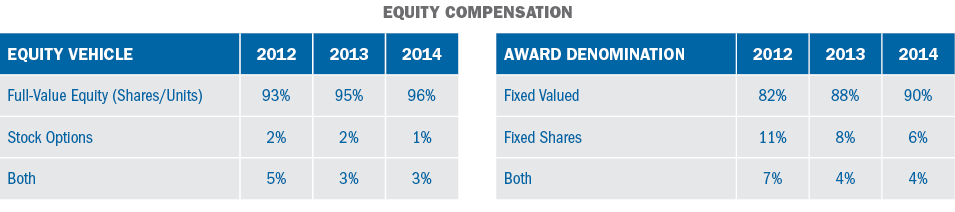
- Equity. Full-value awards (shares/units) are most common and only four percent of companies use stock options. 94 percent of companies denominate equity awards (stock or options) as a fixed value, versus a fixed number of shares which is considered best practice as it manages the value each year.
- Pay Mix. On average, 58 percent equity-based vs. 42 percent cash-based. Alignment with long-term shareholders is reinforced by delivering a majority of compensation in equity.
Committee Member Compensation. little/no change
- Overall Prevalence. 45 percent of companies paid committee-specific member fees1.
- Total Fees. Among companies paying committee member fees, the median is $15.5K.
Committee Chair Compensation. little/no change
- Overall Prevalence. Approximately 90 percent of companies provide additional compensation to committee Chairs, typically through an additional retainer, to recognize additional time requirements, responsibilities, and reputational risk.
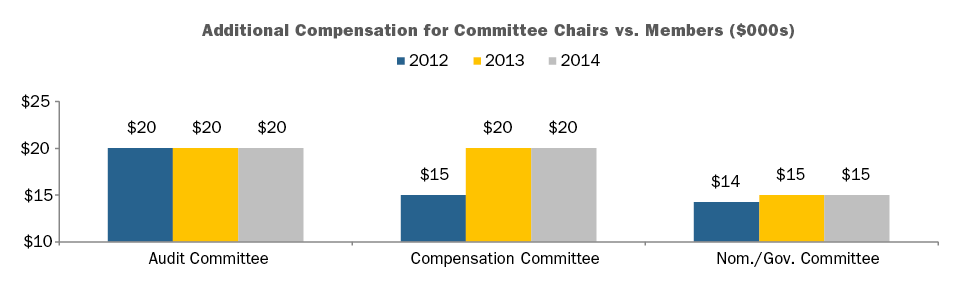
- Fees. At median, $20K in additional compensation (vs. members) was provided to Audit and Compensation Committee Chairs, and $15K additional to Nominating/Governance Committee Chairs.
Independent Board Leader Compensation. little/no change
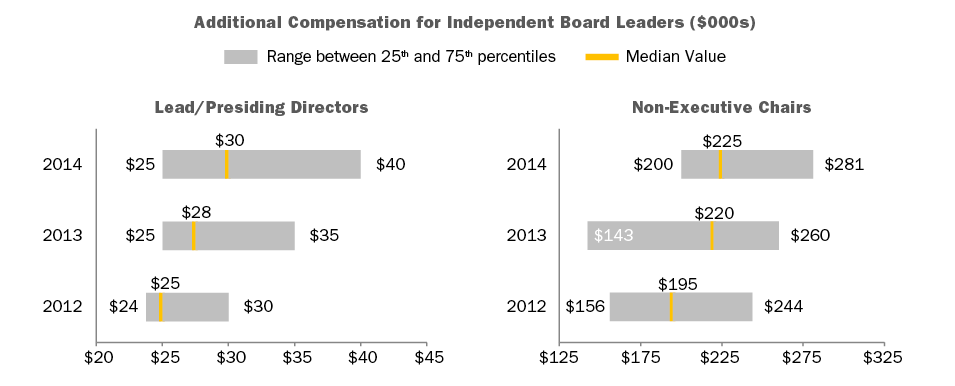
- Non-Exec Chair. Additional compensation is provided by all companies with this role, $225K at median. As a multiple of total Board Compensation, total Board Chair pay is 1.84x a standard Board member, at median.
- Lead Director. Additional compensation – $30K, at median – is provided by nearly all companies with this role2. The differential in pay versus non-executive Chairs is in line with typical differences in responsibilities. Median additional compensation was flat – $25K – for the five years prior to 2013 (median in 2013 was $28K).
Perquisites. little/no change
- Prevalence. Overall, limited use. One-third of companies provide gift matching/charitable contribution.
Pay Limits. little/no change
- 21 percent of companies that amended or adopted new equity plans in 2015 implemented specific limits for director compensation. In total, 27 percent of Fortune 100 companies now have such limits.
CAP Perspective
Board Pay Levels and Structure
We believe director compensation has leveled off – for the time being – and expect to see only modest increases in the next year.
In terms of pay program, fixed retainer structures are now the norm and meeting fees – already minority practice – continue to decline in prevalence as director compensation is now often viewed more as an “advisory fee” than an “attendance fee.”
Director Pay Limits
A number of companies have implemented limits on director compensation. The limits are largely due to advancement of litigation in Delaware court where the issue has been that directors approve their own annual compensation, and the shareholder approved long-term incentive plan did not provide “meaningful limits” on the maximum award that could be granted to a director.
Currently, 27 percent of companies studied (vs. 23 percent in prior year) have included limits for non-employee director compensation in their shareholder approved long-term incentive plan. These limits range from $250K to $3.5 million, $770K at median (vs. $800K in prior year), and typically apply to just equity-based compensation. Some companies have applied the limits to both cash and equity-based compensation, while others have excluded initial at-election equity awards, committee Chair pay, and/or additional pay for Board leadership roles from the limit.
We expect director pay limits to become majority practice within the next few years.
Lead Director Compensation
The Lead Director role has evolved, especially in companies where the CEO and Chairman roles are combined. For example, Boards are engaging in more outreach and meeting with shareholders to talk about governance practices, CEO succession and executive compensation, among other issues, and many investors want to hear from the Lead Director. Nearly all companies studied now provide additional compensation for the Lead Director role.3 However, additional compensation provided for the Lead Director role continues to be quite different than the non-executive Chair role. At median, an additional $30K was provided for the Lead Director role, versus $225K for the non-executive Chair role. The differential in pay is generally in line with typical differences in responsibilities.
Providing additional compensation to the Lead Director sends a signal to investors regarding expectations for the role, including time commitment, responsibilities, and authority. Many times, companies have been able to settle (or argue against) shareholder proposals to split the CEO and Chairman roles by instituting (or emphasizing) a strong Lead Director role and delineating the specific responsibilities of the position. Boards can also reassure investors concerned about overall governance practices at a company by increasing Lead Director responsibilities.
Best in Class Director Compensation Process & Practices
|
Best in Class PROCESS |
|
|
Best in Class PRACTICES |
|
Appendix
1 Audit, Compensation and/or Nominating and Governance committee members.
2 Excludes controlled companies. Also excludes instances where Lead Director role is assumed by Chair of Nominating and Governance Committee, who receives compensation for that role.
3 Excludes controlled companies. Also excludes instances where Lead Director role is assumed by Chair of Nominating and Governance Committee, who receives compensation for that role
4 Total Board Compensation reflects all cash and equity compensation for Board and committee service, excluding compensation for leadership roles such as committee Chair, Lead/Presiding Director, or non-executive Board Chair.
- Perquisites represent only a small portion of the total pay program for a CEO or CFO. However, perquisite based pay is – and we expect will continue to be – highly scrutinized
- In 2014 83% of companies provided perquisites to their CEO, and 81% of companies provided perquisites to their CFO
- The four most common CEO/CFO perquisites in 2014 were: personal use of corporate aircraft, auto allowance, personal security and financial planning
- The median value of total perquisites provided to CEOs increased by approximately 15% to $143,000 in 2014, and was flat at approximately $25,000 for CFOs
Our Survey Sample
Compensation Advisory Partners (“CAP”) reviewed 2015 proxy disclosures at a sample of 100 companies among the Fortune 500, representing nine industry groups. Industry groups included: Automotive, Consumer Goods, Financial Services, Health Care, Insurance, Manufacturing, Pharmaceutical, Retail, and Technology. For the companies studied, the median revenue size and market capitalization was $34 billion and $56 billion respectively.
What We Found
The percentage of companies in our research sample providing perquisites to their CEO stayed constant at 83% from 2013 to 2014. The percentage of companies providing perquisites to CFOs increased 5% from 2013 to 2014 to 81%.
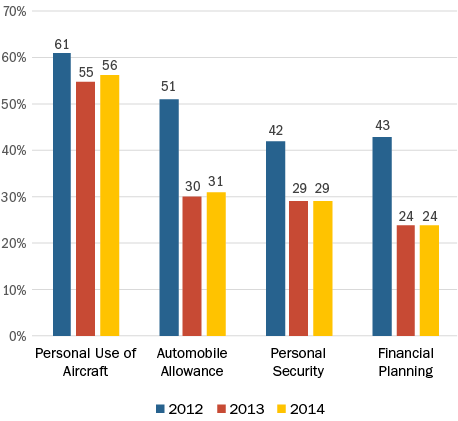
In 2014, the four most common CEO perquisites were: personal use of corporate aircraft (56%), automobile allowance (31%), personal security (29%) and financial planning (24%). While the prevalence of personal use of corporate aircraft was generally flat from 2012 to 2014, the prevalence of automobile allowances, personal security and financial planning decreased sharply (approximately 30– 40%) over the past two years.
CEO Perquisite Prevalence
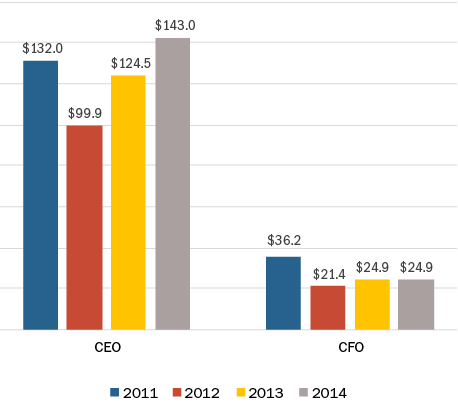
Although the prevalence of major perquisites remained steady in 2014 for CEOs compared to the prior year, the median total value for CEO perquisites increased 15% to $143,000. This value has ranged from $100,000 to $143,000 over the last four years. In contrast, the median value of perquisites for CFOs was relatively flat year-over-year, and has ranged from $21,000 to $36,000 since 2011.
Median CEO and CFO Perquisites Value ($000s)
Perquisites represent only a small portion of an executive’s total compensation, yet are often highly scrutinized. Shareholders prefer that pay be delivered in performance-based vehicles instead of through perquisites. Over the past few years, a number of companies changed their perquisite programs in reaction to increased shareholder scrutiny and specific feedback received from shareholders or proxy advisory firms. However, given fairly consistent prevalence over the past 2 years, data suggests that changes to company perquisite programs may have leveled off. PNC was the only company making a change to a perquisite program in our sample for 2014, increasing their annual perquisite limit from $10,000 to $20,000 for each NEO, other than for the CEO.
|
Perquisites Change Reported in CD&A |
2014 n=1 |
2013 n=7 |
2012 n=9 |
2011 n=14 |
||||
|
# of Cos. |
# of Cos. |
# of Cos. |
# of Cos. |
# of Cos. |
# of Cos. |
# of Cos. |
# of Cos. |
|
|
Eliminated perquisites |
0 |
0% |
6 |
75% |
2 |
22% |
9 |
56% |
|
Eliminated tax gross-ups on perquisites |
0 |
0% |
1 |
13% |
4 |
44% |
6 |
38% |
|
Reduced perquisite program/value |
0 |
0% |
1 |
13% |
2 |
22% |
1 |
6% |
|
Changed perquisite program |
1 |
100% |
0 |
0% |
1 |
11% |
0 |
0% |
Note: Percentages do not add up to 100% due to multiple changes by companies
Conclusion
While Compensation Committees continue to monitor the appropriateness (and competitiveness) of perquisite programs, as well as dollar values and overall executive usage, the degree to which executive perquisites are provided appears to have leveled off. We expect that companies will continue to closely align executive compensation with shareholder interests by limiting non-performance-based compensation, such as perquisites. We caution that any potential (perceived) misuse of executive perquisites will continue to raise the ire of shareholders and proxy advisory firms and provide for headline news.
Compensation Advisory Partners LLC (“CAP”) appreciates the opportunity to comment on proposed rules for clawbacks. As a leading executive compensation consulting firm, we support sound corporate governance.
Today, the SEC approved the final rules related to pay ratio. Companies will be required to disclose their CEO’s pay as a multiple of the pay of their median employee in their 2017 proxy (released in 2018 for calendar year filers). The SEC issued proposed rules in September 2013 and received over 280,000 comments related to the topic. For further details and thoughts please see our earlier CAPFlashes on the topic (Sept 20, 2013 and April 1, 2015) and look for more details in future CAPflashes.
Click here to read SEC’s press release on the topic.
On July 1, 2015, the SEC proposed rules directing the stock exchanges to expand listing standards to require companies to adopt clawback policies. These clawback policies would require executive officers to pay back incentive compensation that was awarded in error under an accounting restatement. According to SEC Chair Mary Jo White, the express purpose of the rules are ‘increased accountability and greater focus on the quality of financial reporting, which will benefit investors and markets.” With these proposed rules, the SEC has now addressed all of the executive compensation governance reforms included in the Dodd-Frank Wall Street Reform and Consumer Protection Act of 2010.
Where Do We Go From Here?
- Most major companies have already implemented clawback policies
- SEC proposal on clawbacks does not align with current market practice
- Includes current and former executive officers
- Triggered exclusively by an accounting restatement resulting from an error
- Triggered regardless of whether executive has committed fraud or misconduct related to the accounting restatement
- Includes a 3-year look-back period
- Generally precludes board discretion
- Accompanied by onerous disclosure rules
- Assess your company’s current clawback policy against the proposed rules
- Brief senior management and the board on the scope of the proposed rules
- Await further developments after the public comment period ends and final rules are issued
Broad Scope
The SEC’s proposal amends the Securities Exchange Act of 1934 (the “Exchange Act”) by adding new Exchange Act Rule 10-D1. Other amendments would apply to filings by foreign private issuers and certain investment companies. As a result, the clawback rules will apply to virtually all listed issuers of equity securities, debt and preferred securities, including emerging growth companies, smaller reporting companies, foreign private issuers and controlled companies.
New Rule 10-D1
As proposed, an issuer would be subject to delisting if it fails to (1) adopt a clawback policy that complies with the new requirements, (2) disclose the policy and (3) comply with the policy to recover compensation under an accounting restatement. Under the proposal, clawback of incentive compensation would be required from current and former executive officers who received excess incentives during the three fiscal years prior to the date on which a company is required to prepare an accounting restatement to correct a material error. The clawback provision applies on a “no fault” basis, regardless of whether misconduct occurred and regardless of whether an individual had any responsibility for the error.
The amount subject to clawback would be the amount that exceeds the amount that the executive officer would have received if the incentive compensation had been determined using restated financial statements. The proposed rules direct companies to use reasonable estimates of the effect that an accounting restatement would have on stock price and total shareholder return to determine amounts subject to recovery.
Limits on Board Discretion
Under the proposal, the situations where a Board could elect not to pursue recovery are limited. The SEC specified situations where the direct expense related to enforcing recovery would exceed the amount recovered. However, even in these situations, the Board would have to go through the process of determining the amount subject to clawback and make an attempt at recovery before deciding not pursue enforcement of the recovery. In addition, foreign private issuers could elect not to comply when clawback would violate home country law.
Trigger for Recovery
New Rule 10-D1 would trigger a clawback in the event that the issuer prepares a restatement of previously issued financial statements to correct an error that was material. Note that the requirement to restate financial statements is enough to trigger the clawback provisions, allowing the SEC to avoid the potentially thorny question of what constitutes a material error. Under GAAP, an error may include mathematical mistakes, mistakes in the application of GAAP principles, or oversights or misuse of facts when the financial statements were prepared. The proposal indicates several types of changes to financial statement that are not error corrections and would not trigger clawback, including
- Retrospective application of a change in accounting principle;
- Retrospective revision to reportable segment information due to a change in the structure of the issuer’s organization;
- Retrospective reclassification due to a discontinued operation;
- Retrospective application of change in reporting entity, such as from a reorganization;
- Retrospective adjustment to provisional amounts in connection with a prior business combination; and
- Retrospective revision for stock splits.
3-Year Look-Back Period
The proposed clawback will apply to excess incentives during a 3-year period prior to the date on which the issuer is required to prepare an accounting restatement. The proposal defines this date as the earlier of:
- The date the issuer’s board of directors, a committee of the board of directors, or the officer or officers of the issuer authorized to take such action if board action is not required, concludes , or reasonably should have concluded , that the issuer’s previously issued financial statements contain a material error; or
- The date a court, regulator or other legally authorized body directs the issuer to restate its previously issued financial statements to correct a material error.
The SEC notes that the first proposed date would generally coincide with the filing of Form 8-K, but Form 8-K is not necessary for recovery. Further, the obligation to clawback does not depend on whether or when restated financial statements are filed.
Application to Executive Officers
The proposed clawback rules apply to current or former executive officers who received incentive compensation. Under the proposal, executive officer is defined as the issuer’s president, principal financial officer, principal accounting officer (or controller), any vice president to the issuer in charge of a principal business unit, division or function (such as sales, administration or finance), any other officer who performs a policy-making function, or any other person who performs a similar policy-making functions for the issuer.
This proposed definition of executive officer is modeled on the definition used in Section 16, so it will apply to a reasonably large group of senior executives. The proposal also specifies that individuals who served as an executive officer at any time during the performance period for incentive compensation subject to recovery will be subject to clawback. This would include incentive compensation authorized before the individual becomes an executive officer and inducement awards granted in new hire situations.
Compensation Subject to Clawback
The SEC proposal contains a very broad definition of “incentive-based compensation” subject to clawback. As proposed, this would be defined as “any compensation that is granted, earned or vested based wholly or in part upon the attainment of any financial reporting measure.” The rules would also specify that “financial reporting measures” are measures determined and presented in accordance with the accounting principles used to prepare the issuer’s financial statements, any measures derived wholly or in part from such financial information and stock price and total shareholder return.
This definition wraps in accounting-based measures, as well as non-GAAP measures. Notably the SEC proposal includes stock price and total shareholder return. Although these are not accounting-based measures, the SEC included them because these measures are affected by accounting information and subject to current disclosure (i.e., stock performance graph and disclosure of high and low stock prices for each quarter within the two most recent fiscal year and any subsequent interim periods). Importantly, stock options and restricted stock that vest solely based on continued service are not subject to clawback.
The SEC acknowledges the complexities associated with trying to determine the amount of excess compensation related to the relationship between an accounting error and stock price. The SEC recognizes that complex analyses may be required. As a solution, the SEC suggests that issuers be permitted to make reasonable estimates and requires disclosure of these estimates.
The proposal includes examples of compensation that would be subject to clawback, as well as compensation that would be excluded:
|
Compensation Subject to Clawback |
Compensation Excluded from Clawback |
|
Non-equity incentive plan awards that are earned based wholly or in part on satisfying a financial reporting measure performance goal |
Salaries |
|
Bonuses paid from a bonus pool, the size of which is determined based wholly or in part on satisfying a financial reporting measure performance goal |
Bonuses paid solely at the discretion of the Compensation Committee or Board, not paid from a pool determined wholly or in part on satisfying a financial reporting measure goal |
|
Restricted stock, RSUs, performance shares, stock options and SARS that are granted or become vested wholly or in part on satisfying a financial reporting measure performance goals |
Bonuses paid on subjective standards (e.g., leadership) and/or completion of a specified employment period |
|
Proceeds received upon the sale of shares acquired through an incentive plan that were granted of vested based wholly or in part on satisfying a financial reporting measure performance goal |
Non-equity incentive plan awards earned solely upon satisfying one or more strategic measures (e.g., consummating a merger or divestiture) or operational measures (e.g., opening a specified number of stores, completion of a project, increase in market share) |
|
Equity awards for which the grant is not contingent upon achieving any financial reporting measure performance goal and vesting is contingent solely upon completion of a specified employment period and/or attaining one or more non-financial reporting measures |
Proposed Disclosure Requirements
Proposed new Rule 10D-1 would require disclosure of the issuer’s policy related to clawback of erroneously awarded compensation. The clawback policy would need to be filed as an exhibit to Form 10-K for listed U.S. issuers.
The proposal contains additional disclosure requirements that are extensive when a restatement was completed or an outstanding balance of excess incentive-based compensation relating to a prior restatement. In these instances, the proposed disclosure would include:
- For each restatement, the date on which the listed issuer was required to prepare an accounting restatement, the aggregate amount of excess incentives and the aggregate amount that remains outstanding as the end of the most recent completed fiscal year;
- The estimates used to determine the excess incentive compensation related to a stock price or total shareholder return measure;
- The name of each person subject to clawback for whom the listed issuer decided not to pursue recovery, the amount forgone and a description of the reason the issuer decided not to pursue recovery; and
- The name and amount due from each person from who, at the end of the last completed fiscal year, excess incentive-based compensation had been outstanding for 180 days or longer.
The proposed disclosure would be included as a separate item, not part of the CD&A. However, companies would have the option of providing the information in the CD&A to provide all information related to the clawback policy in one place.
The proposed rules also include amendments to Summary Compensation Table disclosure. Amounts previously reported would be reduced by the amount recovered by clawback with a footnote explanation. Finally, the required disclosure would be provided as interactive using XBRL block-text tagging.
Other Important Provisions
The proposed rules are incorporated in a 198 page filing. They are very detailed and complex. This article necessarily serves as a summary of the most important points that we see as being of general interest. But there are other details that shed light on the SEC’s thinking, as follows:
- Incentive-based compensation recovery will apply to pre-tax amounts.
- Clawback may occur simultaneously under new Rule 10D-1 and SOX Section 304. If an individual reimburses the Company under Section 304, a credit will be recorded for purposes of new Rule 10D-1.
- Lack of compliance with a clawback policy threatens a company with delisting, depending on the stock exchange’s assessment of whether the company was making a good faith effort to clawback compensation.
- Companies may not indemnify executive officers or former executive officers against the loss of erroneously awarded compensation.
- If an executive purchases third-party insurance, companies would be prohibited from paying the premiums for this insurance.
Timing of New Rules
The SEC’s proposal calls for prompt implementation. The current comment period extends for 60 days. After final rules are adopted, the SEC is calling for the stock exchanges to file their proposed amended listing standards within 90 days. Following the effective date of the stock exchange listing standards, each listed company would be required to adopt a clawback policy within 60 days. Clawback would apply to all excess incentive-based compensation received for any fiscal year ending on or after the effective date of new Rule 10D-1. Similarly, disclosure requirements would become effective immediately on or after the date on which the stock exchange listing standards become effective.