The timing of the final rules may create challenges for companies with shareholder meetings the first quarter of 2011, as Say on Pay is required for all proxy statements filed for annual meetings after January 21, 2011. For companies with annual meetings after January 21, 2011, but before the final rules are issued, the proposed rules will have to serve as the final guidance for developing their Say on Pay proposals.
Highlights of the Guidance on Say on Pay
The proposed rules contain some good news for companies, as the SEC confirmed that the new advisory votes on Say on Pay and Say on Pay frequency will not trigger the filing of a preliminary proxy statement. The SEC also directed that broker discretionary voting of uninstructed shares is not permitted for Say on Pay or Say on Pay frequency votes. Below are highlights of the proposed rules for the Say on Pay and Say on Pay Frequency votes.
Advisory Vote on Say on Pay
The SEC guidance does not specify a form for the language of the Say on Pay vote resolution. However, the proposed rules state that the resolution should indicate that the vote is advisory only and that the vote will cover all aspects of executive compensation for the Named Executive Officers of the company as disclosed in the CD&A, compensation tables and accompanying narrative. Compensation of directors and the risk assessment of the compensation programs for all employees are not intended to be included in the Say on Pay vote. In future CD&A disclosure, companies will need to discuss how their compensation policies and decisions have been influenced by past Say on Pay votes.
Vote on Frequency of Say on Pay Votes
The SEC guidance on the frequency of Say on Pay votes confirms that shareholders will have to be provided with four choices on frequency:
- Every year
- Every two years
- Every three years
- Abstain
While companies are required to provide shareholders with all four of the above choices, the proposed rules do not preclude the company from stating its preference among the alternatives. In the proposed rules, the SEC also confirmed that the vote on the frequency of the Say on Pay vote is advisory in nature and not binding on the company. That is, if a company’s stated frequency preference does not win the plurality of votes, the company can still go ahead and conduct the Say on Pay vote with its preferred frequency.
However, as proposed, the rules will require companies to disclose in the 10-Q or 10-K immediately following the Say on Pay vote whether the company expects to conduct future Say on Pay votes with the frequency selected by the plurality of shareholder votes. Separate shareholder proposals on Say on Pay or Say on Pay frequency may be excluded from the proxy statement provided that the company’s policy is consistent with plurality of votes cast in the most recent vote. Given the above, companies may have a strong incentive to structure the frequency of their Say on Pay votes in accordance with shareholder preferences.
The SEC recognizes that a vote with four choices will raise implementation challenges for companies, as shareholder voting typically follows a yes/no voting format. However, based on the way the Dodd-Frank rules were written, there was little room to interpret the rules as providing for anything other than four choices.
Finally, companies participating in TARP (which are required to conduct a Say on Pay vote annually) will not be required to conduct a vote on the frequency of the Say on Pay vote until the shareholder meeting immediately following the repayment of TARP funds.
Highlights of the Guidance on Say on Parachutes
The SEC’s proposed rules for new enhanced disclosure of golden parachute payments and an advisory vote on parachute payments state that the rules will be effective for proxy or consent solicitations to approve mergers or other transactions after the effective date of SEC amendment to disclosure rules (expected in the first quarter of 2011). This timing is later than expected and is helpful to companies as the new disclosure rules may be challenging to implement.
Disclosure of Golden Parachute Payments
In response to Dodd-Frank’s requirement of disclosure of golden parachute compensation in a “clear and simple form”, the proposed rules will require a new compensation table covering golden parachute compensation to NEOs, including the following elements for each named executive officer:
- Cash severance payments
- Dollar value of accelerated stock awards, in-the-money value of options accelerated, and payments to cancel stock or options
- Pension and deferred compensation enhancements
- Perks and benefits
- Tax reimbursement and gross-up payments
- Other
- Total
Footnotes to the table will require disclosure of what payments are single trigger (triggered by change in control only) and double trigger (triggered by a change in control and termination of employment). In the tabular disclosure, equity will need to be valued based on the stock price as of the last practicable date before the proxy filing. The table will be accompanied by narrative disclosure of the timing of the payments and any conditions that would apply to payments, including covenants (e.g., non-compete, non-solicitation).
Say on Golden Parachute Payments
The new rules require a separate non-binding shareholder advisory vote on golden parachute compensation, to the extent not previously subject to a prior general Say on Pay vote. In order to ensure that parachute payments are subject to the general Say on Pay vote, companies will have to disclose golden parachute compensation in their proxy statements with the new tabular disclosure and enhanced narrative disclosure of golden parachute payments.
It is not clear whether companies will decide to adopt the new disclosure in their proxy statements to ensure that they are subject to the general Say on Pay vote. While there will be some additional disclosure burden involved in providing the new tabular disclosure, many companies are already providing tabular disclosure of termination payments in their annual proxy statements. For these companies, it may be a simple extension of their current disclosure to comply with the new requirements. In any case, disclosure in compliance with the new rules will be required in the merger proxy statement.
Conclusion
The proposed rules have provided adequate clarity for companies to begin developing their Say on Pay and Say on Pay frequency resolutions. While the SEC is seeking comment on a number of aspects of the proposed rules, we expect the final rules to be largely consistent with the proposed rules. In developing the Say on Pay frequency resolution, we expect that most companies will state a preference for the frequency of the vote. Immediately following the passage of Dodd-Frank, our sense was that most companies would prefer biennial or triennial Say on Pay vote frequency; however, based on our discussions with clients we are seeing a trend toward a preference for an annual vote frequency.
The proposed rules for the Say on Golden Parachutes increase the disclosure requirements for companies, but will likely improve the quality of the disclosure from a shareholder’s perspective. It will be interesting to see whether companies choose to voluntarily adopt the new disclosure requirements for golden parachute compensation in annual proxy statements to ensure that golden parachute compensation is subject to the general Say on Pay vote.
Seventy companies were invited to participate in the survey and nineteen completed the full survey. Several companies that did not participate expressed interest, but said that they were too early in the decision-making process to respond.
We asked seven questions in the survey. Here is what we found:
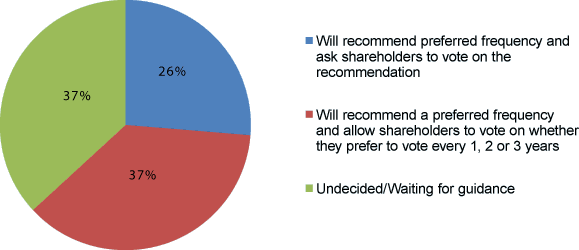
1) Dodd-Frank mandates that companies must solicit a non-binding advisory Say-on-Pay vote from shareholders at least once every three years. Do you anticipate your Board recommending that shareholders approve a specific (preferred) frequency for Say-on-Pay or will you allow shareholders to decide by voting?
The new legislation requires companies to hold a non-binding advisory vote on their executive compensation at least once every three years and to give shareholders the opportunity to vote on the frequency of the Say-on-Pay vote at least every six years. The legislation does not specify the method for the frequency vote (e.g., give shareholders the full range of choices without a recommendation, recommend a preferred frequency but let shareholders pick from the full list, or give the shareholders a yes/no vote on a frequency recommended by management and Board).
The survey results indicate that companies are fairly evenly split between recommending a preferred approach but allowing shareholders to vote on the range of choices (37%) and asking shareholders to vote yes/no on a specific frequency (26%). The remainder of the sample (37%) is undecided or waiting for guidance.
Recommending a Say-on-Pay Vote Frequency to Shareholders
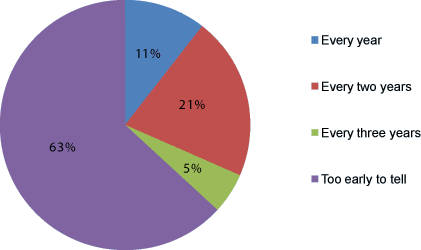
2) If you are going to recommend a preferred frequency to shareholders for Say-on-Pay voting, what do you expect to recommend?
Most companies (63%) say it is too early to tell which frequency they will recommend. Of those that did specify a time period, two years was the most common (21%). But keep in mind that this represents four companies. Given discussions we are having with clients, we would not be surprised if one or three years becomes the more common approach when companies finally implement Say-on Pay.
Choosing a Say-on-Pay Vote Frequency
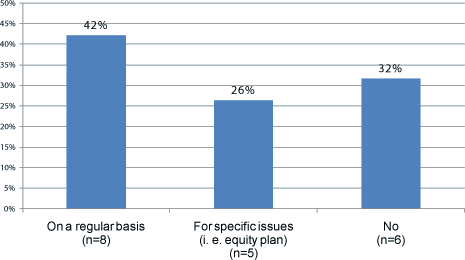
3) Does your company currently engage in active dialogue with your 10 largest shareholders at least once a year on your Company’s executive compensation practices?
Even absent Say-on-Pay, we believe engaging in open and meaningful dialogue with large shareholders is a best practice and can provide insights and avoid surprises. 42% of companies say they currently engage in active dialogue with their shareholders and 26% do so for specific issues (e.g., approval of a new equity plan).
Dialogue with Largest Shareholders
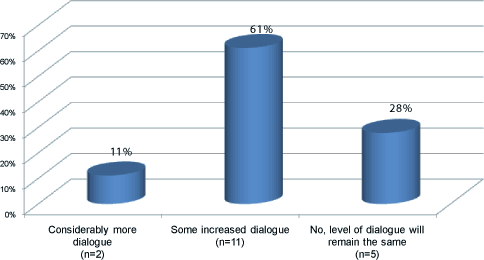
4) Do you anticipate increasing dialogue with your largest shareholders, relative to your executive compensation practices, as a result of the legislation?
We believe companies will increasingly engage their shareholders in dialogue to gain greater insight from them on their views on executive compensation, since this is more informative than a yes/no vote on the full executive compensation program. This is supported by the survey which finds that 70% of respondents expect to increase dialogue with shareholders to at least some degree.
Increasing Dialogue with Largest Shareholders
5) Do you anticipate making meaningful changes to any of your executive compensation practices/programs as a result of the Say-on-Pay requirements?
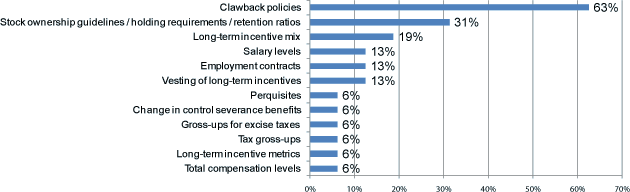
The most commonly anticipated change to executive compensation programs is clawbacks, which is a requirement of the new legislation (63%). Just under one-third of companies anticipate changing their stock ownership and holding requirements. While ownership requirements have been very common, holding requirements (where an executive must hold all or a portion of net shares realized from option exercise (net of taxes and exercise price) and vested equity (net of taxes)) for a specified period time has been an emerging trend. Many more companies may begin to adopt this practice as they try to provide for greater alignment between executives and shareholders.
Anticipated Changes to Executive Compensation Programs*
6) Do you anticipate changing or implementing a clawback policy?
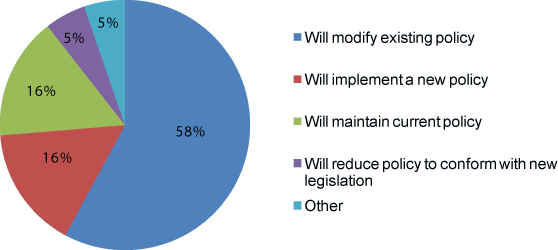
Many companies implemented or enhanced their clawback policies in the recent past; however, the new legislation specifies that the period covered span 3 years. Many companies (58%) must adjust their policy to comply with the new requirements.
Clawback Policy
7) Do you anticipate changing or implementing hedging policies?
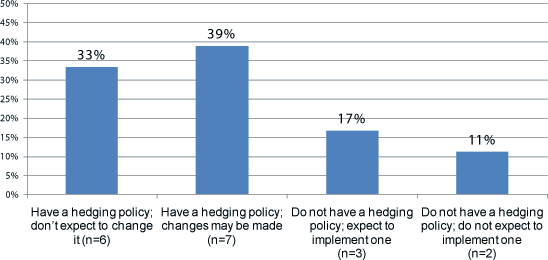
Unlike the clawback requirement, the new legislation does not require a company to implement a hedging policy; however, a company must disclose if it does not have such a policy. 33% of companies currently have a hedging policy and will leave it unchanged. 56% of companies will either implement a policy or anticipate reviewing or changing their current policy. Only 11% state they do not have a hedging policy and do not anticipate implementing one. These companies will have to disclose that they do not have a hedging policy and this may be a negative for shareholders.
Hedging Policy
We hope you find these early findings helpful. Since the SEC will be providing guidance and there is a lot of uncertainty, where companies land on these issues is something of a moving target. Some of the key steps we believe companies should take in the interim include:
- Discussing the implications of the legislation with their Compensation Committee
- Forming a working team to develop a response, including: Human Resources/Compensation, Legal, Investor Relations, outside consultant and legal counsel
- Engaging in dialogues with large institutional shareholders
If you would like to participate in our CAPFlash survey topics going forward, please feel free to sign up at https://www.capartners.com/signup-surveys
* Responses add to more than 100% due to multiple responses by company
***
Please contact us at (212) 921-9350 if you have any questions about the issues discussed above or would like to discuss your own executive compensation issues. You can access our website at www.capartners.com for more information on executive compensation.
What We Found
In response to continued focus on executive compensation and recently enacted legislation, many companies are strengthening governance and other pay practices. The most significant change is the assessment and identification of any material risks arising from compensation programs, required by the SEC for all public companies for the first time in 2010. We also see widespread use of clawbacks, continuing focus on reducing perquisites, executive benefits and eliminating tax gross-ups on perks. Companies are reducing supplemental retirement benefits and continue to emphasize stock ownership guidelines and stock retention requirements.
Compensation Risk Disclosure
The review of material risk arising from compensation programs is an important process, initially required for TARP companies and now required for all public companies by the SEC. Of the 85 companies in our study, 75 companies or 88% make some type of affirmative disclosure related to their assessment of risk in the compensation program. While some companies disclose changes that were made to the compensation programs to discourage risk, none of the companies in our study indicate that their programs can create material adverse risks. The large number of companies including affirmative disclosure in proxy statements is striking, since the disclosure is not required under current rules. Of the 10 companies that did not address compensation risk in their proxy statements, 5 or 50% filed their proxy statements prior to the publication of the SEC’s final disclosure rules in December 2009.
Most of the companies make their risk-related disclosures in the CD&A, with the next most common disclosure being in Section 407, the corporate governance section of the proxy statement. The table below summarizes where risk disclosures were made:
| Section of the Proxy Statement with Compensation Risk Disclosure | No. of Cos. | % of Cos. (n = 75) |
| CD&A | 39 | 52% |
| Section 407 | 19 | 25% |
| CD&A and Section 407 | 7 | 9% |
| Comp Committee Report or Comp Committee Report and CD&A | 2 | 3% |
| Separate Stand Alone Section | 8 | 11% |
The type of disclosure varies significantly, ranging from an in-depth description of the process and key safeguards to just one sentence indicating that the company’s programs do not encourage excessive risk-taking. 71% of the companies that make risk-related disclosures indicate that a formal risk review was conducted and comment on their assessment. Among these companies, the most common approach to the risk review is collaboration between the Compensation Committee, management and the Committee’s independent consultant (20%). The table below summarizes the different approaches used:
| Approach to Compensation Risk Reviews | No. of Cos. | % of Cos. (n = 75) |
| Compensation Committee, Committee’s Consultant and Management | 15 | 20% |
| Compensation Committee and Management | 10 | 13% |
| Compensation Committee and Committee’s Consultant | 9 | 12% |
| Compensation Committee | 7 | 9% |
| Management | 7 | 9% |
| Management and Management’s Consultant | 1 | 1% |
| Not Disclosed | 26 | 35% |
29% of the companies do not describe the risk assessment process and only comment on the results of their assessment of the compensation program. A majority of the companies (84%) describe safeguards that are in place to reduce risk-taking. Such safeguards often include:
- Balanced mix of short and long-term pay
- Use of multiple performance metrics
- Vesting requirements for equity vehicles
- Incentive plan caps
- Clawback policies
- Stock ownership requirements
- Committee discretion and oversight
Clawbacks
The use of clawbacks has increased dramatically in the past few years as a result of SOX and TARP regulations. The policies help alleviate shareholder concerns over managing risk and are viewed as stronger corporate governance. Clawbacks are currently mandated by the SEC for all public company CEOs and CFOs under SOX, for the top 25 executives for participants under TARP, and going forward for executive officers at all public companies as part of the Wall Street Reform and Consumer Protection Act of 2010.
Reflecting broad market trends, a significant majority of our research companies—68 of 85 companies or 80%—maintain some form of clawback provision. For 2009 and 2010, 5 of the 68 companies put a new policy in place and 16 modified existing policies, by expanding the type of compensation that can be recouped, the events that trigger a clawback, or the executives covered.
A financial restatement is required in nearly all cases. Further, 48 companies (71% of those with a clawback) disclose that fraud or misconduct are triggering events. Twelve companies (18%) disclose a non-compete/non-solicitation/confidentiality violation as a trigger, and three include improper ‘risk analysis’ as a trigger.
Based on our review of CD&A disclosures, companies with a clawback include the ability to clawback or recoup the following types of compensation: earned, exercised, outstanding, vested or unvested.
| Compensation Covered in Clawback Policies | No. of Cos. | % of Cos. (n = 68) |
| Incentive compensation (cash or equity) | 40 | 59% |
| Annual incentives only | 5 | 17% |
| Equity incentives only | 5 | 17% |
| Deferred cash | 4 | 6% |
| Severance benefits | 1 | 2% |
| 401k plan (company contributions) | 1 | 2% |
| Future compensation | 7 | 10% |
| Company discretion regarding type of compensation to recoup | 10 | 15% |
Note: Percentages add up to greater than 100% due to multiple responses.
Of interest, examples of some of the less common provisions we found include:
- IBM: Expanded clawback provisions by amending the Excess 401(k) Plus Plan to allow the clawback of Company contributions made after March 2010
- JP Morgan: Failure to identify, raise, or assess, in a timely manner as reasonably expected, risks and/or concerns with respect to risks material to the Firm or its activities, leads to recovery of equity awards for Operating/LOB Management Committee members
- McDonalds: Awards under the severance plan can be recovered if the participant engages in willful fraud that causes harm to the company or is intended to manipulate the performance measures that determine award payouts
- Progressive: Limits recoupment to excess bonus payments as a result of incorrect financial results to the extent that the recovery exceeds the lesser of 5% of the bonus paid or $20,000
In many cases, it is difficult to determine precisely who the clawback policy applies to. Where such disclosure is clear, we note that 17 companies cover all executives in the recovery of any ‘unearned’ compensation, regardless of whether the individuals directly caused any inaccuracy leading to a recovery.
A minority of companies tier their clawback policies, with certain parameters applying to Named Executive Officers, and other parameters applying to a broader ‘executive’ group. In some cases, clawback provisions in long-term incentive awards relate broadly to all eligible award participants.
Many companies did not indicate the time period within which compensation can be recovered after a restatement. Of the 17 cos. that did disclose a time frame for the clawback, the most common is 1 year from the date of restatement, and the range is 1 – 5 years. Three companies indicate that there is no time limit.
Since clawback policies are required by the Wall Street Reform and Consumer Protection Act of 2010 that was recently signed into law, companies will need to review and adopt provisions that align with the new legislation. The law applies to current and former executives who received incentive compensation during the 3 years before the restatement date, with employee misconduct not required as a trigger. SEC guidance is pending.
Stock Ownership Requirements
Stock ownership requirements continue to be an important tool for aligning executives with longer-term shareholder value. The majority of companies have stock ownership guidelines for their executives, typically expressed as a multiple of salary. While less common, many companies also have stock holding requirements where executives must hold a percentage of net shares from stock option exercises or vesting of restricted shares for a period of time. Within our sample, 17 companies, or 20% made changes to their stock ownership requirements. The most significant change among the companies in the study was the adoption or implementation of more restrictive stock holding requirements. Other changes, such as eliminating or extending the compliance time frame, suspending or decreasing ownership guidelines and changing to a fixed number of shares are responses to the volatility in the stock market.
| Type of Change Reported in 2010 CD&A | No. of Cos. | % of Cos. (n = 17) |
| Newly Adopted/More Restrictive Stock Holding Requirements | 8 | 47% |
| Eliminated/Extended Compliance Timeframe | 4 | 24% |
| Increased Stock Ownership Guidelines | 3 | 18% |
| Newly Adopted Stock Ownership Guidelines | 2 | 12% |
| Suspended Ownership Guidelines | 2 | 12% |
| Decreased Stock Ownership Guideline | 1 | 6% |
| Changed Stock Ownership Guideline from Multiple of Salary to Fixed Share Guideline | 1 | 6% |
Note: Percentages add up to greater than 100% due to multiple responses.
Perquisites
Companies continued to reduce perquisites in 2009, building on a trend that has been evident for several years. 16 of 85 companies or 19% of the sample made a change to perquisite programs. A number of companies also eliminated tax gross-ups on perquisites, responding to widespread criticism of this practice.
| Type of Change Reported in 2010 CD&A | No. of Cos. | % of Cos. (n = 16) |
| Reduced perks | 11 | 68% |
| Eliminated tax gross-ups on perks | 10 | 63% |
Note: Percentages add up to greater than 100% due to multiple responses.
The most common reduction in perquisites – seen at 6 of 11 companies (38%) that reduced perquisites—involved curbs on personal use of corporate planes by senior executives. Examples include:
- Eli Lilly: No longer allows executive officers to use company planes for travel to outside board meetings
- Genworth Financial: In 2009, suspended all incidental personal use of corporate aircraft
- MetLife: CEO is no longer required to use the company plane for personal travel
- Morgan Stanley: CEO entered into an aircraft time-sharing agreement with the Company and has since fully reimbursed the Company for the cost of his personal use of the Company aircraft up to the maximum amount permitted by federal aviation regulations
- PNC Financial: Required certain executives to pay for all personal trips on corporate aircraft
- Sara Lee: Terminated all use of its corporate aircraft
Severance And Change In Control Benefits
Given the economic and governance climate, change in control severance benefits have garnered a great deal of attention in recent years from shareholders, advisory groups and the media. In response, program changes have gained traction.
14 of our 85 research companies, or 16%, disclosed changes for 2009/2010 in most recent proxy CD&As consistent with what we are seeing in the broad market:
| Severance and CIC Program Changes | No. of Cos. | % of Cos. (n = 14) |
| Removed excise tax gross up feature – For current participants – For future participants (new hires/ promotions) |
6 2 4 |
43% |
| Changed equity vesting from single to double trigger | 3 | 21% |
| Reduced overall severance and CIC benefits | 2 | 14% |
| Changed definition of pay (bonus) for severance calculation | 2 | 14% |
| Reduced number of eligible participants | 1 | 7% |
| Eliminated executive CIC agreements, introduced exec severance plan | 1 | 7% |
| Increased excise tax cutback threshold above IRS limit | 1 | 7% |
| Eliminated pension supplement | 1 | 7% |
| Reduced benefit continuation period | 1 | 7% |
| Adopted new CIC plan | 1 | 7% |
Note: Percentages add up to greater than 100% due to multiple responses.
Program changes in 8 companies impact current participants and in 6 companies changes apply to new participants only. Five of the 14 companies making changes are in the pharma industry and three are in health care.
Executive Retirement Benefits
Several companies—9 of 85 or 11% of our sample—made changes to executive retirement benefit plans. The most common approach was to reduce supplemental retirement benefits. This might involve closing SERPs to new participants, freezing future benefit accruals or modifying or capping the formula used to calculate benefits.
| Type of Change Reported in 2010 CD&A | No. of Cos. | % of Cos. (n = 9) |
| Froze DB SERP benefits | 4 | 44% |
| Scaled back DB SERP benefits | 2 | 22% |
| Enhanced supplemental DC benefits | 2 | 22% |
| Added retiree medical coverage | 1 | 11% |
Note: Changes to qualified plans available to all employees are not captured here.
Conclusions
In 2009 and 2010, companies continue to reevaluate – and modify – pay and governance practices. Risk assessment disclosure represents the biggest expansion in disclosure requirements. Another trend that emerged is the widespread use of clawbacks. Meanwhile, reductions in perks, change in control severance benefits, and executive retirement benefits, elimination of tax gross-ups, and enhanced stock ownership guidelines continue trends that have been evident for several years. These are all shareholder friendly developments that should improve the alignment between executive compensation and shareholders. We expect companies to continue to re-examine their programs as shareholders continue to demand good governance practices.
***
Please contact us at (212) 921-9350 if you have any questions about the issues discussed above or would like to discuss your own executive compensation issues. You can access our website at www.capartners.com for more information on executive compensation.
- Non-binding advisory votes on Executive Pay and Golden Parachutes
- Independent Compensation Committees, with authority to hire advisors
- Compensation recoupment (“No Compensation for Lies”)
- Additional Disclosure Requirements of pay-for-performance, pay ratios, and employee and director equity hedging policies
Below is a brief description of each of the key provisions impacting executive compensation, along with considerations for companies as they begin to think of the implications of the legislation.
Shareholder Vote on Executive Compensation Disclosures (Section 951)
Advisory Vote on Executive Compensation (i.e., “Say on Pay”)
Description: Companies must submit a resolution to shareholders to approve the compensation of named executive officers
- Vote must occur at least once every three years
- Shareholders must be provided with an opportunity to determine if the vote will take place every one, two, or three years and must be given the opportunity to vote on the frequency every 6 years
- The new requirement will be effective for the first annual shareholder meetings taking place six months after the enactment of the bill, which for calendar year companies means their 2011 shareholder meeting, assuming the bill is signed as expected
Considerations: Companies should examine their compensation programs to ensure program design features have a solid rationale from a shareholder perspective. Consider meeting with key shareholders well in advance of filing the annual proxy statement to explain the compensation program and gain insight on shareholder views of compensation. A recent Compliance and Disclosure Interpretation by the SEC has provided reassurance to companies that they can communicate directly with key shareholders about compensation.
Advisory Vote on Golden Parachutes
Description: In connection with a shareholder vote on a merger or acquisition, companies must submit a non-binding advisory vote to shareholders, including:
- A clear description of any agreements with Named Executive Officers that will be impacted by the merger or acquisition
- Non-binding shareholder advisory vote on any agreements, to the extent not previously subject to the general shareholder advisory vote on executive compensation
Considerations: Vote may have narrow implications as it only covers new agreements or modified agreements in advance of a change in control that have not already been covered under a non-binding shareholder advisory vote. In addition, it does not cover the total change in control costs a company may incur, but only those that relate to the Named Executive Officers. However, as change in control agreements are a key area of focus, such agreements should be reviewed to ensure that agreements are in line with current and emerging practices.
Compensation Committee Independence (Section 952)
Compensation Committee Independence
Description: The Act requires companies to ensure that all members of the Compensation Committee are independent (with limited exceptions), otherwise they cannot be listed by a national securities exchange. Independence will be assessed considering sources of compensation received by the director and affiliation with the company.
Considerations: Companies that have directors not meeting these criteria will need to modify the Committee membership.
Independence of Compensation Consultants and Other Compensation Committee Advisors
Description: The Compensation Committee may only select an advisor after taking into consideration specific factors identified by the SEC. Factors to be considered will include the following:
- Provision of other service to the Company by the advisor
- Amount of fees received from the Company relative to the firms total revenue
- Policies and procedures of the advisor to resolve conflicts of interest
- Business or personal relationships between the advisor and Compensation Committee members
- Stock ownership in the Company by the Advisor
Considerations: Following guidance from the SEC, Compensation Committees will likely want to document that they have reviewed these factors prior to selecting outside advisors.
Compensation Committee Authority Relating to Compensation Consultants
Description: The Compensation Committee has the authority to retain the advice of a compensation consultant and the Company will provide appropriate funding. Compensation Committees are required to disclose the relationship and whether any conflicts of interest arose and how they are being addressed. However, Committees are not required to hire an advisor.
Considerations: Many companies have already provided clear disclosure of the nature of the reporting relationship with the compensation consultant. They may need to enhance the disclosure slightly to clarify that they are in compliance with the new legislation.
Executive Compensation Disclosures (Section 953)
Disclosure of Pay Versus Performance
Description: Companies are required to disclose the relationship between executive compensation and the financial performance of the company, possibly through a graphic presentation.
Considerations: Compensation appears to be defined as compensation actually paid as disclosed in the Summary Compensation Table. For share-based compensation, this may be misleading, as the realized value of the compensation may be very different from the grant value of the compensation. Specific guidance from the SEC is needed to implement this proposal.
Disclosure of Pay Ratio
Description: Companies are required to disclose the ratio of the median annual total compensation of all employees of the issuer (excluding the CEO) to the annual total compensation of the CEO.
Considerations: SEC guidance is required to implement this provision, as for most companies it will be challenging to determine the median compensation of all employees on a comparable basis to the Summary Compensation Table compensation of the CEO.
Recovery of Erroneously Awarded Compensation (Section 954)
Description: Companies will need to develop and implement a policy that provides for the recovery of compensation from current or former executive officers following a financial restatement due to material noncompliance with financial reporting requirements. Policy will apply to any incentive-based compensation (including stock options awarded as compensation) during the 3-year period preceding the date of the restatement.
Considerations: The proposal is more stringent than most clawback policies currently in-effect as it does not require executive misconduct to trigger recoupment. The policy may be challenging to implement in practice for some forms of compensation (e.g., stock options) as it may be difficult to determine the value that needs to be recovered following a restatement.
Disclosure Regarding Employee and Director Hedging (Section 955)
Description: Companies are required to disclose whether any executive or director is permitted to purchase financial instruments that are designed to hedge or offset a decrease in the market value of the company’s stock.
Considerations: Companies that have not already adopted an anti-hedging policy should consider doing so to ensure that they do not have to disclose that executives and directors are permitted to hedge positions in the company’s stock.
Conclusion
The Act will have a significant impact on executive compensation in the near-term as companies work to comply with the new requirements and prepare for “Say on Pay”. Additional guidance from the SEC is expected to assist companies in complying with the new rules. However, given the mandatory “Say on Pay”, a key area of focus for companies should be ensuring that shareholders understand and support the executive compensation program. Two actions that can assist in this are direct conversations with key shareholders and ensuring that the company’s CD&A provides a clear rationale for the compensation program and an easily understandable description of compensation decisions.
***
Please contact us at (212) 921-9350 if you have any questions about the issues discussed above or would like to discuss your own executive compensation issues. You can access our website at www.capartners.com for more information on executive compensation.
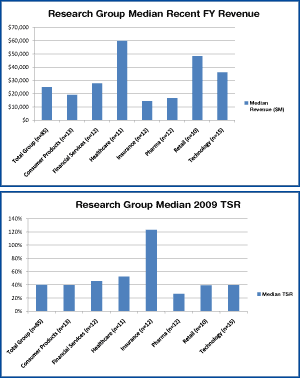
The component companies are large industry leaders. The total sample had median revenue of $25B, market cap of $37B and Total Shareholder Return (TSR) of 40% during 2009. The charts below include summary statistics by industry group. Practices at these leading companies are scrutinized closely by shareholders and the shareholder advisory groups. The responses of these companies to the financial strains in the economy during 2009 gives valuable insight into current practice and changes we expect to see in 2010.
What We Found
Highlights of our research results for the entire sample are below. Future CAP-Flashes will focus on particular industry groups and important topical areas, such as annual and long-term incentive design trends.
Compensation Strategy Changes
Outside of Financial Services, few companies reported changes to compensation strategy—i.e., the targeted pay positioning for executives and the targeted pay mix. Most stayed the course despite the challenging economic conditions in 2009.
Within the Financial Services group, most companies reported changes to compensation strategy, responding to their experience under TARP. Changes within the financial services industry include different pay mixes—examples include:
- Increased emphasis on fixed compensation by reducing incentive compensation and increasing base salary
- Increased emphasis on at risk, incentive compensation
- Majority of compensation delivered in restricted stock, deferred for 5 years
- Reduced portion of bonuses paid in cash and increased the portion of bonuses paid with deferred long-term awards subject to clawback
We expect Financial Services companies to continue to re- evaluate their compensation strategies as they exit TARP and emerge from the financial crisis and enter a more steady state.
Peer Groups Used For Benchmarking
Most companies did not make significant changes to their peer groups used for compensation benchmarking. Of those that did make changes, the majority of changes reported were primarily due to M&A activity in the Consumer Products, Insurance and Pharmaceutical industries. Others tweaked their selection criteria to focus more on companies in their industry and within a reasonable size range.
Base Salary Actions
Senior executive base salary actions continued to be restrained by the poor economy in 2009. Slightly more than half the sample did not increase or reduced salaries in 2009. Industry groups where salary freezes and reductions were widespread included Consumer Products, Health Care, Retail and Technology. Industries where salary increases were more common included Insurance and Pharmaceuticals. Merit increases were generally in the range of 2 – 3% when they were awarded.
| Type of Salary Change Reported in 2010 CD&A | No. of Cos. | % of Cos. (n = 85) |
| No Increase / Salary Freeze – All NEOs | 32 | 38% |
| No Increase / Salary Freeze – CEO Only | 6 | 7% |
| No Increase / Salary Freeze – Select NEOs | 1 | 1% |
| Salary Reduction – All NEOs | 4 | 5% |
| Salary Reduction – CEO Only | 1 | 1% |
| Salary Increase – All NEOs | 17 | 20% |
| Salary Increase – Select NEOs | 14 | 16% |
| Salary Increase – CEO Only | 1 | 1% |
| Salary Increase – TARP Related | 6 | 7% |
| Not Specified | 11 | 13% |
Note: Percentages do not add up to 100% due to multiple responses.
Annual Incentive Plan Design
Overall, 34 companies (40% of the full sample) disclosed making a change to their AIP design in 2009 or for 2010. While there was not a universal trend in the type of design changes being made, most companies are dealing with challenges in the goal setting process and maintaining meaningful performance linkages, linking rewards to the company’s ability to pay, and appropriately considering the impact of overall market conditions. In a nutshell, companies are trying to maintain a precise pay and performance calibration while also allowing for appropriate recognition of significant executive accomplishments.
The breakdown of reported AIP changes is as follows:
| Type of Change Reported in 2010 CD&A | No. of Cos. | % of Cos. Reporting Changes (n = 34) |
| Change in performance metrics used to fund awards | 15 | 44% |
| Increased target award opportunities | 9 | 26% |
| Reduced maximum award payout leverage | 4 | 12% |
| Added discretionary award component | 3 | 9% |
| Use of performance scorecard | 3 | 9% |
| New annual incentive plan (overhaul) | 2 | 6% |
| Other changes | 3 | 9% |
Note: Percentages do not add up to 100% due to multiple responses.
Change in Performance Metrics
Of the companies that changed their performance metrics and/or the mix of those metrics, a majority created a stronger linkage to corporate performance results and strategic priorities to support business changes forced by economic conditions. For example,
McKesson: For FY 2010, bonus goals need to significantly exceed the strategic plan to earn a target payout
Computer Sciences: Reduced the number of performance criteria to focus on key financial goals consistent with the company’s business strategy
T. J. Maxx – Eliminated divisional performance measures and focused on total company income
Sara Lee: Eliminated individual objectives and reallocated to corporate adjusted operating income goal
Merck: For 2010 incentive pool will be determined solely on company performance (as reflected by company scorecard)
There was no distinct trend in the changes made to the financial metrics used, though many changes included more emphasis on earnings, and to a lesser degree, revenue growth. Companies in the Insurance, Pharmaceutical and Retail industries made the most changes to metrics.
Discretion and Broad Performance Assessments
Some companies are increasing the role of discretion or broader retrospective performance assessment, to help ensure that significant market factors are considered at year end. For example, Genworth’s compensation committee uses discretionary judgment of performance against strategic objectives, including key financial criteria, to determine payouts. Microsoft’s compensation committee uses business judgment to help determine awards, and considers executive performance across a range of financial, operational, and strategic measures.
Another approach used by some companies includes use of a scorecard, which typically provides parameters for financial, operational, strategic, customer, and/or individual performance measurement. BNY-Mellon adopted such an approach to determine annual bonuses; and for 2010 Merck disclosed new incentive pool funding based on a company scorecard (solely company performance).
Changing Long-Term Incentive Practices
Most companies made changes to long-term incentive programs that either took effect in 2009 or will become effective in 2010—70% (60 out of 85) of companies reported changes. The most commonly reported changes involved changes to the mix of long-term incentive award vehicles granted and changes to the metrics used for long-term incentives. Here is a breakdown of what we found:
| Type of Change Reported in 2010 CD&A | No. of Cos. | % of Cos. Reporting Changes (n = 60) |
| Different mix of award vehicles | 33 | 55% |
| Different long-term performance metrics | 23 | 38% |
| Change in size of long-term award guidelines | 12 | 20% |
| Limits on dividend equivalents | 7 | 12% |
| Change in leverage in performance scales | 6 | 10% |
| Other changes | 9 | 15% |
Note: Percentages do not add up to 100% due to multiple responses.
Long-Term Award Mix
Among the companies that changed the mix of long-term award vehicles, two trends emerged. More than 50% of companies reporting a change in long-term award mix increased the emphasis on performance-based awards. Increased use of time-based awards – particularly among companies that had difficulty setting long-term financial goals during the recent period of economic uncertainty—was also common, but much less so. Finally, a few companies used options to a greater extent citing the difficulty in setting goals and attractive stock prices.
| Changes In Long-Term Incentive Award Mix | No. of Cos. | % of Cos. Reporting Changes (n = 33) |
| Greater emphasis on performance-based awards | 18 | 55% |
| Greater emphasis on time-based restricted stock/unit awards | 8 | 24% |
| Greater emphasis on options | 3 | 9% |
| Other | 4 | 12% |
Size of Long-Term Award Guidelines
Relatively few companies – only 14% of the total sample of 85 companies and 20% of the companies reporting changes to long-term programs—reported changing the size of long-term award target guidelines in 2009. Of the companies reporting a change, 67% decreased award guidelines and 25% increased award guidelines. One company reported migrating from fixed share guidelines to value-based guidelines, but did not indicate whether the change represented an increase or a decrease in value.
Long-Term Performance Metric Changes
Changes in long-term performance metrics were widespread. 25% of the total sample reported changing long-term incentives by adding new metrics; an additional 4% reduced the number of metrics used. Both relative and absolute TSR were selected as metrics by a number of companies. Return on equity/capital, revenue growth and cash flow were also popular choices.
| New Performance Metric | No. of Cos. | % of Cos. (n = 21) |
| Relative TSR | 5 | 24% |
| Absolute TSR of Stock Price Growth | 3 | 14% |
| Return on Equity or Capital | 4 | 19% |
| Revenue Growth | 3 | 14% |
| Cash Flow | 3 | 14% |
| Other Financial Metrics | 7 | 33% |
Note: Percentages do not add up to 100% due to multiple responses
Treatment of Dividend Equivalents and Other Plan Changes
Changes in the treatment of dividend equivalents was the most common plan design change reported. Seven companies moved to limit the payment of dividend equivalents until shares were earned or vested. Other design changes were more subtle, such as changes to the length of performance periods or the amount of leverage in performance scales.
Conclusions
Absent regulatory constraints, we did not see wholesale changes in 2009. Companies tended to stay the course in 2009 as the economic cycle bottomed out and the first signs of a recovery began to appear, but several clear trends did emerge. These include continued restraint on base salary increases, refinements to annual incentive and long-term incentive plan metrics and greater use of performance based long term incentives. These are all shareholder friendly developments that should improve the alignment between executive compensation and shareholders. We expect companies to continue to re-examine their programs as the economy improves and shareholders continue to demand performance and compensation program alignment.
***
Please contact us at (212) 921-9350 if you have any questions about the issues discussed above or would like to discuss your own executive compensation issues. You can access our website at www.capartners.com for more information on executive compensation.
| Each pay consulting relationship is unique. Once the consultant is selected, the committee should define in advance its objectives and expectations. |
Board compensation committees must not only deal with the competing demands of regulators and shareholders, but must now operate in an environment where their actions and decisions are highly visible and often criticized. For many boards, hiring an out-side compensation consultant to help them navigate this highly complex environment is a worthwhile and prudent business decision. A consultant can help the committee fulfill its oversight and governance responsibilities while maintaining competitive, compliant, and responsible executive pay.
In this article, we discuss how the compensation committee and the compensation consultant can have an effective relationship. The process begins with the compensation committee defining its objectives and expectations and hiring the consultant. We then discuss procedures that emphasize communication and facilitate productivity.
A mutually beneficial consulting relationship will require considerable dialogue. When the relationship is built on a solid foundation, differing points of view can be addressed without detriment to the ongoing consulting relationship.
An effective consulting relationship begins with the selection process. The human resources department or procurement may begin the process with a “request for proposal.” However, the process should be driven by the compensation committee itself. Selection criteria should be identified as well as any required skills, knowledge, or experience. Often, experience in a particular industry, or experience with a specific transaction, such as an IPO or merger is important. If the company is expanding internationally, global resources and data may be needed.
The full compensation committee should be involved in interviewing the consultant or team, and they should assure that those they are interviewing will be the ones involved in the engagement. The committee must be comfortable with the consultant’s experience on similar issues facing the company, with the consultant’s technical acumen, access to available resources, and ability to present a coherent and well thought-out point of view. The consultant’s references should also be checked.
| Where the committee is not experienced in working with outside advisors, the consultant can help structure objectives and processes that work. |
Each consulting relationship is unique. A start-up company, an IPO, or a newly merged or acquired company may need help with virtually every aspect of employee pay design. Other companies may need an overall review of management’s pay recommendations and expert opinion to the committee at each meeting. Others may need specific technical expertise (a company in Chapter 11; one that has received TARP monies, etc.)
Once the consultant is selected, the committee should define in advance its objectives for the year and its expectations of the consultant. This need not be an involved or lengthy process, but in any working relationship, purpose and context need to be provided.
For example, if the compensation committee needs education and training on executive pay issues and practices, it should inform the consultant. If the committee is not comfortable with the design of the incentive plans that have provided lucrative payouts while stock price remained flat, the consultant should know about it. If there is disagreement over Ike CEO’s pay or the pay and performance linkage, the consultant should be alerted.
Certainly, if the prior consultant did not meet the expectations of the committee, the new consultant should be told why. Where the compensation committee is not experienced in working with outside advisors, the consultant is in an excellent position to help structure objectives and processes that work.
Most of all, the committee relies on the consultant for experience and expertise, to help ensure that the company is not exposed in terms of inappropriate pay practices. Ultimately, the overall goals of the compensation committee and consultant are the same: to help the board perform its governance and oversight role in an informed manner.
| It is surprising how often committee chair/ consultant dialogue does not happen or comes too late to avoid a problem. |
Throughout the year, the compensation committee and consultant should adhere to certain practices that will lead to a successful working relationship. There will still be challenges and tough issues to work through together, but these processes will help materially in achieving committee objectives.
- At the beginning of every year, the consultant should develop a “statement of work” that defines the scope of their consulting activities for the coming year, including deliverables, fees, timing, and reporting relationships to the committee. If there is an annual calendar of meeting dates and activities, the statement of work is straightforward. Since the human resource function is typically responsible for the annual calendar, this planning helps to ensure that all parties have a common understanding for the year ahead.
- If the committee has not done so already, its goals and objectives should be articulated to the consultant. This should include objectives for the consultant, but might also include objectives for the committee itself. The committee chairperson should also alert the consultant to any critical issues facing the committee.
- In a new relationship, the committee will often request that the consultant provide a high-level review of the company’s executive pay program, highlighting any atypical or uncompetitive pay practices or plan features that should be reviewed in detail. It is incumbent on the consultant to uncover potential problem areas that need to be addressed.
- The committee chairperson and consultant should review meeting materials in advance of each meeting, preferably before the materials are mailed, which allows for revisions. This allows both parties to understand each other’s point of view and pose questions that will help in meeting preparation.
- The consultant should assure that the chair under-stands the key messages to be delivered on a particular topic. The chair, in turn, can use the opportunity to bring the consultant up to speed on any strong committee views or business issues that may be relevant to the subject matter at hand. This could include plan design, competitive analysis, the CEO’s contract or pay recommendations. It is surprising how often this dialogue does not happen, or comes at the last minute when it is often too late to resolve an issue or avoid a problem during the meeting.
- The consultant should be available for every meeting and executive session, as requested by the chairperson. Time should be scheduled for debriefing, particularly when follow-up activities are required. When the meeting agenda is full, or when many decisions have been made, follow-up ensures that everyone has similar takeaways.
- The committee’s annual calendar typically includes a review of compensation strategy, annual pay benchmarking, assessment of the pay and performance relationship, and risk assessment. At the most basic level, both parties should work to avoid controversial pay practices, ensure that pay programs support company strategy, and establish appropriate performance linkages for incentive plans. These are joint responsibilities. Any review of CEO pay (with recommendations) should go to the chairperson first, without prior review by the CEO.
- The performance of outside advisors should be evaluated as part of the committee’s annual self -evaluation. Even if the consultant assists the committee with the evaluation, it is important that the members review the overall relationship each year to determine if the consultant is meeting expectations. Feedback should be provided to the consultant.
- At the end of each year, management (usually human resources) should provide the committee with documentation on the consultant’s fees and deliverables for the year. A summary of all services and fees provided by the consultant’s firm to the company overall should also be provided.
- As part of the committee’s review of the proxy Compensation Discussion and Analysis (CD&A), the required language describing the consultant’s involvement in pay decisions should be reviewed, as well as other needed disclosure.
- There should be a clear process for requesting and approving additional work for the consultant during the year. If management has a need for additional work, the committee should approve it. If the amount of work the consultant’s company does overall is significant, the committee may want to know about such work in advance.
| In today’s environment, the compensation committee cannot be passively waiting for problems to occur. It relies on the consultant to uncover relevant and timely pay issues. |
The processes described above will contribute to a productive relationship between the compensation committee and its consultant. The following success factors can strengthen the relationship even more.
| The consultant should not play both sides of an issue, and has a responsibility to express an opinion even if it is not one shared with the chair, the committee or the CEO. |
- The chairperson and consultant must have access to one another during the year. They should communicate before and after each meeting, and whenever necessary.
- Both parties must have realistic expectations about the relationship. They may not always agree on every issue, but this is not a signal of failure or dysfunctional relationship. The committee must be open to views and opinions different from its own, and consultants must understand that their responsibility is to voice opinions to the committee, even if it is not what the board (or CEO) wants to hear.
- The committee and consultant should proactively review company pay programs and practices, while anticipating potential issues or necessary changes. In today’s environment, the compensation committee cannot be reactive and wait for problems to occur. The consultant must uncover relevant and timely issues.
For example, if the company intends to seek shareholder approval of a new long-term incentive plan share reserve, the committee should research the voting policies of their largest institutional investors before making the request. When advisory groups introduce new policies, companies should review their programs to anticipate any problem areas that could arise. The committee should also involve the board’s audit or risk committee in an annual evaluation of pay programs as it relates to risk.
- Understand that the ultimate decision-making is the responsibility of the compensation committee, not the consultant. The committee needs to exercise its own judgment after getting the best information and advice possible.
In the past year, consultant independence has come to the forefront. Since 2006, if a consultant played a role in determining or recommending executive or director pay, the consultant had to be identified in the company’s proxy and the scope of services and reporting relationship had to be noted. SEC rules approved in December 2009 expanded the requirement to include the fee disclosure if a consultant provides additional services to the company beyond $120,000 in the aggregate. Also in 2009 draft legislation delivered from the Treasury Department to Congress included a provision that any compensation consultant or legal counsel hired by the compensation committee must be “independent” from management.
Most full-service consulting firms have independence standards to manage any potential conflicts, while a boutique firm specializing only in executive compensation is generally structured to reduce the potential for conflict.
Treasury Department Fact Sheet
Providing Compensation Committees With New Independence
Draft legislation was delivered by the Treasury Department to Congress in 2009 to promote the independence of compensation committees. Key elements would include:
- Compensation committee members will be required to meet stronger standards for independence that are to be issued by the SEC.
- To ensure that compensation committees receive objective advice, any compensation consultants and legal counsel hired by the committee must be independent from management.
- Committees must be given the authority and funding to hire independent consultants, outside counsel, and other advisors who can help ensure that the committee bargains for pay packages in the best interests of shareholders.
The compensation committee should also have procedures in place regarding the consultant relationship (hiring and firing authority, direct access to the committee, performance evaluation, executive sessions, etc.) that help ensure objective advice, as well as a protocol on mitigating conflicts. Absent a mandated definition of consultant independence, what is important is that the committee be satisfied with the relationship and that there are procedures to avoid conflict.
A related issue which has attracted increased attention is the use of more than one compensation consultant. If two consultants are used (one reporting to the compensation committee, the other to management) the roles should be clearly defined and agreed to in advance. The predominant view is that one consultant reporting to the committee is a more effective arrangement, but the dual consultant model is certainly workable.
To have an effective working relationship, both the compensation committee and the consultant have specific roles to play.
Outside compensation consultant. It is expected that the consultant know the company and industry and stay current on all regulatory issues, as well as best practices in plan design, performance measurement, and pay practices. The consultant should not play both sides of an issue, and has a responsibility to express an opinion even if it is not one shared with the chairperson, the committee, or the CEO. Above all else, the consultant needs to be a “trusted advisor” helping the committee think strategically, raising questions and issues the committee should be thinking about.
Compensation committee. Many committee activities are dictated by various regulatory bodies (stock exchanges, the SEC. FASB, etc.), or specific legislation, such as Sarbanes-Oxley. At a tactical level, each committee must follow its charter to ensure members are fulfilling their responsibilities.
The committee also needs to work with other committees of the board (audit, nominating/governance, risk, etc.) and keep the full board informed of decisions, particularly on CEO compensation. The compensation committee chairperson should develop a healthy working relationship with the CEO.
The committee itself should maintain adequate skills among its members. Diverse areas of expertise and complementary skills are a plus, and basic financial acumen a necessity. Most importantly, the committee must represent the shareholders.
While the formal reporting relationship of the consultant must be to the committee, a good working relationship between the consultant and management can have an extremely positive impact. Management provides necessary compensation data and financial or legal information. Management can also confirm data accuracy and timeliness, and provide a historical perspective or rationale for unusual pay practices. It can explain how certain programs are implemented (such as company specific definitions for metrics used in incentive plans.)
A good relationship with management can also help provide information on the various viewpoints held on pertinent issues, and offer insights on culture and business strategy. In many cases, pre-committee meeting conference calls and preparation may involve the consultant, the compensation committee chair, and human resources. When all three parties are involved, productivity in the committee meetings can be greatly enhanced. Open communication, where appropriate, contributes to better working relationships overall.
| A good working relationship between the consultant and management is a positive. Management provides necessary pay and financial information, plus insights on culture and business strategy. |
Executive compensation is a sensitive area. Such factors as company performance, personal views on pay, or a shareholder vote against committee members can temporarily change committee dynamics. Additionally, problem areas can arise: a mistake may be made as a result of not having current data; meeting participants may not be fully prepared when a specific issue arises that was not on the agenda; a committee member may question a methodology used by the consultant; or the consultant may be caught in the middle of two disparate views. Most issues can be worked out. The important thing is for the chairperson and consultant to acknowledge a problem when it occurs, accept responsibility for their role in the misunderstanding, and focus on action to correct the problem.
In the future, the need for compensation committees to work effectively with consultants will increase as new regulations take effect and companies work their way out of the current recession. The committee’s role and potential impact – as well as its exposure to public scrutiny – will not diminish.
Nonetheless, along with greater demands and challenges comes the opportunity to make meaningful decisions in shaping pay programs. In many companies, this will ultimately result in pay strategies and programs that are tightly aligned with the competitive market and meaningful returns to shareholders
Please contact us at (212) 921-9350 if you have any questions about the issues discussed above or would like to discuss your own executive compensation issues. You can access our website at www.capartners.com for more information on executive compensation.
Reprinted by THE CORPORATE BOARD
4400 Hagadorn Rd, Okemos, MI 48864-2414, (517) 336-1700
www.corporateboard.com @ 2010 by Vanguard Publications, Inc.
Following the collapse of Enron and WorldCom, compensation committees became aware of the dangers of loading up executives with outsized stock option grants which might tempt them to “inflate” short-term earnings and stock price. Companies and their compensation committees did one or more of the following: they reduced the size of option grants, introduced stock ownership guidelines and share retention programs, and diversified the portfolio of incentive vehicles by adding restricted stock and performance plans. These long-term incentives contain less leverage than options, reducing the temptation to swing for the fences.
Incentive compensation, whether for executives or the broader employee population, has been identified as a significant contributor to the financial crisis. To protect the “safety and soundness” of our financial system and provide remediation, the Federal Reserve and the Securities and Exchange Commission have proposed guidance and disclosure requirements which require companies to conduct a thorough review of the relationship between pay and risk taking. The objective of a “risk assessment” is to identify plans or practices that may encourage employees to take unnecessary or excessive risk which could threaten the company or, in the case of financial firms, the safety of the broader financial system.
Conducting a Risk Review
There are four steps in conducting a risk review:
- Create the process
- Develop a framework to examine incentive plans and practices
- Assess current plans
- Communicate results and identify refinements
Creating the Process
A comprehensive risk review requires a multi-disciplinary team composed of human resources, risk management, legal, finance, and corporate and business unit leaders. In the initial phase human resources professionals (including compensation) compile comprehensive information about the company’s incentive plans. This includes identifying all incentive plans, revisiting the organization’s compensation philosophy (including the appropriateness of the comparators used for benchmarking), summarizing key incentive plan design features, and reviewing historic pool levels and pay mix to determine if a “risk adjustment” is needed. Concurrently, risk and finance professionals compile a risk profile by bringing together their individual assessments of where risk exists or is likely to originate.
Developing a Framework for Examining Incentive Plans and Practices
The next step is to develop a framework for determining to what extent risk impacts incentive plans and practices. The team identifies the types of risk — operational, credit, market, and reputational — that exist in the company and the behaviors and actions that need examination and monitoring. Although all incentive plans should be reviewed, the focus initially will be on the lines of business and the individual contributors with higher risk profiles. The framework includes a series of questions relating to how the incentive plans operate. The following address the key areas of concern:
- How are incentive pools developed?
- Are the incentive pools capped or uncapped?
- Are the metrics appropriate given the type of business?
- Are operational controls in place to prevent participants from manipulating results?
- Is the plan unduly focused on short-term results?
- Do incentive timeframes match income recognition?
It is also important to examine incentive plan governance:
- Who designs the plans?
- Who approves the plans and how are they tracked?
- Who validates the performance and payments?
- What is the level of oversight by finance, risk management, human resources, senior management?
The framework can also identify design features that help to mitigate risk, e.g., a combination of performance metrics (ideally including multi-year results), a pay mix that balances short-term and long-term compensation, and incentive leverage scales that encourage performance improvement without requiring home runs.
SEC Disclosure Rules (approved December 16, 2009)
- The SEC requires a narrative disclosure about the company’s compensation policies and practices for all employees, not just executive officers, if the compensation policies and practices create risks that are reasonably likely to have a material adverse effect on the company
- This disclosure threshold is similar to the one used for the Management Discussion and Analysis
- Disclosure would be included in a separate section of the proxy, not in the Compensation Discussion and Analysis
- The SEC provides a non-exclusive list of situations that potentially could trigger disclosure:
- At a business unit of the company that carries a significant portion of the company’s risk profile;
- At a business unit with compensation structured significantly differently than other units within the company;
- At a business unit where the compensation expense is a significant percentage of the unit’s revenues; and
- At a business where bonuses are awarded upon accomplishment of a task, while the income and risk to the company from the task extend over a significantly longer period
- Smaller reporting companies are excluded
- Companies are not required to make an affirmative statement that compensation plans are not risky
Note: While the SEC does not require disclosure if a company determines that its incentive plans are not reasonably likely to create risks with material adverse consequences, we expect companies to describe the risk assessment process in their proxy statements, highlighting features of their programs that mitigate risk and changes they have made to improve risk and incentive alignment.
Assessing Current Plans
The first plan to review is the executive incentive plan. It is important to validate both the plan and the compensation philosophy against the company’s risk profile as other plans will be aligned with these principles. In fact, many of the issues addressed with respect to senior executives will apply to other employees.
The compensation committee and the chief risk officer (and often the risk committee or audit committee of the board of directors) participate in this process. An analysis of the metrics used to fund the corporate pool is particularly important. For example, financial firms need to address whether incentive plan metrics include capital adjusted results. Companies also need to demonstrate that incentive plan payments reflect a broad view of performance that extends beyond short-term earnings. The balance in the senior executive pay package between short-term, intermediate, and long-term results, and between cash and equity compensation are important to consider.
Many plans have features which can mitigate risk, such as multi-year performance periods, stock ownership guidelines and stock retention requirements, bonus and equity claw backs if results are later found to be inaccurate, and mandatory bonus deferrals. While these practices do not guarantee that unnecessary risk taking is being averted, they do encourage the desired alignment between senior executive pay and long-term performance.
Next, the multi-disciplinary team conducts a similar analysis of other incentive plans. This usually begins by analyzing how the bonus or incentive pools are funded, i.e., whether they use corporate, business unit, or individual results, and whether the pools are based solely on formulas or include an element of management judgment. It is important to examine how the metrics used align with corporate plan metrics and business goals. One important practice to mitigate risk includes incorporating time horizons in the incentive plan that reflects the company’s time horizon for recognizing income or losses. When products or transactions contain a long tail that can only be assessed over time, multi-year performance should impact incentive payouts. A major mismatch can occur when large upfront bonuses are awarded before the company is able to recognize profitability from a product or transaction. Other questions to be addressed are similar to those already covered in the assessment of the executive incentive plan:
- Does fixed compensation represent an appropriate percentage of the total pay package?
- Are safeguards (such as caps, discretionary components, deferrals and controls over how products are priced) in place for revenue-based plans?
- Does the mix of cash and equity reflect the preferred alignment between the business unit or individual participant and the company?
- What is the process for goal setting and approving payouts? Is the Audit Committee involved in the performance measurement approval for the executive plans?
- Are claw backs and mandatory deferrals in place? If not, should they be adopted?
Finance, risk management, and human resources should have an ongoing role in developing and reviewing business unit compensation plans. They need to have the authority to make recommendations for change. They also need to be compensated in a manner that ensures that their independent oversight of the process is not compromised.
Communicating Results
Led by the chief risk officer, the team presents its assessment to management and the compensation committee. This consists of an evaluation of executive and other employee incentive plans that have the potential to create unnecessary or excessive risk (the threshold for financial institutions) or that are reasonably likely to create a material adverse effect on the company (see SEC Disclosure Rules).
The presentation highlights businesses with higher (and lower) risk profiles, the criteria used to assess the risk, and an analysis of the corresponding incentive plans and how they are structured to mitigate these risks. In organizations with multiple incentive plans, it is common to sort the plans by level of risk, (from high to low) and by the level of pay (from high to low) for purposes of prioritizing the review process, examining individual plan features, and presenting findings and recommendations (see Risk to Pay Relationship chart on page 4). The team offers an opinion on whether any of the incentive plans are likely to constitute a material adverse risk, or in financial firms, whether the incentive plans align with the Federal Reserve’s guidance on “safety and soundness.” Finally, the team presents to the compensation committee recommendations on how the company’s incentive plans, policies, and practices should be structured or modified to address risk. These modifications may be company-wide (e.g., a shift in some portion of variable to fixed pay for all employees), or may be refinements affecting a smaller group of employees (e.g., a three-year deferral program with payment tied to future business unit results). In almost all cases, some changes are to be expected.
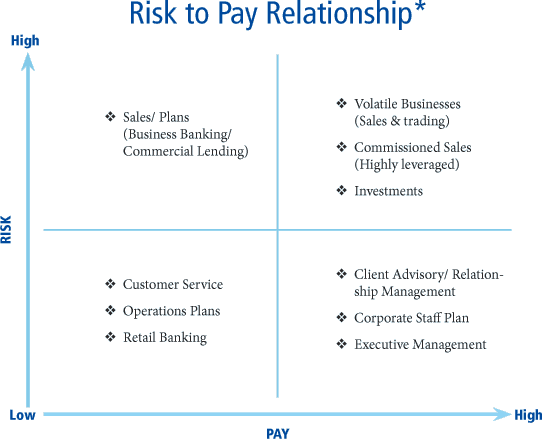
* Based on a financial services firm but the principle is applicable across industries
Given the increased focus on risk management and the responsibility of compensation committees and boards to supervise the potential for incentive plans to encourage excessive risk taking, we expect most companies will develop processes to identify and address these issues. Additionally, while the SEC does not require companies to make any affirmative disclosure if they do not believe that their incentive plans create risks with material adverse consequences, we expect many companies to describe the risk assessment process in their proxy statements.
A risk review is not a one-time event. In the future, incentive plans will be more regularly monitored and reviewed by a designated internal group with the authority and independence to raise issues and make recommendations. This kind of enhanced management oversight represents sound business practice. Companies that establish an accepted and understood pay to risk relationship will be better positioned to achieve strategic business goals while maintaining responsible and defensible incentive compensation programs.
Please contact us at (212) 921-9350 if you have any questions about the issues discussed above or would like to discuss your own executive compensation issues. You can access our website at www.capartners.com for more information on executive compensation.