| Each pay consulting relationship is unique. Once the consultant is selected, the committee should define in advance its objectives and expectations. |
Board compensation committees must not only deal with the competing demands of regulators and shareholders, but must now operate in an environment where their actions and decisions are highly visible and often criticized. For many boards, hiring an out-side compensation consultant to help them navigate this highly complex environment is a worthwhile and prudent business decision. A consultant can help the committee fulfill its oversight and governance responsibilities while maintaining competitive, compliant, and responsible executive pay.
In this article, we discuss how the compensation committee and the compensation consultant can have an effective relationship. The process begins with the compensation committee defining its objectives and expectations and hiring the consultant. We then discuss procedures that emphasize communication and facilitate productivity.
A mutually beneficial consulting relationship will require considerable dialogue. When the relationship is built on a solid foundation, differing points of view can be addressed without detriment to the ongoing consulting relationship.
An effective consulting relationship begins with the selection process. The human resources department or procurement may begin the process with a “request for proposal.” However, the process should be driven by the compensation committee itself. Selection criteria should be identified as well as any required skills, knowledge, or experience. Often, experience in a particular industry, or experience with a specific transaction, such as an IPO or merger is important. If the company is expanding internationally, global resources and data may be needed.
The full compensation committee should be involved in interviewing the consultant or team, and they should assure that those they are interviewing will be the ones involved in the engagement. The committee must be comfortable with the consultant’s experience on similar issues facing the company, with the consultant’s technical acumen, access to available resources, and ability to present a coherent and well thought-out point of view. The consultant’s references should also be checked.
| Where the committee is not experienced in working with outside advisors, the consultant can help structure objectives and processes that work. |
Each consulting relationship is unique. A start-up company, an IPO, or a newly merged or acquired company may need help with virtually every aspect of employee pay design. Other companies may need an overall review of management’s pay recommendations and expert opinion to the committee at each meeting. Others may need specific technical expertise (a company in Chapter 11; one that has received TARP monies, etc.)
Once the consultant is selected, the committee should define in advance its objectives for the year and its expectations of the consultant. This need not be an involved or lengthy process, but in any working relationship, purpose and context need to be provided.
For example, if the compensation committee needs education and training on executive pay issues and practices, it should inform the consultant. If the committee is not comfortable with the design of the incentive plans that have provided lucrative payouts while stock price remained flat, the consultant should know about it. If there is disagreement over Ike CEO’s pay or the pay and performance linkage, the consultant should be alerted.
Certainly, if the prior consultant did not meet the expectations of the committee, the new consultant should be told why. Where the compensation committee is not experienced in working with outside advisors, the consultant is in an excellent position to help structure objectives and processes that work.
Most of all, the committee relies on the consultant for experience and expertise, to help ensure that the company is not exposed in terms of inappropriate pay practices. Ultimately, the overall goals of the compensation committee and consultant are the same: to help the board perform its governance and oversight role in an informed manner.
| It is surprising how often committee chair/ consultant dialogue does not happen or comes too late to avoid a problem. |
Throughout the year, the compensation committee and consultant should adhere to certain practices that will lead to a successful working relationship. There will still be challenges and tough issues to work through together, but these processes will help materially in achieving committee objectives.
- At the beginning of every year, the consultant should develop a “statement of work” that defines the scope of their consulting activities for the coming year, including deliverables, fees, timing, and reporting relationships to the committee. If there is an annual calendar of meeting dates and activities, the statement of work is straightforward. Since the human resource function is typically responsible for the annual calendar, this planning helps to ensure that all parties have a common understanding for the year ahead.
- If the committee has not done so already, its goals and objectives should be articulated to the consultant. This should include objectives for the consultant, but might also include objectives for the committee itself. The committee chairperson should also alert the consultant to any critical issues facing the committee.
- In a new relationship, the committee will often request that the consultant provide a high-level review of the company’s executive pay program, highlighting any atypical or uncompetitive pay practices or plan features that should be reviewed in detail. It is incumbent on the consultant to uncover potential problem areas that need to be addressed.
- The committee chairperson and consultant should review meeting materials in advance of each meeting, preferably before the materials are mailed, which allows for revisions. This allows both parties to understand each other’s point of view and pose questions that will help in meeting preparation.
- The consultant should assure that the chair under-stands the key messages to be delivered on a particular topic. The chair, in turn, can use the opportunity to bring the consultant up to speed on any strong committee views or business issues that may be relevant to the subject matter at hand. This could include plan design, competitive analysis, the CEO’s contract or pay recommendations. It is surprising how often this dialogue does not happen, or comes at the last minute when it is often too late to resolve an issue or avoid a problem during the meeting.
- The consultant should be available for every meeting and executive session, as requested by the chairperson. Time should be scheduled for debriefing, particularly when follow-up activities are required. When the meeting agenda is full, or when many decisions have been made, follow-up ensures that everyone has similar takeaways.
- The committee’s annual calendar typically includes a review of compensation strategy, annual pay benchmarking, assessment of the pay and performance relationship, and risk assessment. At the most basic level, both parties should work to avoid controversial pay practices, ensure that pay programs support company strategy, and establish appropriate performance linkages for incentive plans. These are joint responsibilities. Any review of CEO pay (with recommendations) should go to the chairperson first, without prior review by the CEO.
- The performance of outside advisors should be evaluated as part of the committee’s annual self -evaluation. Even if the consultant assists the committee with the evaluation, it is important that the members review the overall relationship each year to determine if the consultant is meeting expectations. Feedback should be provided to the consultant.
- At the end of each year, management (usually human resources) should provide the committee with documentation on the consultant’s fees and deliverables for the year. A summary of all services and fees provided by the consultant’s firm to the company overall should also be provided.
- As part of the committee’s review of the proxy Compensation Discussion and Analysis (CD&A), the required language describing the consultant’s involvement in pay decisions should be reviewed, as well as other needed disclosure.
- There should be a clear process for requesting and approving additional work for the consultant during the year. If management has a need for additional work, the committee should approve it. If the amount of work the consultant’s company does overall is significant, the committee may want to know about such work in advance.
| In today’s environment, the compensation committee cannot be passively waiting for problems to occur. It relies on the consultant to uncover relevant and timely pay issues. |
The processes described above will contribute to a productive relationship between the compensation committee and its consultant. The following success factors can strengthen the relationship even more.
| The consultant should not play both sides of an issue, and has a responsibility to express an opinion even if it is not one shared with the chair, the committee or the CEO. |
- The chairperson and consultant must have access to one another during the year. They should communicate before and after each meeting, and whenever necessary.
- Both parties must have realistic expectations about the relationship. They may not always agree on every issue, but this is not a signal of failure or dysfunctional relationship. The committee must be open to views and opinions different from its own, and consultants must understand that their responsibility is to voice opinions to the committee, even if it is not what the board (or CEO) wants to hear.
- The committee and consultant should proactively review company pay programs and practices, while anticipating potential issues or necessary changes. In today’s environment, the compensation committee cannot be reactive and wait for problems to occur. The consultant must uncover relevant and timely issues.
For example, if the company intends to seek shareholder approval of a new long-term incentive plan share reserve, the committee should research the voting policies of their largest institutional investors before making the request. When advisory groups introduce new policies, companies should review their programs to anticipate any problem areas that could arise. The committee should also involve the board’s audit or risk committee in an annual evaluation of pay programs as it relates to risk.
- Understand that the ultimate decision-making is the responsibility of the compensation committee, not the consultant. The committee needs to exercise its own judgment after getting the best information and advice possible.
In the past year, consultant independence has come to the forefront. Since 2006, if a consultant played a role in determining or recommending executive or director pay, the consultant had to be identified in the company’s proxy and the scope of services and reporting relationship had to be noted. SEC rules approved in December 2009 expanded the requirement to include the fee disclosure if a consultant provides additional services to the company beyond $120,000 in the aggregate. Also in 2009 draft legislation delivered from the Treasury Department to Congress included a provision that any compensation consultant or legal counsel hired by the compensation committee must be “independent” from management.
Most full-service consulting firms have independence standards to manage any potential conflicts, while a boutique firm specializing only in executive compensation is generally structured to reduce the potential for conflict.
Treasury Department Fact Sheet
Providing Compensation Committees With New Independence
Draft legislation was delivered by the Treasury Department to Congress in 2009 to promote the independence of compensation committees. Key elements would include:
- Compensation committee members will be required to meet stronger standards for independence that are to be issued by the SEC.
- To ensure that compensation committees receive objective advice, any compensation consultants and legal counsel hired by the committee must be independent from management.
- Committees must be given the authority and funding to hire independent consultants, outside counsel, and other advisors who can help ensure that the committee bargains for pay packages in the best interests of shareholders.
The compensation committee should also have procedures in place regarding the consultant relationship (hiring and firing authority, direct access to the committee, performance evaluation, executive sessions, etc.) that help ensure objective advice, as well as a protocol on mitigating conflicts. Absent a mandated definition of consultant independence, what is important is that the committee be satisfied with the relationship and that there are procedures to avoid conflict.
A related issue which has attracted increased attention is the use of more than one compensation consultant. If two consultants are used (one reporting to the compensation committee, the other to management) the roles should be clearly defined and agreed to in advance. The predominant view is that one consultant reporting to the committee is a more effective arrangement, but the dual consultant model is certainly workable.
To have an effective working relationship, both the compensation committee and the consultant have specific roles to play.
Outside compensation consultant. It is expected that the consultant know the company and industry and stay current on all regulatory issues, as well as best practices in plan design, performance measurement, and pay practices. The consultant should not play both sides of an issue, and has a responsibility to express an opinion even if it is not one shared with the chairperson, the committee, or the CEO. Above all else, the consultant needs to be a “trusted advisor” helping the committee think strategically, raising questions and issues the committee should be thinking about.
Compensation committee. Many committee activities are dictated by various regulatory bodies (stock exchanges, the SEC. FASB, etc.), or specific legislation, such as Sarbanes-Oxley. At a tactical level, each committee must follow its charter to ensure members are fulfilling their responsibilities.
The committee also needs to work with other committees of the board (audit, nominating/governance, risk, etc.) and keep the full board informed of decisions, particularly on CEO compensation. The compensation committee chairperson should develop a healthy working relationship with the CEO.
The committee itself should maintain adequate skills among its members. Diverse areas of expertise and complementary skills are a plus, and basic financial acumen a necessity. Most importantly, the committee must represent the shareholders.
While the formal reporting relationship of the consultant must be to the committee, a good working relationship between the consultant and management can have an extremely positive impact. Management provides necessary compensation data and financial or legal information. Management can also confirm data accuracy and timeliness, and provide a historical perspective or rationale for unusual pay practices. It can explain how certain programs are implemented (such as company specific definitions for metrics used in incentive plans.)
A good relationship with management can also help provide information on the various viewpoints held on pertinent issues, and offer insights on culture and business strategy. In many cases, pre-committee meeting conference calls and preparation may involve the consultant, the compensation committee chair, and human resources. When all three parties are involved, productivity in the committee meetings can be greatly enhanced. Open communication, where appropriate, contributes to better working relationships overall.
| A good working relationship between the consultant and management is a positive. Management provides necessary pay and financial information, plus insights on culture and business strategy. |
Executive compensation is a sensitive area. Such factors as company performance, personal views on pay, or a shareholder vote against committee members can temporarily change committee dynamics. Additionally, problem areas can arise: a mistake may be made as a result of not having current data; meeting participants may not be fully prepared when a specific issue arises that was not on the agenda; a committee member may question a methodology used by the consultant; or the consultant may be caught in the middle of two disparate views. Most issues can be worked out. The important thing is for the chairperson and consultant to acknowledge a problem when it occurs, accept responsibility for their role in the misunderstanding, and focus on action to correct the problem.
In the future, the need for compensation committees to work effectively with consultants will increase as new regulations take effect and companies work their way out of the current recession. The committee’s role and potential impact – as well as its exposure to public scrutiny – will not diminish.
Nonetheless, along with greater demands and challenges comes the opportunity to make meaningful decisions in shaping pay programs. In many companies, this will ultimately result in pay strategies and programs that are tightly aligned with the competitive market and meaningful returns to shareholders
Please contact us at (212) 921-9350 if you have any questions about the issues discussed above or would like to discuss your own executive compensation issues. You can access our website at www.capartners.com for more information on executive compensation.
Reprinted by THE CORPORATE BOARD
4400 Hagadorn Rd, Okemos, MI 48864-2414, (517) 336-1700
www.corporateboard.com @ 2010 by Vanguard Publications, Inc.
Following the collapse of Enron and WorldCom, compensation committees became aware of the dangers of loading up executives with outsized stock option grants which might tempt them to “inflate” short-term earnings and stock price. Companies and their compensation committees did one or more of the following: they reduced the size of option grants, introduced stock ownership guidelines and share retention programs, and diversified the portfolio of incentive vehicles by adding restricted stock and performance plans. These long-term incentives contain less leverage than options, reducing the temptation to swing for the fences.
Incentive compensation, whether for executives or the broader employee population, has been identified as a significant contributor to the financial crisis. To protect the “safety and soundness” of our financial system and provide remediation, the Federal Reserve and the Securities and Exchange Commission have proposed guidance and disclosure requirements which require companies to conduct a thorough review of the relationship between pay and risk taking. The objective of a “risk assessment” is to identify plans or practices that may encourage employees to take unnecessary or excessive risk which could threaten the company or, in the case of financial firms, the safety of the broader financial system.
Conducting a Risk Review
There are four steps in conducting a risk review:
- Create the process
- Develop a framework to examine incentive plans and practices
- Assess current plans
- Communicate results and identify refinements
Creating the Process
A comprehensive risk review requires a multi-disciplinary team composed of human resources, risk management, legal, finance, and corporate and business unit leaders. In the initial phase human resources professionals (including compensation) compile comprehensive information about the company’s incentive plans. This includes identifying all incentive plans, revisiting the organization’s compensation philosophy (including the appropriateness of the comparators used for benchmarking), summarizing key incentive plan design features, and reviewing historic pool levels and pay mix to determine if a “risk adjustment” is needed. Concurrently, risk and finance professionals compile a risk profile by bringing together their individual assessments of where risk exists or is likely to originate.
Developing a Framework for Examining Incentive Plans and Practices
The next step is to develop a framework for determining to what extent risk impacts incentive plans and practices. The team identifies the types of risk — operational, credit, market, and reputational — that exist in the company and the behaviors and actions that need examination and monitoring. Although all incentive plans should be reviewed, the focus initially will be on the lines of business and the individual contributors with higher risk profiles. The framework includes a series of questions relating to how the incentive plans operate. The following address the key areas of concern:
- How are incentive pools developed?
- Are the incentive pools capped or uncapped?
- Are the metrics appropriate given the type of business?
- Are operational controls in place to prevent participants from manipulating results?
- Is the plan unduly focused on short-term results?
- Do incentive timeframes match income recognition?
It is also important to examine incentive plan governance:
- Who designs the plans?
- Who approves the plans and how are they tracked?
- Who validates the performance and payments?
- What is the level of oversight by finance, risk management, human resources, senior management?
The framework can also identify design features that help to mitigate risk, e.g., a combination of performance metrics (ideally including multi-year results), a pay mix that balances short-term and long-term compensation, and incentive leverage scales that encourage performance improvement without requiring home runs.
SEC Disclosure Rules (approved December 16, 2009)
- The SEC requires a narrative disclosure about the company’s compensation policies and practices for all employees, not just executive officers, if the compensation policies and practices create risks that are reasonably likely to have a material adverse effect on the company
- This disclosure threshold is similar to the one used for the Management Discussion and Analysis
- Disclosure would be included in a separate section of the proxy, not in the Compensation Discussion and Analysis
- The SEC provides a non-exclusive list of situations that potentially could trigger disclosure:
- At a business unit of the company that carries a significant portion of the company’s risk profile;
- At a business unit with compensation structured significantly differently than other units within the company;
- At a business unit where the compensation expense is a significant percentage of the unit’s revenues; and
- At a business where bonuses are awarded upon accomplishment of a task, while the income and risk to the company from the task extend over a significantly longer period
- Smaller reporting companies are excluded
- Companies are not required to make an affirmative statement that compensation plans are not risky
Note: While the SEC does not require disclosure if a company determines that its incentive plans are not reasonably likely to create risks with material adverse consequences, we expect companies to describe the risk assessment process in their proxy statements, highlighting features of their programs that mitigate risk and changes they have made to improve risk and incentive alignment.
Assessing Current Plans
The first plan to review is the executive incentive plan. It is important to validate both the plan and the compensation philosophy against the company’s risk profile as other plans will be aligned with these principles. In fact, many of the issues addressed with respect to senior executives will apply to other employees.
The compensation committee and the chief risk officer (and often the risk committee or audit committee of the board of directors) participate in this process. An analysis of the metrics used to fund the corporate pool is particularly important. For example, financial firms need to address whether incentive plan metrics include capital adjusted results. Companies also need to demonstrate that incentive plan payments reflect a broad view of performance that extends beyond short-term earnings. The balance in the senior executive pay package between short-term, intermediate, and long-term results, and between cash and equity compensation are important to consider.
Many plans have features which can mitigate risk, such as multi-year performance periods, stock ownership guidelines and stock retention requirements, bonus and equity claw backs if results are later found to be inaccurate, and mandatory bonus deferrals. While these practices do not guarantee that unnecessary risk taking is being averted, they do encourage the desired alignment between senior executive pay and long-term performance.
Next, the multi-disciplinary team conducts a similar analysis of other incentive plans. This usually begins by analyzing how the bonus or incentive pools are funded, i.e., whether they use corporate, business unit, or individual results, and whether the pools are based solely on formulas or include an element of management judgment. It is important to examine how the metrics used align with corporate plan metrics and business goals. One important practice to mitigate risk includes incorporating time horizons in the incentive plan that reflects the company’s time horizon for recognizing income or losses. When products or transactions contain a long tail that can only be assessed over time, multi-year performance should impact incentive payouts. A major mismatch can occur when large upfront bonuses are awarded before the company is able to recognize profitability from a product or transaction. Other questions to be addressed are similar to those already covered in the assessment of the executive incentive plan:
- Does fixed compensation represent an appropriate percentage of the total pay package?
- Are safeguards (such as caps, discretionary components, deferrals and controls over how products are priced) in place for revenue-based plans?
- Does the mix of cash and equity reflect the preferred alignment between the business unit or individual participant and the company?
- What is the process for goal setting and approving payouts? Is the Audit Committee involved in the performance measurement approval for the executive plans?
- Are claw backs and mandatory deferrals in place? If not, should they be adopted?
Finance, risk management, and human resources should have an ongoing role in developing and reviewing business unit compensation plans. They need to have the authority to make recommendations for change. They also need to be compensated in a manner that ensures that their independent oversight of the process is not compromised.
Communicating Results
Led by the chief risk officer, the team presents its assessment to management and the compensation committee. This consists of an evaluation of executive and other employee incentive plans that have the potential to create unnecessary or excessive risk (the threshold for financial institutions) or that are reasonably likely to create a material adverse effect on the company (see SEC Disclosure Rules).
The presentation highlights businesses with higher (and lower) risk profiles, the criteria used to assess the risk, and an analysis of the corresponding incentive plans and how they are structured to mitigate these risks. In organizations with multiple incentive plans, it is common to sort the plans by level of risk, (from high to low) and by the level of pay (from high to low) for purposes of prioritizing the review process, examining individual plan features, and presenting findings and recommendations (see Risk to Pay Relationship chart on page 4). The team offers an opinion on whether any of the incentive plans are likely to constitute a material adverse risk, or in financial firms, whether the incentive plans align with the Federal Reserve’s guidance on “safety and soundness.” Finally, the team presents to the compensation committee recommendations on how the company’s incentive plans, policies, and practices should be structured or modified to address risk. These modifications may be company-wide (e.g., a shift in some portion of variable to fixed pay for all employees), or may be refinements affecting a smaller group of employees (e.g., a three-year deferral program with payment tied to future business unit results). In almost all cases, some changes are to be expected.
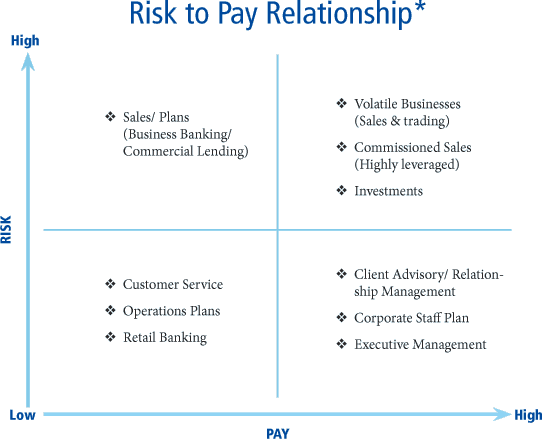
* Based on a financial services firm but the principle is applicable across industries
Given the increased focus on risk management and the responsibility of compensation committees and boards to supervise the potential for incentive plans to encourage excessive risk taking, we expect most companies will develop processes to identify and address these issues. Additionally, while the SEC does not require companies to make any affirmative disclosure if they do not believe that their incentive plans create risks with material adverse consequences, we expect many companies to describe the risk assessment process in their proxy statements.
A risk review is not a one-time event. In the future, incentive plans will be more regularly monitored and reviewed by a designated internal group with the authority and independence to raise issues and make recommendations. This kind of enhanced management oversight represents sound business practice. Companies that establish an accepted and understood pay to risk relationship will be better positioned to achieve strategic business goals while maintaining responsible and defensible incentive compensation programs.
Please contact us at (212) 921-9350 if you have any questions about the issues discussed above or would like to discuss your own executive compensation issues. You can access our website at www.capartners.com for more information on executive compensation.
Based on the dialogue we have seen among compensation committees, we believe the 2010 proxy season will demonstrate that a new level of responsibility has taken hold. Management and committees are struggling to ensure they are doing the right thing when it comes to compensation and that pay is closely aligned with performance. Additionally, some of the incentive program designs and governance practices imposed on financial services companies operating under TARP have had an impact on other industries.
Some of the early trends we are seeing in 2010 are detailed below.
Base Salaries
In 2009, roughly one-third of companies did not give salary increases. Many companies even cut salaries for executives, typically by 5-10%. With the economy showing early signs of a recovery, close to 90% of companies are planning for salary increases in 2010. Merit pools are expected to be lower than pre-recession levels, typically ranging from 2-3%. While many companies are providing salary increases, they will use these smaller pools more strategically, by targeting top performers and highest potential executives, and withholding increases to others.
RiskMetrics Group Problematic Pay Practices
While not a complete list, RMG views the following as problematic pay practices:
- Multi-year guarantees for salary increases, non-performance based bonuses, and equity compensation;
- Including additional years of unworked service that results in significant additional benefits, without sufficient justification, or including long-term equity awards in the pension calculation;
- Perquisites for former and/or retired executives, and extraordinary relocation benefits (including home buyouts) for current executives;
- Change-in-control payments exceeding 3 times base salary and target bonus; change-in-control payments without job loss or substantial diminution of duties (“single triggers”); new or materially amended agreements that provide for ‘modified single triggers’ (under which an executive may voluntarily leave for any reason and still receive the change-in-control severance package); new or materially amended agreements that provide for an excise tax gross-up (including “modified gross-ups);
- Tax reimbursements related to executive perquisites or other payments such as personal use of corporate aircraft, executive life insurance, bonus, etc;
- Dividends or dividend equivalents paid on unvested performance shares or units;
- Executive using company stock in hedging activities, such as “cashless” collars, forward sales, equity swaps or other similar arrangements; or
- Repricing or replacing of underwater stock options/stock appreciation rights without prior shareholder approval (including cash buyouts and voluntary surrender/subsequent regrant of underwater options)
In the financial services industry, given the impact of TARP and other regulatory initiatives, compensation is being re-mixed. Many financial service firms had increases to rebalance the mix between fixed and variable compensation. This helps avoid any perception that leveraged compensation packages encourage excessive risk-taking. In addition an annual risk assessment is becoming integral to the committee’s process across industries (this topic will be covered in the upcoming CAPflash on Risk Assessment).
Annual Incentives
Many companies’ experiences during two recessions within the last decade have highlighted the challenges with setting targets for incentive plan purposes. Beginning in 2009, many companies have started to incorporate a greater level of discretion in their annual incentive plans.
Companies found that strictly formulaic incentive plans sometimes failed to capture the true quality of the financial performance delivered. Additionally, Committees increasingly want the ability to improve the alignment between pay and performance. Providing for a level of discretion over incentive payouts allows Committees to recognize non-financial factors, individual performance and the challenges management faced in delivering the financial results on a retrospective basis.
For 2009 payouts, we expect to see an increased use of discretion by compensation committees, with more in-depth analysis of the factors influencing payout decisions. This may include a review of multiple financial metrics, analysis of performance relative to peers, strategic and operational results.
While results will vary by industry, we expect 2009 annual incentives payouts to exceed 2008 levels, when many companies paid zero or below target awards.
Long-term Incentives
In 2009, companies struggled to reconcile collapsing share prices with the need to recognize and reward their top performers and rising stars. Many companies did not grant equity as deeply or as broadly as they had in the past. In many cases, we saw a reduction in long-term incentive awards ranging from 10% – 30%. This decrease was partly due to efforts to manage annual share usage in a year with significantly lower stock prices In 2010, we are expecting grant values to level off or increase slightly as stock prices recover. We also expect to see a continued focus on performance-based long-term incentive plans and a decline in the use of or emphasis on stock options.
In 2010, individual differentiation will continue to be a key theme in long-term incentives as companies continue to manage their share usage and overall expense. The most dramatic examples occur deeper in the organization. At middle management levels, 100% may be eligible for awards, but typically 50%, and in some companies as few as 25%, actually receive awards.
Time-vested restricted stock and “salary stock” has become commonplace for companies operating under TARP. Outside of financial services, however, compensation committees have sharpened their focus on performance, employing a variety of performance-based awards. Shareholders and the various shareholder advocacy groups support these approaches, encouraging the trend.
Pay Mix
In 2009, many companies reviewed the mix of pay they offered. Companies want to ensure there is an appropriate balance between short and long-term compensation as well as fixed vs. variable pay. Within financial services, many companies re-balanced the amounts executives received in salary, annual cash incentives and equity. This rebalancing is intended to align the time horizon of compensation with the risk profile of the company and will vary by industry.
Clawbacks
Clawback provisions for annual and long-term incentives are becoming more common across industries. This is another example of a practice required by TARP spilling over into general industry. Clawbacks come in a variety of flavors. Some require employees to forfeit or reimburse compensation for a period of time if an executive engages in conduct that results in a restatement of financial results. Other clawbacks are fashioned more broadly, allowing companies to recoup compensation if results deteriorate over time for any reason. Providing for clawbacks helps further align pay and performance and mitigates the potential risks of executives making short-term decisions that have a detrimental impact on the company over time. Some companies, especially in financial services, are increasing the use of deferred compensation to make it easier to recoup compensation later, if the need arises.
Stock Holding Requirements
The requirement to hold stock for a period of time following vesting or exercise of options has become increasingly prevalent over the last few years, although still not a majority practice. Companies with such requirements generally ask executives to hold 50% to 100% of net shares for a period of one to three years, or even to retirement or beyond for a minority of companies. Stock holding requirements continue to be a focus for companies as they are viewed as another practice to mitigate risk in compensation programs. Stock ownership guidelines, most often expressed as a multiple of base salary, are common for most companies. Some companies are re-evaluating their stock ownership guidelines and denominating the guideline in shares as opposed to a multiple of salary as a response to the volatility in the market.
Change in Control Protections
Pressure from shareholder advisory groups and activist investors are leading to reductions in change in control protections. As companies review their programs, many are committing to eliminate gross-ups on 280(g) excise taxes going forward. Some of these companies are grandfathering this provision for existing participants, while select companies are eliminating them completely for all participants. A few companies are asking executives with contractual rights to gross-ups to waive them. These companies recognize that gross-ups are a red flag in the current environment and acknowledge that the potential cost to the company, or acquiring company, far exceeds the benefit to the executive. As companies eliminate the gross-up feature, some provide the executive with the choice to receive the full amount of their change in control benefits and pay the excise tax themselves or reduce the benefits to a level just below the level which would trigger the excise tax payment.
In addition to eliminating gross-ups, more companies are moving to double-trigger vesting on equity following a change in control (i.e., executive must be terminated without cause or terminate for good reason following the change in control).
Summary
The magnitude of the economic crisis increased the level of scrutiny of executive compensation practices over the past two years to unprecedented levels. The actions we have seen companies take in 2009 have been greatly impacted by the environment. As companies release their proxy statements in the next few months, we will get a better sense of the final decisions, but we believe that both senior leaders within companies and compensation committees are supporting a new level of responsibility and accountability.
Please contact us at (212) 921-9350 if you have any questions about the issues discussed above or would like to discuss your own executive compensation issues. You can access our website at www.capartners.com for more information on executive compensation.
We view the report as required reading for outside directors, senior management and HR professionals. The report amounts to a call for action for boards of directors and compensation Committees to re-examine their compensation programs to ensure that the link between pay and performance is strong and the programs reflect best practices and high governance standards.
The report recommends that executive compensation programs reflect the five guiding principles:
- Principle One – Paying for the right things and paying for performance
“Compensation programs should be designed to drive a company’s business strategy and objectives and create shareholder value, consistent with an acceptable risk profile and through legal and ethical means. To that end, a significant portion of pay should be incentive compensation, with payouts demonstrably tied to performance and paid only when performance can be reasonably assessed.” - Principle Two – The “right” total compensation
“Total compensation should be attractive to executives, affordable for the company, proportional to the executive’s contribution, and fair to shareholders and employees, while providing payouts that are clearly aligned with actual performance.” - Principle Three – Avoid controversial pay practices
“Companies should avoid controversial pay practices, unless special justification is present.” - Principle Four – Credible board oversight of executive compensation
“Compensation committees have a critical role is restoring trust in the executive compensation setting process and should demonstate credi ble oversight of executive compensation. To effectively fulfill this role, compensation committees should be independent, experienced, and knowledgeable about the company’s business.” - Principle Five – Transparent communications and increased dialogue with shareholders
“Compensation programs should be transparent, understandable and effectively communicated to shareholders. When questions arise, boards and shareholders should have meaningful dialogue about executive compensation.”
In addition to the guiding principles, the report contains concrete recommendations on how to implement effective executive compensation programs. Click on the link http://www.conference-board.org/pdf_free/ExecCompensation2009.pdf to access the full report of Conference Board?s Task Force on Executive Compensation.
Please contact us at (212) 921-9350 if you have any questions about the issues discussed above or would like to discuss your own executive compensation issues. You can access our website at www.capartners.com for more information on executive compensation.
We found that 20 out of 25 companies (80%) retained the services of an executive compensation advisory firm in 2008. The large multi-service human resource consulting firms dominated, with either Towers Perrin, Mercer or Watson Wyatt providing services to 12 of the 20 companies (60%). The remaining eight companies (40%) retained smaller boutique firms that are unlikely to provide other services, including Pearl Meyer & Partners, Frederick W. Cook, Total Reward Strategies LLC, Compensation Strategies LL, ExeQuity and icca .
Two of the 20 companies (10%) reported changing advisors, but a trend toward the boutique firms was not apparent. Chevron replaced Hewitt, a multi-service firm, with ExeQuity, but Unitedhealth Group moved in the other direction, replacing Semler-Brossy, a boutique, with Towers Perrin, a multi-service firm.
Seventeen of the 20 companies (85%) indicated that their executive compensation advisory firm was independent. Three companies (15%) did not address this issue in their disclosures.
Nine of the 20 companies (45%) defined an independent compensation consultant as a firm that did not do any other work for the company. One company (5%) applied this standard to the individual adviser, rather than the firm, noting that the individual consultant did no other work for the company. Seven of the 20 companies (35%) maintained that their compensation consultant was independent, while allowing the consulting firm to provide other services. Several noted that the extent of these services were modest or immaterial. In some cases, the Compensation Committee required advance approval of other services. In other cases, Committee approval was not required specifically.
Several companies added their own unique provisions to their definition of independence. Some examples include:
- Requiring that the consulting firm annually attest to compliance with the stipulation to do no other work;
- Rotating the consultant after five years, and prohibiting the Company from hiring any consulting firm staff involved with the account for one year;
- Requiring that the individual consultant not be involved in other work, prohibiting sharing of information on compensation with other staff of the consulting firm, and requiring that the consultant’s compensation not depend on cross-selling other services;
- Limiting payments to affiliates of the consulting firm to two percent of aggregate gross revenues of the consulting firm and its affiliates;
- Prohibiting the consulting firm from providing services directly to senior officers of the Company.
Two companies embraced the concept of enhanced disclosure. Home Depot disclosed fees paid to both its consulting firm and to an affiliate of its consulting firm that provides other services related to the retirement plan. Another company committed to disclose aggregate fees by category of service if it determined that its consultant was not independent. In this case, the consulting firm would not be deemed independent if it or its affiliates provide other services that exceed two percent of gross revenues; or if individuals serving the Compensation Committee provide other services not at direction and under supervision of the Committee. A third approach we have seen used outside of the Fortune 25 population is to publish the ratio of executive compensation consulting fees to fees for other services, with the consulting firm deemed independent provided fees for other services are less than compensation consulting fees.
In summary, the majority of companies are now defining independence strictly to prohibit the firm and the individual consultant from doing other work for the company. A minority of Compensation Committees allow their consultants to perform other work, but require Committee approval and/or a materiality threshold.
Assuming the SEC is ultimately called to develop standards for consultant independence, what approach will they take? If the SEC requires consulting firms to do no other work, the SEC will limit the ability of the large multi-service consulting firms to compete in the marketplace. On the other hand, if the SEC imposes less rigorous standards, it may be in the awkward position of espousing a set of standards that are less comprehensive than in place currently at the majority of large companies.
Please contact us at ((212) 921-9350 or [email protected]) if you have any questions about the independence issues discussed above or would like to discuss your own executive compensation issues.
Below we review the recent legislative and regulatory activity, culminating in passage of the Corporate and Financial Institution Compensation Fairness Act of 2009 by the House on July 30, 2009.
Shareholder Empowerment Act
Representative Gary Peters proposed an amendment to the Securities and Exchange Act of 1934 that would require a number of reforms, including enhanced proxy access, independent chairman for corporate boards and say on pay. The Act would require boards retaining advisors in connection with negotiating employment contracts or compensation agreements with executives to retain only independent advisors that report solely to the board of directors or the committee responsible for executive compensation. The Act also requires that companies not agree to indemnify or limit the liability of compensation advisers or advisory firms.
Examples of criteria Boards should consider in determining whether an adviser is independent suggested by Peters include:
The extent (as measured by annual fees and other relevant metrics) to which the individual adviser or advisory firm provides other services to the Company or its executives;
Whether individual advisers are permitted to hold equity and do hold equity in the Company; and
Whether an advisory firm’s incentive compensation plan links the compensation of individual advisers to the advisory firm’s provision of other services to the issuer.
Corporate and Financial Institution Compensation Fairness Act of 2009
Representative Barney Frank, Chairman of the House Financial Services Committee, submitted H.R. 3269 a few weeks later. The primary purpose of this Act is to amend the Securities Exchange Act of 1934 to provide shareholders with an advisory vote on executive compensation and to prevent perverse incentives in the compensation practices of financial institutions. But independence standards for both Compensation.
Committee members and outside compensation consultants are also addressed. H. R. 3269 was passed by the House on July 30, 2009.
H.R. 3269 requires that Compensation Committee advisers for all public companies – including compensation consultants, legal counsel, or other advisers — meet new standards for independence to be established by the SEC within nine months of the Act’s enactment. While the bill will not become law unless the Senate acts, many feel that independence will almost certainly become an absolute requirement for Compensation Committees.
The bill was amended to provide that the SEC’s regulations for independence and disclosure are competitively neutral among categories of consultants. The intent here is to preserve the ability of Compensation Committees to retain either boutique consulting firms that only provide compensation consulting advice or multi-service consulting firms that provide other services, such as actuarial services or outsourcing. Nevertheless, we predict that it will be difficult for multi-service firms to compete effectively if they provide substantial other services to corporate clients.
The Compensation Committee would have the authority, in its sole discretion, to retain an independent compensation consultant and would be directly responsible for the appointment, compensation, and oversight of the work of the consultant. Committees would not be required to follow the adviser’s recommendations and would continue to be expected to exercise its own judgment, but they would own the process.
Frank’s Act also requires disclosure in the proxy whether or not the adviser met the standards for independence that the SEC will establish. Finally, appropriate funding of payments to independent advisers, as determined by the Compensation Committee, will be required, assuring Committees’ access to appropriate advisers.
Treasury’s Proposed Investor Protection Act of 2009
On July 16, 2009, Treasury submitted draft legislation to congress that would ensure the independence of Compensation Committees. Treasury noted that Compensation Committees without access to independent compensation consultants may be at a significant disadvantage when negotiating pay plans with management. Treasury sought to level the playing field by providing Committees with access to compensation consultants, legal counsel, and other advisers.
Treasury noted that conflicts of compensation consultants are pervasive since advisory firms often provide other, non-compensation related services to companies. In addition the fees earned for other services often dwarf the fees earned from compensation consulting.
Treasury outlined several new requirements applicable to all public companies within nine months of the bill’s enactment. First, the SEC would be empowered to set standards for consultant independence. Each Compensation Committee would be authorized to retain an independent compensation consultant and would be directly responsible for the appointment, compensation, and oversight of the work of the independent consultant.
The Committee’s choices would be subject to proxy disclosure. The company would be required to disclose whether or not the Compensation Committee retained an independent compensation consultant. If the Committee did not retain an independent consultant, the rationale not to do so would need to be explained.
SEC Proposed Rules on Proxy Disclosure and Solicitation Enhancements
The SEC also weighed in on the compensation consultant independence issues. Currently companies are required to disclose the role of compensation consultants in determining executive and director compensation, including whether they are engaged directly by the Compensation Committee. The SEC noted that many compensation consultants provide a broad range of additional services to companies, and fees for other services may be larger than fees earned by consultants for executive compensation. The SEC noted that “ provision of such additional service by compensation consultants or their affiliates may create the appearance, or risk, or a conflict of interest that may call into question the objectivity of the consultants’ executive pay recommendations.”
Under the SEC’s proposed rules, if a consultant played a role in determining or recommending the amount or form of executive or director compensation and also provided additional services, the Company would be required to disclose:
A description of all additional services provided during the prior fiscal year;
Aggregate fees for all additional services, as well as aggregate fees related to executive and director compensation consulting;
Management’s role in the decision to engage the consultant for additional services;
Whether the Board or Compensation Committee approved all of these additional services.
We expect the SEC to modify these disclosure rules to respond to the requirement for “competitively neutral” regulations embedded in H.R. 3269. The SEC’s proposed rules are not competitively neutral since fee disclosure would apply only if additional services were provided. This confers a major advantage on boutique firms that do not provide additional services, since they would be exempt from the disclosure requirements. The attention of regulatory and legislative bodies on this issue will certainly continue. As we point out below (“How Companies Handle Independence Issues”) some companies are already initiating their own independence standards for compensation consultants.
Please contact us at ((212) 921-9350 or [email protected]) if you have any questions about the independence issues discussed above or would like to discuss your own executive compensation issues. Compensation Advisory Partners LLC