The survey, based on 2013 survey data, provides a rare look at how non-profit/government organizations attract, motivate and incentivize their employees. Data includes hard-to-find statistics on the size and nature of short-term and long-term incentive pay practices, including the types of plans and vehicles used. More than 175 participants from nonprofit and government organizations responded to the survey.
Previously conducted in 2007 and 2011, this year’s incentive pay compensation surveys represent our third collaboration with WorldatWork. With this longitudinal data, we provide insight on the key compensation trends and explain the reasons behind them.
Compensation Trends: Nonprofit/Government Organizations:
- In 2013, 78% of nonprofit and government organizations reported using short-term incentive plans, while 16% reported using cash long-term incentive plans.
- Nonprofit and government organizations favor simplicity by operating a limited number of short-term incentive plans. Of the respondents, 68% report having three or fewer short-term incentive plans in place.
- The majority of organizations (62%) rely on 4 to 6 performance measures in their Annual Incentive Plans in order to reward performance across several different dimensions.
The survey, based on 2013 survey data, provides a rare look at how private companies attract, motivate and incentivize their employees. Data includes hard-to-find statistics on the size and nature of short-term and long-term incentive pay practices, including the types of plans and vehicles used, as well as private company equity sharing ratios, liquidity, and valuation provisions. More than 190 participants from private, for-profit organizations responded to the survey.
Previously conducted in 2007 and 2011, this year’s incentive pay compensation surveys represent our third collaboration with WorldatWork. With this longitudinal data, we provide insight on the key compensation trends and explain the reasons behind them.
Compensation Trends: Privately Held Organizations:
- More than 75% of companies with a short-term incentive plan offer more than one program, with 39% of respondents reporting four or more short-term incentive plans.
- Annual Incentive Plans, the most prevalent short-term incentive plan at private companies, are offered to employees at the exempt, salaried level and above at most organizations.
- In 2013, 56% of companies offered long-term incentive plans, down from 61% in 2011. Long-term cash plans are the most prevalent long-term incentive vehicle with 51% prevalence in 2013.
CHANGES IN ANNUAL INCENTIVE PLAN DESIGN
Overall, 37% of companies made changes to their annual incentive plan design in 2012 or 2013. The most common changes were to increase the target incentive opportunity for the CEO and/or CFO (43% of companies making a change to increase target award opportunities) or to change to the annual incentive performance metrics (35%). Companies continue to review and enhance the pay-for-performance relationship through changes to the annual incentive program.
|
Type of Change Reported in CD&A |
2012 No. of Cos. |
% of Cos. Reporting Changes |
|
|
2012 (n = 37) |
2011 (n = 43) |
||
|
Increase target award opportunities (CEO and/or CFO) |
16 |
43% |
28% |
|
Change in performance metrics used to fund awards |
13 |
35% |
42% |
|
Change in performance metric weighting/mix |
4 |
11% |
21% |
|
Adopt mandatory deferral mechanism |
4 |
11% |
n/a |
|
Change in maximum award payout |
3 |
8% |
12% |
|
Other Changes |
8 |
22% |
19% |
Note: Due to multiple responses, does not add up to 100%.
Change in Target Bonus Opportunity
Last year median target bonus opportunities for the CEO and CFO positions increased by 6 and 1 percentage points to 159% and 101% of salary, respectively. The target bonus opportunity for CEOs in the Technology industry increased by 50 percentage points in 2012 due to an increase in the target opportunity at Apple (from 50% to 100% of salary) and Verizon (from 187.5% to 250%). Conversely, in the Consumer Goods industry, target bonus opportunities decreased year over year due to new incumbents in these roles.
|
Industry |
Median Target Bonus as a % of Salary |
|||||
|
CEO |
CFO |
|||||
|
2012 |
2011 |
Change in %age Pts. |
2012 |
2011 |
Change in %age Pts. |
|
|
Automotive |
138% |
130% |
+8% |
88% |
88% |
0% |
|
Consumer Goods |
160% |
170% |
-10% |
90% |
100% |
-10% |
|
Financial Services |
n/m |
n/m |
n/m |
n/m |
n/m |
n/m |
|
Health Care |
145% |
145% |
0% |
101% |
100% |
+1% |
|
Insurance |
200% |
200% |
0% |
130% |
120% |
+10% |
|
Manufacturing |
142% |
156% |
-14% |
93% |
95% |
-2% |
|
Pharmaceutical |
150% |
150% |
0% |
97% |
91% |
+6% |
|
Retail |
190% |
168% |
+12% |
90% |
85% |
+5% |
|
Technology |
250% |
200% |
+50% |
135% |
121% |
+14% |
|
Total Sample |
159% |
153% |
+6% |
101% |
100% |
+1% |
Note: Financial Services industry is excluded since most companies in our study do not disclose target bonus opportunities for the Named Executive Officers.
Change in Performance Metrics
Of the companies that changed or plan to change the performance metric:
- Nine (9) companies added metrics to the current plan
- Two (2) companies reduced the number of metrics, and
- Two (2) companies kept the same number of metrics but replaced a metric in the incentive plan.
Several companies indicated that their rationale for changing annual incentive metrics was, in large part, to better align executive pay with the business strategy and shareholder interests:
- Caterpillar: Incorporated Operating Profit After Capital Charge (OPACC) as a measure, to reflect how the Company is utilizing its assets in order to generate shareholder value
- CIGNA: Added a customer loyalty metric in 2013 to emphasize its business strategy and focus on the customers it serves
- Hewlett Packard: Introduced year over year improvement in Return on Invested Capital as an annual incentive metric to focus executives on the business turnaround
ANNUAL INCENTIVE PLAN DESIGN / PRACTICES
Award Leverage
Most companies reviewed did not disclose a threshold level of performance required to receive a bonus payment. Instead, these companies disclosed a minimum bonus of $0. For the 37 companies that did disclose a threshold bonus, 50% of target is the most prevalent payout percentage. However 20 companies, disclose a minimum bonus payout of less than 50% of target with a majority of these companies paying out for results based on one of multiple plan metrics. A majority of companies (58%) have a maximum bonus opportunity of 200% of target bonus. Thirteen (13) companies have a maximum bonus of 250% of target or higher. Four (4) of these companies are in the Consumer Goods industry and three (3) are in the Technology industry.
|
Threshold as a % of Target (n=37) |
||
|
Range |
# of Cos. |
% of Cos. |
|
< 25% |
10 |
27% |
|
25% < 50% |
10 |
27% |
|
50% |
12 |
32% |
|
50% < 75% |
1 |
3% |
|
75 <100% |
4 |
11% |
|
Maximum as a % of Target (n = 78) |
||
|
Range |
# of Cos. |
% of Cos. |
|
100% < 150% |
2 |
3% |
|
150% < 200% |
16 |
21% |
|
200% |
45 |
58% |
|
200% < 250% |
2 |
3% |
|
> 250% |
13 |
17% |
Of the six (6) companies that made changes to their maximum bonus potential in 2012/2013, three (3) companies increased the maximum bonus potential and three (3) companies reduced the maximum. Two (2) of these companies (Allstate and Colgate-Palmolive) changed the maximum payout for the CEO only.
Annual Incentive Plan Metrics
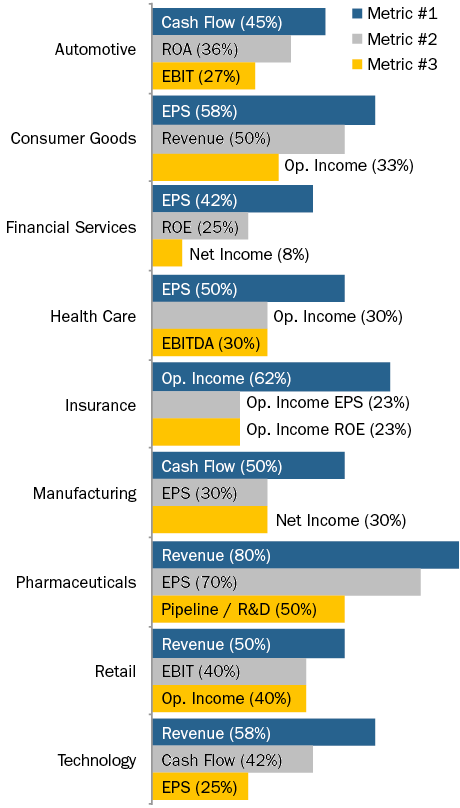
Similar to 2011, Revenue, EPS, Cash Flow and Operating Income continue to be the most prevalent metrics used across all companies, although we see some variation in metrics by industry. In 2013, 30% of companies disclose using two (2) metrics in their annual incentive programs, 29% use three (3) metrics, and 12% of companies use four (4) or more metrics. Approximately 85% of these companies use a profit-based metric in combination with Revenue and/or Cash Flow.
Refer to the chart below for the three (3) most prevalent metrics by industry:
|
Industry |
Actual Bonus as a % of Target Bonus – CEO |
|||||
|
2012 |
2011 |
|||||
|
25th%ile |
Median |
75th%ile |
25th%ile |
Median |
75th%ile |
|
|
Automotive |
69% |
102% |
131% |
130% |
153% |
186% |
|
Consumer Goods |
94% |
103% |
137% |
78% |
132% |
149% |
|
Financial Services |
44% |
80% |
120% |
111% |
114% |
130% |
|
Health Care |
103% |
127% |
157% |
116% |
127% |
159% |
|
Insurance |
112% |
130% |
144% |
85% |
106% |
130% |
|
Manufacturing |
100% |
107% |
146% |
119% |
136% |
162% |
|
Pharmaceutical |
125% |
142% |
156% |
130% |
144% |
161% |
|
Retail |
79% |
117% |
136% |
112% |
129% |
147% |
|
Technology |
90% |
99% |
124% |
75% |
100% |
149% |
|
Total Sample |
93% |
112% |
144% |
105% |
133% |
156% |
Note: Most companies in the Financial Services industry does not disclose target bonus. Figures for the Financial Services industry reflects actual bonus as a percentage of 3-year average actual bonus.
2012 Actual Bonus Payout
Similar to 2011, approximately 95% of companies awarded bonuses to their Named Executive Officers for 2012 performance. Overall, the median CEO bonus was 112% of target compared to 133% in 2011, indicating that 2012 performance generally exceeded par, but was not as strong as 2011 performance. Median 2012 bonus payouts in the Health Care, Insurance, Pharmaceutical and Retail industries exceeded target by 15 – 40 percentage points while payouts in the Automotive, Consumer Goods, Manufacturing and Technology industries were closer to target.
15% of companies in our study require executives to defer all or a portion of their annual incentive payout. Nearly 50% of companies that require a portion of the annual incentive award to be deferred are in the Financial Services industry. Among companies with mandatory deferrals outside of the Financial Services industry, two (2) companies pay a portion of the annual incentive in restricted stock units if the total payout exceeds a specific level:
- HCA Holdings: Any bonus payout above target is delivered 50% in cash and 50% in restricted stock units
- 3M: Annual incentive payouts in excess of 200% of target are paid in the form of restricted stock units
CONCLUSIONS
Companies are continuing to refine their annual incentive program to ensure executive pay is aligned with the Company’s business strategy and key success indicators. These recent trends also indicate that companies are modestly increasing CEO pay through the bonus opportunity and award leverage. Actual payouts for 2012, however, indicate stronger performance goals and moderately above target payouts, yet lower than the previous year. Revenue, EPS, Cash Flow and Operating Income continue to be the most prevalent annual incentive plan metrics with a majority of companies using two (30%) or three (29%) metrics to reward executives for company performance. We expect companies to continue to refine metrics and performance goals / leverage linkages in the annual incentive plan as shareholders and proxy advisory firms scrutinize the executive compensation program.
Among the 100 company sample, median revenue was $33B, median market capitalization was $37B and median Total Shareholder Return (TSR) was 19% in 2012.
What We Found
Although shareholder support for Say on Pay has been increasing year-over-year with a significant majority of companies receiving over 90% support, companies continue to regularly review and modify their executive compensation programs in response to shareholders, proxy advisory firms and good governance practices. Consistent with our findings last year, companies continue to modify clawback policies and scale back perquisites. New to our research in 2013, hedging /pledging polices have also gained traction as a result of Dodd-Frank and ISS’ policies.
Dodd Frank
The Dodd Frank Wall Street Reform and Consumer Protection Act (Dodd Frank) was signed into law in 2010 and will require the following governance practices:
- Companies must implement a clawback policy for executive officers that allows for recoupment of any incentive compensation, with a three-year look back, due to any restatements
- Companies must disclose whether they have a policy that prohibits hedging of company shares (e.g., through the purchase of derivatives that protect executives from stock price swings)
- Companies must disclose whether they have a policy to address pledging of company shares (e.g., as collateral for a loan)
The SEC has yet to release guidance on these areas and the timing of future guidance is uncertain. As such, many companies have taken steps to implement policies on their own.
Clawbacks
Dodd Frank requires a broader definition of clawbacks compared to Section 304 of SOX, which applies to CEOs and CFOs. When clawback policies were first adopted by Dodd Frank many companies took a “wait and see” approach; however, with the continued delay in final regulations, companies have been more proactive in modifying their policies.
Nearly all of our research companies – 94 of 100 (94%) – have some form of clawback policy, compared to 86% and 80% in 2011 and 2010, respectively. In 2012, 10 companies adopted a new policy and 11 modified existing provisions. The two industries that saw the most changes to their clawback polices included automotive (45% of companies) and financial services (45% of companies). Typically financial services firms expanded their clawback policies to cover all incentive awards and situations beyond just financial restatements.
As was the case in prior years, a financial restatement (83%) and misconduct (75%) are the most common triggers for a clawback.
Under nearly all policies, it is most common for companies to include the ability to recoup compensation previously granted and it is less prevalent to clawback any future incentive compensation. While the final rules are not expected to include future compensation, we expect companies that already have this provision may continue to include it.
|
Compensation Subject to Clawback |
2012 |
2011 |
2010 |
|||
|
No. of cos |
% of Cos. n=94. |
No. of cos. |
% of Cos. N=98 |
No. of Cos. |
% of Cos. n=89 |
|
|
Prior LTI |
88 |
95% |
95 |
97% |
79 |
89% |
|
Prior Annual Incentive |
86 |
92% |
92 |
94% |
81 |
91% |
|
Future Annual Incentive |
19 |
20% |
16 |
16% |
20 |
22% |
|
Future LTI |
18 |
19% |
15 |
15% |
14 |
16% |
Note: Percentages add up to greater than 100% due to multiple responses
Coverage extends to NEOs in 91% of companies, which is consistent with our findings in 2010 and 2011. Of the other 9% of companies, most define coverage as, “executive officers, officers, senior executives or senior management.” Companies are not required to disclose the level of program detail in the proxy, but we expect most program provisions are more broad-based.
Similar to our findings in 2010 and 2011, less than a quarter of companies indicate the length of the look-back period during which compensation can be recovered after a financial restatement. Of the 20 companies that disclosed a time frame, the most common is 1 year (47% of companies) from date of restatement, followed by 3 years (26% of companies). While not common practice, some companies disclose a different time period for annual incentives and long-term incentives.
While many companies are waiting for the SEC to adopt final rules before making comprehensive changes to their policies, companies have been proactive over the last 3 years in adopting clawback policies. On their own merits, such provisions:
- Provide the Board with flexibility to clawback for unforeseen circumstances
- Allow flexibility for the Board to access whether the reinstatement had implications for shareholders (e.g., economic issue or accounting issue)
- Increase executive accountability
- Garner positive reaction from shareholders
- Receive credit by ISS in the QuickScore evaluation (under Equity Risk Mitigation topic)
As we await for the SEC to propose final rules, there are several practical challenges to clawing back compensation, such as how to clawback equity gains, how to claw back from former employees and the tax implications of clawbacks.
HeDGING AND PLEDGING
Hedging and pledging have become shareholder/ corporate governance issues, especially now that ISS views any hedging and significant pledging by insiders to be indicative of a potential failure of risk oversight on behalf of a company’s Board. The Board’s policy regarding these practices is most commonly reflected in the company’s insider trading policy, but it can be addressed through Board resolutions or a stand-alone policy.
Hedging is viewed as a poor practice as it insulates executives from stock price movement and reduces alignment with shareholders. Pledging, in modest amounts, may not be viewed as negatively as hedging, yet can become problematic if there were a significant decline in stock price and which necessitated a sale of shares. Given the potential negative perception of insider hedging and pledging, companies have begun to adopt policies to limit these provisions. Anti-hedging and pledging policies are in place at 91% and 59% of companies studied, respectively; 59% of companies have both policies in place and 32% only have a hedging policy.
|
Hedging / Pledging Policy |
2012 |
|
|
No. of cos |
% of Cos. n=100 |
|
|
Hedging |
91 |
91% |
|
Pledging |
59 |
59% |
|
Both |
59 |
59% |
|
Hedging Only |
32 |
32% |
Note: Percentages add up to greater than 100% due to multiple responses
An example of typical disclosure of a prohibition on hedging/pledging is reflected in PepsiCo’s proxy disclosure:
“Our insider trading policy prohibits executive officers from using any strategies or products (such as derivative securities or short-selling techniques) to hedge against the potential changes in the value of PepsiCo Common Stock. In addition, executive officers may not hold PepsiCo securities in a margin account or pledge PepsiCo stock or PepsiCo stock options as collateral for a loan.”
Pledging was not addressed in Dodd-Frank per se, and we do not know what the SEC’s position will be in the future. We do however expect more companies to adopt pledging policies going forward given ISS’ 2012 policy statement that identified pledging of company stock by executives as a poor practice.
To improve Say on Pay results, many companies have already have already implemented policies that prohibit hedging and pledging.
Perquisites
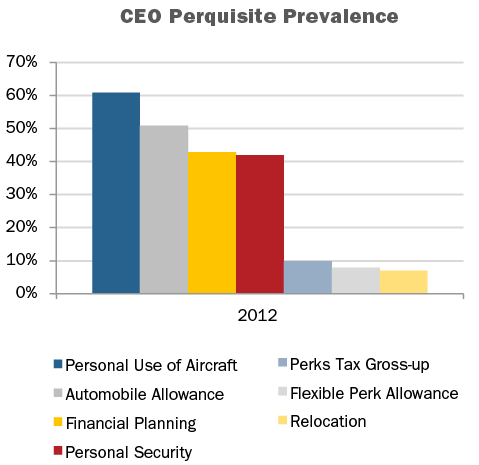
In 2012, companies in our research (91%) provided one or more perquisites to the CEO. Most commonly provided perquisites to the CEO include personal use of aircraft (61%), automobile allowance (51%), financial planning (43%) and personal security (42%).
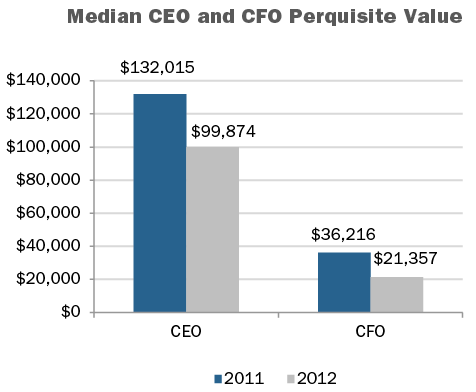
The value of perquisites offered to executives however, has continued to decrease. Median perquisite values disclosed for the CEO and CFO in 2012 were $99,874 and $21,357, respectively. This is a 32% decrease for CEOs and a 70% decrease in value for CFOs in our research. The manufacturing industry had the highest median perquisite values of $319,793 and $69,069 for the CEO and CFO, respectively.
Perquisites tend to be a small proportion of an executive’s total compensation, yet are often highly visible. Shareholders prefer to see pay delivered in performance-based vehicles vs. perquisite programs. Over the past few years, companies have been making changes to these programs in reaction to increased shareholder scrutiny and specific feedback received from shareholders or the likes of ISS or Glass Lewis. In 2012, 9 of 100 companies (9%) disclosed making a change to their perquisite program, a continuation of the trend to reduce perquisites that took hold several years ago.
|
Perquisite Change Reported in 2012 CD&A |
2012 |
2011 |
2010 |
|||
|
No. of Cos. |
% of Cos. n=9 |
No. of Cos. |
% of Cos. n=14 |
No. of Cos. |
% of Cos. n=20 |
|
|
Eliminated tax gross-ups on perquisites |
4 |
44% |
6 |
43% |
8 |
40% |
|
Eliminated perquisite |
2 |
22% |
9 |
64% |
11 |
55% |
|
Reduced perquisite program/value |
1 |
11% |
1 |
7% |
2 |
10% |
|
Changed perquisite program |
1 |
11% |
0 |
0% |
3 |
15% |
Note: Percentages add up to greater than 100% due to multiple responses
Occasionally, a company eliminates a perquisite and offsets some of the lost value or reduction through a salary increase or a one-time payment. An example from 2012 is Lear Corp, which disclosed the following:
“Effective January 1, 2012, we eliminated a separate annual perquisite allowance by adding this amount to the base salary of our Named Executive Officers. However, for purposes of determining incentive awards in 2012 and 2013, which are specified as a multiple of salary, the prior perquisite amount is excluded.”
Importantly, Lear excluded the amount of this increase for purposes of incentives, eliminating the potential to provide an even greater, unintentional increase, in total.
The changes in 2012 include two companies eliminating perquisite allowances, one company approving residential security measures for the CEO and one company reducing the allowance for personal use of aircraft for the CEO and CFO. We expect this trend to sustain as more and more companies are responding to the concerns of their shareholders, which can be voiced through a company’s Say on Pay vote.
Conclusions
With Say on Pay votes held annually for a majority of companies, we continue to see companies stay ahead of the curve and track “best practices” in order to satisfy shareholders and proxy advisory firms. This results in reevaluations of company pay and governance practices, and as our research shows, continued modification of perquisite programs and clawback policies, and adoption of hedging and pledging policies. The goal continues to be closer alignment of executive compensation with shareholder interests. We expect companies and Boards to more proactively monitor proxy advisory firm policies and Dodd-Frank legislation when considering changes to pay programs.
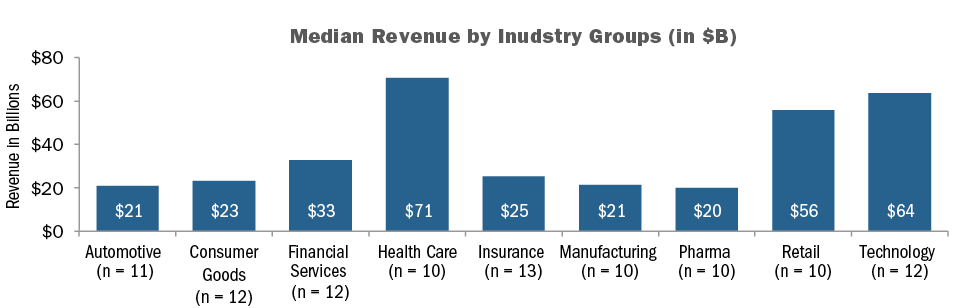
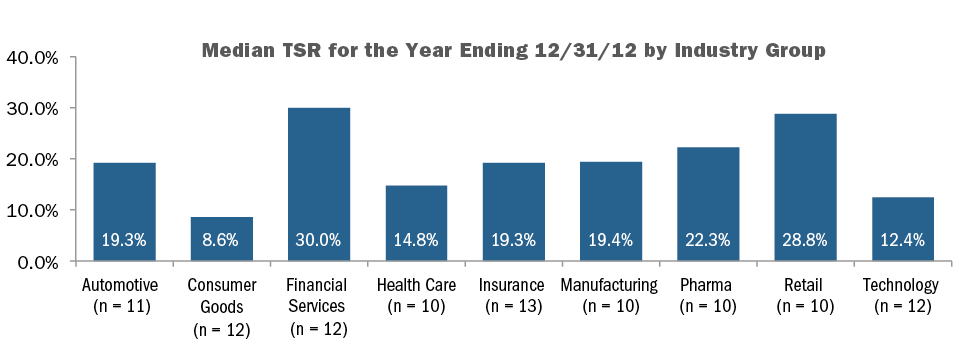
Among the 100 company sample, median revenue was $33B, median market capitalization was $37B and median Total Shareholder Return (TSR) was 19% in 2012. As indicated in the charts below, there is significant variation in company size and performance by industry.
COMPENSATION PHILOSOPHY
Nearly 60% of companies in our study disclose a target total pay position for the Named Executive Officers (“NEOs”). Of these companies, approximately 75% target total pay at median, up from 60% a year ago; indicating that companies are shifting their compensation pay philosophy to a market median standard in reaction to increased scrutiny from shareholders and proxy advisory firms.
|
Target Total Compensation Pay Positioning (n=57) |
CEO |
CFO |
|
Below Median |
1% |
0% |
|
At Median |
74% |
75% |
|
Above Median |
25% |
25% |
CAP Perspective: Change in targeted pay position to median reflects movement to adopt more conservative target pay practices that demonstrate a strong link to performance.
PAY MIX
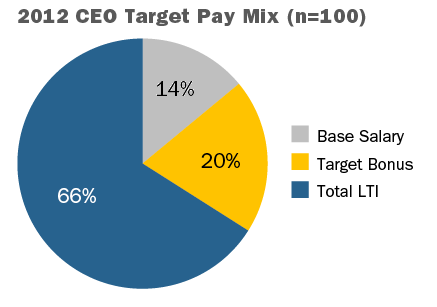
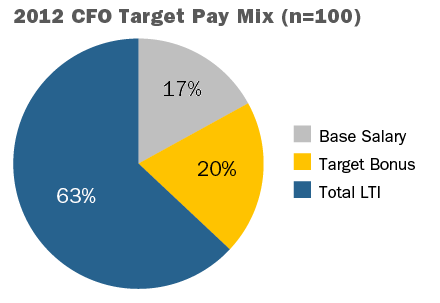
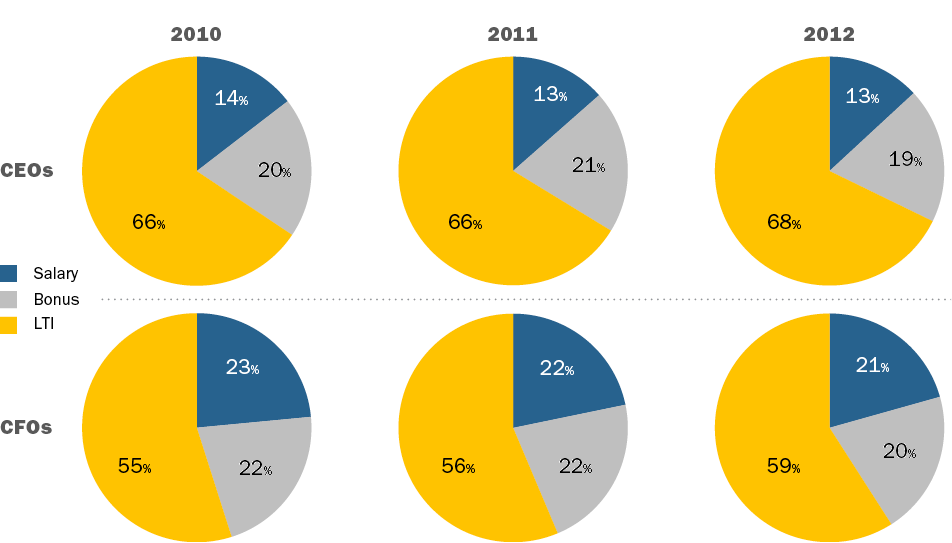
Overall, companies did not make significant shifts in the total pay mix in 2012 vs. 2011. CEO and CFO total pay continues to place significant emphasis on long-term incentives (“LTI”); on average, LTI reflects 66% of pay for CEOs and 63% for CFOs.
CHANGES IN TARGET PAY LEVELS
The chart below shows average year over year change in target pay levels for CEOs and CFOs in our study. 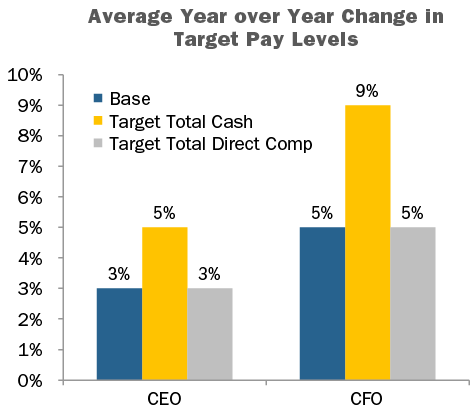
Note: Excludes newly hired/promoted executives and one-time sign-on/retention equity awards. Percentages include zeroes.
CAP Perspective: We see increases in target pay levels in the low single digits, though the most significant increase is in target annual incentive opportunities suggesting that companies are increasing performance-based pay to reinforce the pay-for-performance link.
Base Salary
CEO base salaries in 2012 increased 3%, on average, though only 46% of companies provided salary increases. Base salaries for CFOs increased by 5% though fewer companies provided an increase in 2012 (68%) vs. 2011 (78%) suggesting salary increases were made less frequently for senior executives than other employees.
Executives in the Health Care and Pharmaceutical industries were more likely to receive a salary increase (70% of CEOs in the Health Care industry and 90% of CFOs in the Pharmaceutical industry) than those in other industries. Financial Services, Insurance and Technology industries were less likely to provide a salary increase for the CEO in 2012.
|
Base Salary Action |
CEO |
CFO |
||
|
2012 |
2011 |
2012 |
2011 |
|
|
Increase |
46% |
47% |
68% |
78% |
|
No Change |
52% |
50% |
26% |
20% |
Note: Does not include newly hired CEOs or CFOs. Therefore, percentages do not add up to 100%.
Target Bonus
Target bonus for both the CEO and CFO increased modestly at median levels. At the 75th percentile, the bonus opportunity for CFOs increased by almost 20 percentage points. Target bonuses for CEOs in the Automotive, Consumer Goods and Technology industries increased the most in 2012. CFOs in the Automotive, Retail and Technology industries saw significant increases as well.
|
Summary Statistics |
Target Bonus as a % of Salary |
|||||
|
CEO |
CFO |
|||||
|
2012 |
2011 |
Change in %age Pts. |
2012 |
2011 |
Change in %age Pts. |
|
|
75th Percentile |
200% |
200% |
0% |
143% |
125% |
+18% |
|
Median |
157% |
153% |
+3% |
103% |
100% |
+3% |
|
25th Percentile |
133% |
135% |
-2% |
90% |
85% |
+5% |
Target Total Cash Compensation
Target total cash compensation increased for both the CEO (5%) and CFO (9%) in 2012, mainly due to increases in annual incentive opportunities.
Total Long-term Incentives (LTI)
Increases in total LTI in 2012, on average, were fairly modest; total LTI increased by 3% for CEOs and 5% for CFOs. However, some industries saw significant increases in LTI year over year: CEOs in the Health Care and Consumer Goods industries, on average, received increases in LTI of 30% and 20%, respectively. CFOs in the Technology and Retail industries received the highest increases of 24% and 9%, respectively.
Target Total Compensation
Target total compensation increased over 2011 levels primarily through increases in target annual incentives and, in some industries, through increases in LTI. These findings varied by industry. Financial Services, Pharmaceutical and Retail companies, on average, provided the most significant increases in target annual incentives over other pay components, while Consumer Goods and Health Care industries had the greatest increase in target LTI opportunities.
CONCLUSIONS
Overall, companies had modest increases in target pay levels for the CEO and CFO, through changes in annual and long-term incentives. The Consumer Goods and Health Care industries saw increases in the 15%-20% range driven by higher LTI opportunity while other industries saw more modest changes in total pay levels. Compensation philosophies continue to migrate to median as companies adopt a more conservative pay philosophy. Overall pay mix for the CEO continues to maintain a strong LTI component (66% of pay) with salary representing smaller component of pay (14%), on average. We expect shareholders and proxy advisory firms to continue to influence company pay strategy, as companies to continue to provide modest increases in target total pay mainly through incentive compensation.
|
Industry |
Average Year over Year Change in CEO Target Pay – Top 3 Industries and Overall Sample |
|||
|
Base |
Target Bonus |
LTI |
Target Total Compensation |
|
|
Health Care |
2% |
4% |
30% |
19% |
|
Consumer Goods |
3% |
13% |
20% |
17% |
|
Automotive |
4% |
7% |
7% |
6% |
|
Overall Sample |
3% |
8% |
3% |
3% |
Last year, the study showed an increase in compensation for both CEOs and CFOs, but at much lower levels than the prior year. This leveling off of pay was partially driven by a stabilizing economy and increased confidence in goal setting, leading to less volatility in corporate performance results in incentive plans. To determine if this trend is continuing, we conducted a similar study in 2013 using a sample set of 62 US public companies. The study analyzes executive pay data disclosed by companies with revenues ranging from $1 to $145 billion, with median revenues of $9 billion. Only companies with the same CEO and CFO incumbents from 2010 to 2012 were included in order to focus on year-over-year changes for an individual incumbent. Similar to our methodology in prior years, financial services firms were excluded from the study, as this industry’s compensation practices continue to evolve in the years post the financial crisis.
Our findings, summarized below, indicate that overall, increases in total compensation levels for both CEOs and CFOs slowed in 2011-2012 compared to double-digit pay increases in the 2009-2010 period and mid-single-digit increases in the 2010-2011 period. This dramatic slowdown suggests that the halting economic recovery is having an impact. Percentage pay increases in all three years were higher for CFOs compared to CEOs, driven by slightly higher increases in long-term compensation and smaller decreases in annual bonus. The slower rate of growth in CEO compensation may be driven by the continued focus on CEO pay by shareholders and proxy advisory firms and the increased demand for pay and performance alignment. On an absolute basis, CFO pay continues to be approximately one-third of CEO pay.
Study Results
Salaries
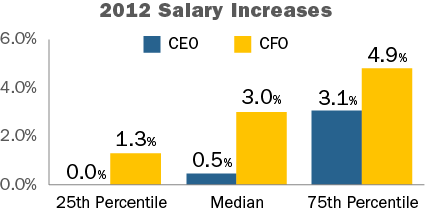
In 2012, approximately 85% of CFOs received salary increases. The median increase was 3.0% and the 75th percentile increase was 4.9%. In comparison, only 53% of CEOs received salary increases and the increases were smaller — 0.5% at median and 3.1% at the 75th percentile. The prevalence of salary increases for CFOs remained similar to last year with about 85% of incumbents receiving a salary increase. Among CEOs, approximately 55% received a salary increase, similar to 2010.
|
Salary Increase Prevalence |
||||||
|
|
2009 – 2010 |
2010 – 2011 |
2011 – 2012 |
|||
|
|
No Increase |
Increase |
No Increase |
Increase |
No Increase |
Increase |
|
CEO |
43.8% |
56.3% |
34.4% |
65.6% |
46.8% |
53.2% |
|
CFO |
25.0% |
75.0% |
12.5% |
87.5% |
14.5% |
85.5% |
Actual Pay Levels
Overall, actual total direct compensation (salary plus actual annual incentive plus the grant date value of long-term incentives) for CEOs and CFOs leveled off in 2011-2012. These lower, single-digit changes in pay levels are consistent with the increased focus on pay for performance we have seen over the last few years. They also likely reflect the slow pace of economic recovery. At the median, salary increases were higher for CFOs than CEOs in 2011-2012. Bonus levels decreased for both CEOs and CFOs and long-term incentives increased modestly (2%) for CFOs and remained flat (0%) for CEOs.
|
Median Percentage Change in Pay Components |
||||||
|
|
2009 – 2010 |
2010 – 2011 |
2011 – 2012 |
|||
|
Pay Components |
CEO |
CFO |
CEO |
CFO |
CEO |
CFO |
|
Salary |
1.0% |
3.7% |
1.8% |
3.5% |
0.5% |
3.0% |
|
Actual Bonus |
19.0% |
22.7% |
0.0% |
3.5% |
-2.8% |
-1.2% |
|
Long-Term Incentives |
10.1% |
14.8% |
10.0% |
10.3% |
0.0% |
2.0% |
|
Actual Total Direct Comp. |
14.4% |
20.0% |
3.6% |
7.5% |
-0.3% |
1.4% |
|
Financial Performance (Median Levels) |
|||
|
Year |
Total Shareholder Return (as of 12/31) |
1-Year Revenue Growth |
1-Year Net Income Growth |
|
2010 |
24% |
10% |
19% |
|
2011 |
5% |
9% |
13% |
|
2012 |
14% |
3% |
2% |
While movement in pay among CFOs and CEOs was directionally aligned, absolute CFO total direct compensation levels, on average, have been approximately 30% of CEO total direct compensation levels over the last three years.
Target Pay Mix
In terms of target compensation levels, the overall pay mix remained largely unchanged from 2010 to 2012, with a greater emphasis on at-risk pay for CEOs than for CFOs.
Long-Term Incentive (LTI) Vehicle Prevalence and Mix
The use of at least two long-term incentive vehicles continues to be the majority practice when awarding LTI to CEOs and CFOs. The role of stock options has remained steady in the overall mix with companies delivering about 30% of LTI using this vehicle. On average, performance-based LTI continues to comprise approximately 50% of LTI for CEOs and CFOs. Data shows that 80% of CFOs and 85% of CEOs received some form of performance-based awards as part of their LTI program in 2012.
|
Number of LTI Vehicles Used in 2012 |
||
|
|
% in Total |
|
|
CEO |
CFO |
|
|
1 |
24% |
17% |
|
2 |
47% |
53% |
|
3 |
27% |
28% |
|
Average |
2 |
2 |
|
LTI Mix |
||||||
|
2010 |
2011 |
2012 |
||||
|
Vehicle |
CEO |
CFO |
CEO |
CFO |
CEO |
CFO |
|
Stock Options |
33% |
30% |
32% |
32% |
30% |
32% |
|
Time Vested Restricted Stock |
20% |
23% |
17% |
22% |
16% |
20% |
|
Perf. Based LTI |
48% |
47% |
51% |
46% |
53% |
48% |
Conclusion
As companies and Boards focus on the alignment between pay and performance, and the economic recovery continues at a slow pace, it is not surprising that pay increases have slowed over the last 3 years. The rates of increases continue to be for higher CFOs compared to CEOs; however, the increases for both have slowed dramatically in 2011-2012. We expect future changes in compensation for these positions to continue to be closely linked to overall company performance, as well stock price performance, since the majority of pay for CEOs and CFOs is delivered through long-term incentives.
For the 114 company sample, median revenue was $30B, median market capitalization was $29B and median Total Shareholder Return (TSR) was 3% for 2011.
What We Found
With the majority of companies in our sample holding annual Say-on-Pay votes, we are seeing companies review various aspects of their pay programs/practices more frequently and make incremental changes. Given the intense pressure from shareholders and proxy advisory firms, companies and their Compensation Committees and outside consultants are annually re-evaluating pay programs. Companies need to stay ahead of the curve and track emerging “best practices” in order to satisfy shareholders. In line with our findings last year, we are continuing to see comprehensive risk assessments, modification of clawback policies and elimination of perquisites and supplemental retirement benefits.
Compensation Risk Disclosure
Of the 114 companies in our study, 113, or 99% made some type of affirmative disclosure on risk assessment in the most recent proxy. This is up from 95% of companies in our 2010 analysis. This affirmative disclosure responds to shareholders who want to be assured that compensation programs are not encouraging risky behavior. Similar to 2010, none of the companies disclosed that their incentive programs create material adverse risks.
Most companies make their risk-related disclosure in the CD&A of the proxy statement, with the corporate governance section of the proxy statement ranking as the second most common place to provide risk disclosure. The table below summarizes where risk disclosures were made:
|
|
2011 |
2010 |
||
|
Section of the Proxy Statement |
No. of Cos. |
% of Cos. n=113 |
No. of Cos. |
% of Cos. n=105 |
|
CD&A |
45 |
40% |
49 |
47% |
|
Corporate Governance Section (Section 407) |
31 |
27% |
25 |
24% |
|
CD&A and Corporate Governance Section (Section 407) |
19 |
17% |
14 |
13% |
|
Separate Stand Alone Section |
13 |
12% |
11 |
10% |
|
CD&A and Compensation Committee Report |
4 |
3% |
4 |
4% |
|
Compensation Committee Report |
1 |
1% |
2 |
2% |
Responsibility for completing the risk assessment process varies by company. Of the companies disclosing a risk assessment, 40 companies (35%) reported that management and the Compensation Committee worked together to conduct the assessment, while 25 companies (23%) reported that the Compensation Committee worked alone to conduct the assessment. This year 96% of companies disclosed who conducted the risk assessment. The table below provides further detail on which groups were involved in the compensation risk review.
|
|
2011 |
2010 |
||
|
Approach to Compensation Risk Reviews |
No. of Cos. |
% of Cos. n=113 |
No. of Cos. |
% of Cos. n=105 |
|
Management and Compensation Committee |
40 |
35% |
35 |
33% |
|
Compensation Committee |
25 |
23% |
17 |
16% |
|
Compensation Committee and Consultant |
17 |
15% |
15 |
14% |
|
Management, Compensation Committee and Consultant |
15 |
13% |
12 |
11% |
|
Management |
8 |
7% |
13 |
12% |
|
Not Disclosed |
5 |
4% |
5 |
5% |
|
Management & Consultant |
3 |
3% |
8 |
8% |
Clawbacks
While the SEC initially planned to implement rules for recouping executive compensation during the first half of 2012, their proposed schedule has been eliminated and no new timetable has been set. Even with no SEC timetable, companies continue to be proactive in adopting clawback policies that go beyond Section 304 of Sarbanes-Oxley, which applies to CEOs and CFOs and the top 25 executives at companies under TARP. Further, while most companies were waiting for final rules, before changing their programs, we are seeing many companies make changes now to respond to the intensifying executive compensation environment.
A significant majority of our research companies – 98 of 114 (86%) – have some form of clawback provision, compared to 80% in 2010. In 2011, 16 of the 98 companies adopted a new clawback policy or amended their existing one: 8 companies adopted a new policy and the other 8 modified existing provisions.
As was the case in 2009 and 2010, a financial restatement is required to trigger a clawback in nearly all cases (84 companies or 86% of those with a clawback, compared to 83% in 2010). Further, 78 companies (80% of those with a clawback, compared to 74% in 2010) disclosed that misconduct is a triggering event and 49 companies (50% of those with a clawback, compared to 51% in 2010) disclosed fraud as a trigger.
It is most common for companies with a clawback policy to include the ability to clawback or recoup compensation previously granted. While it is not currently prevalent for companies to adjust future incentive compensation, this may change based on final rules by the SEC.
|
2011 |
2010 |
|||
|
Compensation Subject to Clawback |
No. of Cos. |
% of Cos. n=98 |
No. of Cos. |
% of Cos. n=89 |
|
Prior LTI |
95 |
97% |
79 |
89% |
|
Prior Annual Incentive |
92 |
94% |
81 |
91% |
|
Adjust Future Annual Incentive |
16 |
16% |
20 |
22% |
|
Adjust Future LTI |
15 |
15% |
14 |
16% |
Note: Percentages add up to greater than 100% due to multiple responses.
Clawback policies cover proxy named executive officers (“NEOs”) in 92% of companies, similar to our findings in 2010, with company’s typically defining coverage as, “executive officers, officers, senior executives or senior management.” The other 8% of companies do not define specific coverage. It is not, however, required to disclose this level of program detail in the proxy, and at many companies the use of clawbacks is broad-based.
Similar to our findings for 2010, a minority of companies (22 companies or 22%) indicate the time period which compensation can be recovered after a financial restatement. Of the 22 companies that disclosed a time frame, the most common is 1 year (41% of companies) from the date of restatement and the range is 1-3 years. Interestingly, some companies are also disclosing different time periods for annual incentives and long-term incentives.
The most comprehensive clawback policies seen in our research apply to executives in financial services companies. Large banks now typically have provisions that extend well beyond those required by SOX or suggested in Dodd-Frank. These detailed programs are likely due to the regulators involvement in the compensation design process, as a result of the financial crisis and TARP. Many of the large banks have multiple programs that can impact different employee populations or pay elements for varying reasons (i.e. financial restatement, fraud, misconduct, inattention to risk, inaccurate performance measurement or unacceptable performance). Morgan Stanley’s policy serves as an example of a comprehensive policy:
Morgan Stanley: “The clawback can be triggered if an individual’s act or omission causes a restatement of the Company’s consolidated financial results or constitutes a violation of the Company’s risk policies and standards, whether such action results in a favorable or unfavorable impact to the Company’s financial results. PSUs are subject to clawback following payment if the Committee determines that the payout was based on materially inaccurate financial statements or other performance metric criteria. Deferred-cash based awards are subject to clawback if an individual’s act or omission causes, or is reasonable expected to cause, a substantial financial loss on trading strategy, investment, commitment or holding in either the current year or any prior year.”
We believe most companies are waiting for the SEC to adopt final rules before changing their clawback provisions. But in light of the SEC’s delayed schedule and the attention of shareholders and the media on this topic, companies will continue to modify their programs to respond to current conditions. Currently, the proposed rules apply to both current and former executives and cover all incentive compensation within 3 years of a financial restatement, regardless of whether intentional misconduct exists.
Perquisites
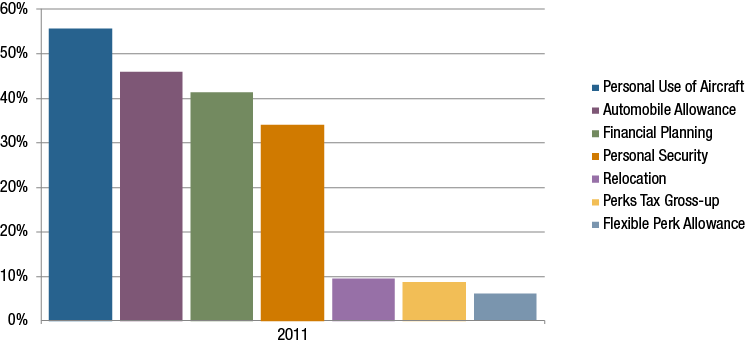
Notwithstanding the trend of decreasing executive perquisites, nearly all companies in our research provide some perquisites to CEOs that extend beyond the benefits provided to the broad employee population. Typical perquisites provided to the CEO include personal use of aircraft (54%), automobile allowance (46%), financial planning (41%) and personal security (35%).
While select perquisites are still somewhat prevalent for CEOs, the trend of reducing executive perks has continued in 2011. It is not surprising that as shareholders express concerns through annual Say-on-Pay votes, one area where companies are responding is by reducing perquisite programs in favor of more performance-based pay. Perquisites are often fairly low in total costs, but high in visibility and sensitivity. In 2011, 14 of 114 companies (12%) disclosed making a change to perquisite programs. Similar to 2009 and 2010, the most prevalent change was the elimination of certain perquisites.
|
|
2011 |
2010 |
||
|
Type of Change Reported in 2011 CD&A |
No. of Cos. |
% of Cos. n=14 |
No. of Cos. |
% of Cos. n=20 |
|
Eliminated perquisites |
9 |
64% |
11 |
55% |
|
Eliminated tax gross-ups on perquisites |
6 |
43% |
8 |
40% |
|
Reduced perquisites |
1 |
7% |
2 |
10% |
|
Changed perquisites |
0 |
0% |
3 |
15% |
Note: Percentages add up to greater than 100% due to multiple responses.
Among companies eliminating perquisites, the most common (in 4 of 9 companies) involved eliminating personal travel on the corporate aircraft or use of company automobile/automobile allowance. 2 of 9 (22%) eliminated home security benefits. Further, of the 9 companies that eliminated perquisites, 3 made up for the lost value in either annual base salary going forward or a one-time payment to cover the loss of the benefit.
Executive Retirement Benefits
16 of 114 companies (14%) disclosed making some type of change to executive retirement plans/benefits in 2011, a slight decrease from 2010 where 17% of companies disclosed a change. As was the case in 2010, t