In November 2015, Vivient Consulting and WorldatWork invited a sample of WorldatWork’s non-publicly traded members to participate in their “Incentive Pay Practices: Nonprofit, Government Organizations” compensation survey. More than 125 nonprofit and government organizations representing state, local and federal government entities, charitable and education organizations participated in the survey. This compensation survey updates the original survey completed by Vivient and WorldatWork in 2013.
The new 2016 compensation survey research shows that short-term cash incentives and bonus programs continue to dominate the incentive-pay landscape as a vast majority of organizations use and rely on incentive-based pay practices to recruit, motivate and reward employees.
Vivient’s Bonnie Schindler reports: “Nonprofits and government organizations report their annual incentive plans are more effective than their for-profit counterparts — a sign that incentives are leveling the playing field for all organizations competing for top talent.”
Key Findings from the 2016 Compensation Survey for Nonprofits and Government Organizations
- In 2015, more than 75% of nonprofit and government organizations favored simplicity by offering three or fewer short-term incentive plans.
- While government incentive-pay budgets remain modest, nonprofit budgets have increased significantly. Nonprofit, short-term incentive budgets are starting to approach the levels reported by the private, for-profit organizations.
- More than 80% of nonprofit and government organizations said their AIPs were effective at achieving their objectives.
- Of the nonprofit/government organizations with AIPs in place, 65% reported the programs are used to reward employees while 62% use the incentives to focus employees on specific organizational goals.
In November 2015, Vivient Consulting and WorldatWork invited a sample of WorldatWork’s non-publicly traded members to participate in their second “Incentive Pay Practices: Privately Held Companies” compensation survey. Approximately 200 private, for-profit companies responded to the survey, representing manufacturing, consulting, professional, scientific and technical services, finance and insurance, media, software and retail trades. This compensation survey updates the original survey completed by Vivient and WorldatWork in 2013.
The new 2016 compensation survey research shows that short-term cash incentives and bonus programs continue to dominate the incentive-pay landscape as a vast majority of organizations use and rely on incentive-based pay practices to recruit, motivate and reward employees.
Vivient’s Bonnie Schindler reports: “While cash continues to dominate long-term incentives at private companies, we are seeing an uptick in the use of real equity in the form of stock options.”
Key Findings from the 2016 Compensation Survey for Private, For-Profit Organizations
- Between 2013 and 2015, the prevalence of short- and long-term incentive programs remained steady at private companies. Short-term incentives decreased slightly to 94% from 97%, while long-term incentives also decreased slightly to 53% from 56%.
- In 2015, almost 75% of privately held companies with a short-term incentive plan offered at least three programs.
- Annual Incentive Plans (AIPs), the most prevalent short-term incentive plan at private companies, are offered to employees at the exempt, salaried level and above at most organizations.
- At the 75th percentile, the majority of private companies increased their short-term incentive budgets to 12% of operating profit in 2015. They forecast an increase to 14% of operating profit for 2016.
HIGHLIGHTS
- Most large public companies have maintained consistent approaches to delivering annual incentives to their executive leadership teams.
- We frequently see minor adjustments to annual incentive plan designs — most often modifying performance measures – rather than wholesale change.
- Most companies use multiple measures to ensure the annual incentive plan provides balance and aligns with overall business strategy.
- Median CEO annual target bonuses increased 10 percentage points to 170% of salary in 2014.
- In contrast, CFO annual target bonuses remained the same at 100% of salary.
- Overall, 2014 annual incentive payouts were slightly lower than in 2013.
CHANGES IN ANNUAL INCENTIVE PLAN DESIGN
32% of companies in CAP’s database changed their annual incentive plan design in 2014 or 2015. The most common changes were modifications to the performance metrics used to fund awards and increases to the target award opportunities offered to the CEO or CFO. Another common change was to adjust the weightings/mix applicable to performance metrics. These changes, as well as other modifications shown in the chart below, illustrate that companies continue to review and enhance the pay-for-performance relationship through changes to the annual incentive program.
|
Type of Change Reported in CD&A |
2014 No. of Cos. |
% of Cos. Reporting Changes |
||
|
2014 (n = 32) |
2013 (n = 34) |
2012 (n = 37) |
||
|
Change in performance metrics used to fund awards |
16 |
50% |
47% |
43% |
|
Increased/Reduced target award opportunities (CEO and/or CFO) |
12 |
38% |
32% |
11% |
|
Change in performance metric weighting/mix |
5 |
16% |
32% |
35% |
|
Change in maximum award payout |
4 |
13% |
9% |
8% |
|
Other changes |
3 |
9% |
12% |
22% |
Note: Due to multiple changes, does not add up to 100%.
Modifications to Performance Metrics
Among the companies that changed the performance metrics used for annual incentives, the most common approaches were to either maintain the same number of metrics or reduce the number of metrics. This avoids adding complexity to annual incentive while allowing for better alignment of pay with performance:
- Six (6) companies kept the total number of metrics the same, but replaced a metric;
- Six (6) companies reduced the number of metrics; and
- Four (4) companies added metrics to the current plan.
Changes made by many companies were done so to better align incentives with their business strategy:
- Bristol-Myers Squibb: Added a new pipeline metric as a measure to highlight the importance of pipeline delivery to the near-term and long-term success of the company.
- Intel: Moved from a single set of company-wide operational goals to business-unit-specific operational goals – significantly reducing the number of performance goals, in order to drive a sharper focus on key strategic initiatives, increase visibility into those initiatives, and enhance accountability.
- Verizon Communications: Consistent with Verizon’s strategic plan, adjusted the weightings of the financial measures from 2013 to place a greater emphasis on free cash flow, given the importance of cash generation and debt reduction following the acquisition of sole ownership of Verizon Wireless. In addition, a sustainability measure was introduced, reflecting Verizon’s commitment to reducing the environmental impact of its operations.
Increases in Target Bonus Opportunity
CAP’s database tracks the size of target annual bonus awards for both CEOs and CFOs. When we looked across all industries in 2014, we found that the median target bonus opportunity increased for CEOs by 10 percentage points to 170% of salary. By industry, the largest increase we saw was in Automotive, where CEO target bonus awards increased by 15 percentage points. Significantly, none of our industry groups registered a decline in CEO target annual bonuses, although Financial Services do not typically define target bonuses.
When we looked across all industries at CFO target bonus opportunities, we saw no change year-over-year. The median target bonus for CFOs remained the same at 100% of salary. By industry, Technology CFOs saw the greatest increase (25 percentage points). Across other industries, median target CEO/CFO bonus increases were generally between 0 and 10 percentage points. Similar to the CEO data, no industry group saw a decline in CFO annual bonus targets.
|
Industry |
Median Target Bonus as a % of Salary |
|||
|
CEO |
CFO |
|||
|
2014 |
2013 |
2014 |
2013 |
|
|
Automotive |
150% |
135% |
95% |
85% |
|
Consumer Goods |
165% |
160% |
100% |
93% |
|
Financial Services |
n/m |
n/m |
n/m |
n/m |
|
Health Care |
150% |
150% |
100% |
100% |
|
Insurance |
210% |
200% |
125% |
120% |
|
Manufacturing |
153% |
147% |
90% |
88% |
|
Pharmaceutical |
150% |
150% |
100% |
98% |
|
Retail |
200% |
200% |
125% |
125% |
|
Technology |
220% |
210% |
150% |
125% |
|
Total Sample |
170% |
160% |
100% |
100% |
Note: Companies among all industries that did not disclose target bonus opportunities were excluded from both the 2013 and 2014 target bonus analysis. Financial Services industry is excluded since most companies in our study do not disclose target bonus opportunities for the Named Executive Officers.
ANNUAL INCENTIVE PLAN DESIGN PRACTICES
Award Leverage
CAP reviewed proxy disclosure to understand how companies are establishing the payout range (i.e., the threshold payout and the maximum payout expressed as a percentage of the target payout) for annual incentives. Most companies that we reviewed identify the minimum payout as zero and do not separately disclose a threshold level of performance. For the 37 companies that did disclose a threshold bonus payout, a payout of 50% of target is the most common percentage. Twenty companies, however, disclose a minimum bonus payout of less than 50% of target which scales down to 25% or lower.
Approximately 75% of companies disclose the maximum bonus opportunity. A majority of companies in our sample (60%) have a maximum bonus opportunity of 200% of target bonus. Ten (10) companies have a maximum bonus of 250% of target or higher. Most of these companies are in the Consumer Goods, Pharmaceutical, and Technology industries.
|
Threshold Payout as a % of Target (n = 37) |
||
|
Range |
# of Cos. |
% of Cos. |
|
< 25% |
10 |
27% |
|
> 25% < 50% |
10 |
27% |
|
50% |
13 |
35% |
|
> 75% < 100% |
4 |
11% |
|
Maximum Payout as a % of Target (n = 73) |
||
|
Range |
# of Cos. |
% of Cos. |
|
> 125% < 150% |
2 |
3% |
|
> 150% < 200% |
14 |
19% |
|
200% |
44 |
60% |
|
> 200% < 250% |
3 |
4% |
|
> 250% |
10 |
14% |
Annual Incentive Plan Metrics
EPS, Revenue, Cash Flow and Operating Income are the most common metrics used in annual incentive plans. Similar to last year, our findings suggest that EPS is used more broadly across industries while Revenue tends to be used in consumer-driven industries.
Most companies use multiple performance metrics in the annual incentive plan. 33% of companies disclose using two (2) metrics, 31% use three (3) metrics, and 16% use four (4) or more metrics.
The use of multiple performance metrics allows for annual incentive payouts to be tied more closely to overall company performance. For example, companies using bottom-line measures in the annual incentive plan will often also include top-line measures for balance. Among CAP’s sample, 36% of “multiple-metric” companies that use a measure of profit (EPS, Operating Income, etc.) also use Revenue.
In addition to financial measures, approximately 15% of companies disclose using non-financial measures in their annual incentive plans such as talent, culture, and diversity initiatives. 55% of companies disclose that individual performance considerations impact annual incentive payouts.
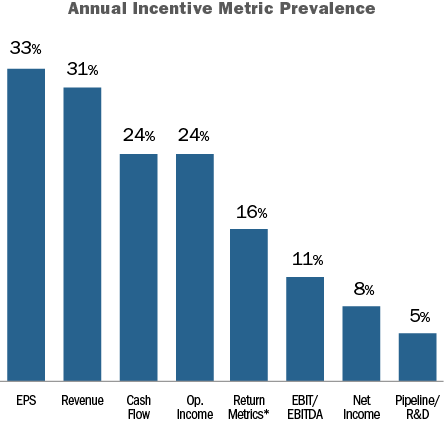
*Return metrics include: ROE, ROA, and ROI/ROIC.
The chart below shows the three (3) most common metrics by industry in 2014:
|
Industry |
Metric #1 |
Metric #2 |
Metric #3 |
|
Automotive |
Cash Flow (45%) |
EBIT (45%) |
ROA (27%) |
|
Consumer Goods |
Revenue (67%) |
EPS (58%) |
Cash Flow (33%) |
|
Financial Services |
EPS (33%) |
ROE (17%) |
Op. Income (8%) |
|
Health Care |
EPS (40%) |
Op. Income (30%) |
EBIT (30%) |
|
Insurance |
Op. Income (46%) |
Op. ROE (23%) |
Op. EPS (15%) |
|
Manufacturing |
Cash Flow (30%) |
EPS (30%) |
Revenue (20%) |
|
Pharmaceuticals |
Revenue (70%) |
EPS (70%) |
Pipeline/R&D (50%) |
|
Retail |
Revenue (40%) |
Op. Income (40%) |
EBIT (30%) |
|
Technology |
Revenue (58%) |
Cash Flow (50%) |
Op. Income (33%) |
Note: Percentages reflect the prevalence of companies disclosing the metric.
2014 Actual Bonus Payouts
Nearly all companies (94%) awarded bonuses to their CEO for 2014 performance. Three companies did not pay a bonus to the CEO as a result of company performance: Coca-Cola, McDonalds, and Target.
Overall, the median CEO bonus payout was 114% of target (or 225% of salary, at median). Across industries, bonuses for Pharmaceutical CEOs exceeded target by the greatest amount (146% of target, at median). 3 of the 9 industries CAP surveyed had a median bonus payout of less than 100%: Retail (82%), Consumer Goods (92%), and Technology (95%).
|
Industry |
Bonus Payout at a Percent of Target |
|||||
|
75th Percentile |
Median |
25th Percentile |
||||
|
2014 |
2013 |
2014 |
2013 |
2014 |
2013 |
|
|
Automotive |
146% |
183% |
122% |
165% |
103% |
120% |
|
Consumer Goods |
148% |
133% |
92% |
112% |
33% |
70% |
|
Financial Services |
124% |
142% |
112% |
126% |
97% |
102% |
|
Health Care |
149% |
149% |
124% |
127% |
108% |
116% |
|
Insurance |
139% |
170% |
132% |
150% |
110% |
123% |
|
Manufacturing |
155% |
119% |
115% |
111% |
98% |
98% |
|
Pharmaceutical |
173% |
158% |
146% |
138% |
118% |
122% |
|
Retail |
100% |
119% |
82% |
78% |
75% |
68% |
|
Technology |
127% |
121% |
95% |
88% |
86% |
69% |
|
Total Sample |
145% |
150% |
114% |
122% |
95% |
95% |
Note: Most companies in the Financial Services industry do not disclose a target bonus for the CEO. For these companies, 3-year average actual bonus was used as a proxy for target bonus.
Conclusion
In our experience, most companies strive to achieve the following with regard to annual incentive plan design:
- Alignment with the company’s business plan
- A balanced portfolio of performance metrics
- An appropriate mix of corporate versus business unit / strategic performance considerations
- The proper amount of structured discretion and/or individual performance
These objectives can be achieved by continuing to assess plan design in relation to strategy and making minor modifications, such as changes to performance metrics and their weightings, as necessary. Short of a major economic shift or regulatory change, we expect to see only modest changes to annual incentive plan designs.
- Perquisites represent only a small portion of the total pay program for a CEO or CFO. However, perquisite based pay is – and we expect will continue to be – highly scrutinized
- In 2014 83% of companies provided perquisites to their CEO, and 81% of companies provided perquisites to their CFO
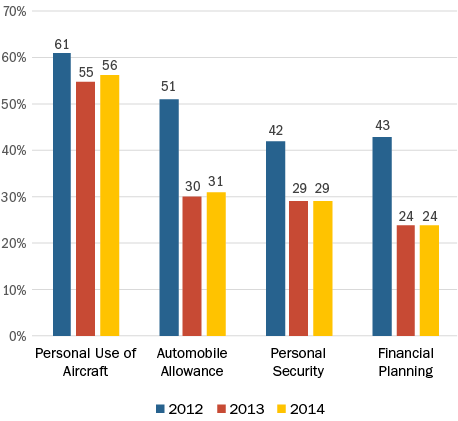
- The four most common CEO/CFO perquisites in 2014 were: personal use of corporate aircraft, auto allowance, personal security and financial planning
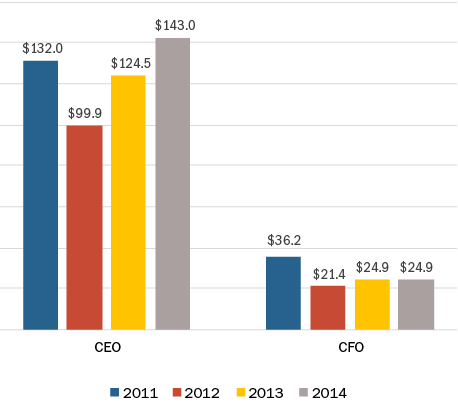
- The median value of total perquisites provided to CEOs increased by approximately 15% to $143,000 in 2014, and was flat at approximately $25,000 for CFOs
Our Survey Sample
Compensation Advisory Partners (“CAP”) reviewed 2015 proxy disclosures at a sample of 100 companies among the Fortune 500, representing nine industry groups. Industry groups included: Automotive, Consumer Goods, Financial Services, Health Care, Insurance, Manufacturing, Pharmaceutical, Retail, and Technology. For the companies studied, the median revenue size and market capitalization was $34 billion and $56 billion respectively.
What We Found
The percentage of companies in our research sample providing perquisites to their CEO stayed constant at 83% from 2013 to 2014. The percentage of companies providing perquisites to CFOs increased 5% from 2013 to 2014 to 81%.
In 2014, the four most common CEO perquisites were: personal use of corporate aircraft (56%), automobile allowance (31%), personal security (29%) and financial planning (24%). While the prevalence of personal use of corporate aircraft was generally flat from 2012 to 2014, the prevalence of automobile allowances, personal security and financial planning decreased sharply (approximately 30– 40%) over the past two years.
CEO Perquisite Prevalence
Although the prevalence of major perquisites remained steady in 2014 for CEOs compared to the prior year, the median total value for CEO perquisites increased 15% to $143,000. This value has ranged from $100,000 to $143,000 over the last four years. In contrast, the median value of perquisites for CFOs was relatively flat year-over-year, and has ranged from $21,000 to $36,000 since 2011.
Median CEO and CFO Perquisites Value ($000s)
Perquisites represent only a small portion of an executive’s total compensation, yet are often highly scrutinized. Shareholders prefer that pay be delivered in performance-based vehicles instead of through perquisites. Over the past few years, a number of companies changed their perquisite programs in reaction to increased shareholder scrutiny and specific feedback received from shareholders or proxy advisory firms. However, given fairly consistent prevalence over the past 2 years, data suggests that changes to company perquisite programs may have leveled off. PNC was the only company making a change to a perquisite program in our sample for 2014, increasing their annual perquisite limit from $10,000 to $20,000 for each NEO, other than for the CEO.
|
Perquisites Change Reported in CD&A |
2014 n=1 |
2013 n=7 |
2012 n=9 |
2011 n=14 |
||||
|
# of Cos. |
# of Cos. |
# of Cos. |
# of Cos. |
# of Cos. |
# of Cos. |
# of Cos. |
# of Cos. |
|
|
Eliminated perquisites |
0 |
0% |
6 |
75% |
2 |
22% |
9 |
56% |
|
Eliminated tax gross-ups on perquisites |
0 |
0% |
1 |
13% |
4 |
44% |
6 |
38% |
|
Reduced perquisite program/value |
0 |
0% |
1 |
13% |
2 |
22% |
1 |
6% |
|
Changed perquisite program |
1 |
100% |
0 |
0% |
1 |
11% |
0 |
0% |
Note: Percentages do not add up to 100% due to multiple changes by companies
Conclusion
While Compensation Committees continue to monitor the appropriateness (and competitiveness) of perquisite programs, as well as dollar values and overall executive usage, the degree to which executive perquisites are provided appears to have leveled off. We expect that companies will continue to closely align executive compensation with shareholder interests by limiting non-performance-based compensation, such as perquisites. We caution that any potential (perceived) misuse of executive perquisites will continue to raise the ire of shareholders and proxy advisory firms and provide for headline news.
Introduction
CAP set out to see if CEO pay levels among Wall Street Banks have returned to pre-crisis levels (i.e., 2007). In addition, we reviewed other financial sector firms1 to see how CEO pay levels have moved over the same time period. Hedge funds and private equity firms were not included in the review.
For reference, comparisons were also made to large non-bank companies across other industries ("Fortune 30"). In total, 65 companies were examined.
CEO Compensation – Highlights
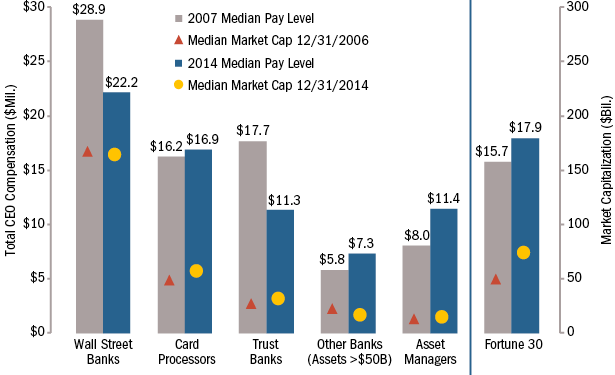
- Wall Street CEO pay continues to exceed all other financial services companies studied; however, the gap between Wall Street Banks and other companies studied has narrowed significantly since 2007
- Pay levels for most Wall Street and Trust Bank CEOs have not returned to pre-crisis levels
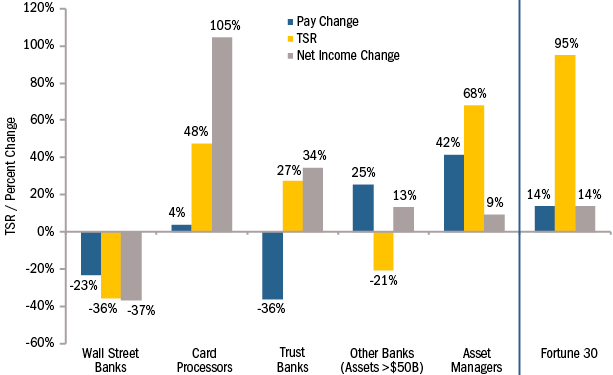
- CEO pay among Asset Managers had the most significant increase, with median pay increasing 42% since 2007
- Regional Bank (assets >$50 billion) and Card Processor CEO pay exceeds pre-crisis levels
- From 2007 to 2014, changes in pay levels did not directly align with changes in stock price or Total Shareholder Return2 (“TSR”), with two exceptions. Asset Managers with strong stock appreciation also received significant growth in pay. Wall Street banks with decreases in stock price reported lower pay levels.
Current Pay Levels
As shown in Chart 1, CEO compensation at Wall Street Banks remains higher than other companies studied, however the differential has decreased since 2007. Wall Street Banks are also significantly larger than most of the other companies studied, in terms of market capitalization and net income.
Chart 1: Pay Levels vs. Company Size
Change in Compensation Since 2007
Have financial services companies returned to pre-crisis pay levels?
|
No |
|
|
Yes |
|
Chart 2: Pay vs. Performance
Conclusion
By 2014, most of the groups of companies studied have recovered from the financial crisis, as evidenced by increases in net income and TSR versus their 2007 results (Chart 2). It appears that companies have used restraint in making corresponding increases to CEO pay, recognizing that (1) shareholders sustained significant losses during the crisis, (2) material increases in pay should follow improved results for shareholders, and (3) public and regulatory scrutiny on financial company pay practices has been unrelenting.
As we look ahead, for both financial and non-financial firms, we expect continued sensitivity to executive pay levels, especially CEO pay levels. While companies have recouped losses from 2007, there will be ongoing pressure to demonstrate that CEO pay is aligned with performance, in terms of financial success and shareholder returns.
Appendix – Methodology
|
Item |
Definition |
|
Total Compensation |
Represents compensation as reported in Summary Compensation Table, excluding change in pension value and/or above market interest on non-qualified deferred compensation. For 2007 compensation, equity award values were taken from the Grants of Plan-Based Awards Table to consistently reflect the fair market value of equity awards granted in the year reviewed. |
|
Median |
Median was calculated for data sets with 5 or more companies. For data sets with less than 5 companies, average was used. |
|
Data Set |
Description |
|
Fortune 30 |
Includes the largest companies based on 2013 revenues, excluding any financial services companies, controlled companies, companies that were not public in 2007, or any companies that did not file a proxy statement between 9/1/2014 and 5/15/2015. AmerisourceBergen, Archer-Daniels-Midland, AT&T, Boeing, Cardinal Health, Chevron, Costco, CVS Health, Express Scripts, Exxon Mobil, Ford Motor, General Electric, General Motors, Hewlett-Packard, IBM, Kroger, Valero, Verizon, and Wal-Mart |
|
Wall Street Banks |
Bank of America, Citigroup, Goldman Sachs, JPMorgan Chase, and Morgan Stanley |
|
Card Processors |
American Express, Capital One, and Discover Financial |
|
Trust Banks |
BNY Mellon, Northern Trust, and State Street |
|
Other Banks |
All banks with assets greater than $50B, not listed above. BB&T, Comerica, Fifth Third, Huntington Bancshares, KeyCorp, M&T Bank, PNC, Regions Financial, SunTrust, U.S. Bancorp, Wells Fargo, and Zions |
|
Asset Managers |
10 largest Asset Managers by market capitalization on 12/31/2014. Affiliated Managers Group, BlackRock, Charles Schwab, Eaton Vance, Federated Investors, Franklin Resources, Invesco, Legg Mason, SEI Investments, T. Rowe Price (excludes Blackstone) |
1 Card Processors (that are also Bank Holding Companies), Trust Banks, Other Banks (with assets >$50B), and Asset Managers. For a complete list of companies in each category, see Appendix.
2 Stock price plus reinvested dividends.
Annually, Compensation Advisory Partners (CAP) evaluates pay levels for Chief Financial Officers (CFOs) and Chief Executive Officers (CEOs). This year’s analysis is based on a sample of 108 companies with median revenues of $12.4 billion. For more information on how we developed the sample of companies, please see below under Sample Screening Methodology.
Highlights
- Salary increases were provided much more frequently to CFOs, with approximately 70% receiving a salary increase, than to CEOs
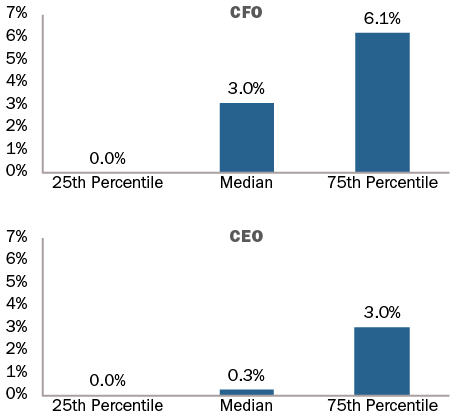
- The median salary increase was only 0.3% for CEOs, while CFO salaries grew by 3.0%
- Similar to last year, the median increases in actual total direct compensation (i.e., cash plus equity) for both CEOs and CFOs, were in the low single-digits
- 2014 median increases in actual total direct compensation were 3.2% for CEOs and 5.2% for CFOs
- Slightly higher pay growth for CFOs was partially driven by higher annual bonus target opportunities in 2014
- On an absolute basis, CFO total compensation continues to approximate one-third of CEO total compensation
- Little or no changes observed in how long-term incentives are delivered to CEOs and CFOs; Long-term incentive mix continues to emphasize performance-based equity
Study Results
Salaries
In the last 2 years, approximately 70% of CFOs received salary increases. The median salary increase for CFOs was 3.0% and the 75th percentile salary increase was 6.1%. In comparison, only about half of CEOs received salary increases. The median salary increase for CEOs was only 0.3% at median and the 75th percentile salary increase was 3.0%.
|
% of Executives Receiving Salary Increases |
||||
|
|
2012 – 2013 |
2013 – 2014 |
||
|
|
No Increase |
Receiving Increase |
No Increase |
Receiving Increase |
|
CEO |
52% |
48% |
49% |
51% |
|
CFO |
31% |
69% |
28% |
72% |
2014 Salary Increases
Actual Pay Levels
Our findings indicate a median rate of increase in actual total direct compensation levels for both CEOs and CFOs in the low-single digits. The median increases over the last two years ranged between 3% and 5%. During 2013-2014, actual total direct compensation (salary plus actual annual incentive plus the grant date value of long-term incentives) for CEOs and CFOs increased by 3.2% and 5.2%, respectively.
Industry Trends
2014 Median Salary Increase by Industry
2014 Median Actual Total Compensation Increase by Industry
|
Median Percentage Change in Pay Components |
||||
|
|
2012 – 2013 |
2013 – 2014 |
||
|
Pay Components |
CEO |
CFO |
CEO |
CFO |
|
Salary |
0% |
3.0% |
0.3% |
3.0% |
|
Actual Bonus |
4.1% |
3.7% |
4.3% |
7.8% |
|
Long-Term Incentives |
2.3% |
3.1% |
3.7% |
4.2% |
|
Actual Total Direct Compensation |
3.7% |
3.6% |
3.2% |
5.2% |
As seen in the table above, the median 2014 increase in actual bonus for CFOs was double the median increase for CEOs. This large increase in annual bonus is partially driven by higher bonus target opportunities in 2014 for CFOs, with the median target bonus increasing from 90% to 100% of salary. In contrast, CEO target bonus opportunities remained relatively flat at approximately 150% of salary.
|
Target Bonus as % of Salary |
||||
|
|
2013 |
2014 |
||
|
Pay Components |
CEO |
CFO |
CEO |
CFO |
|
25th Percentile |
125% |
75% |
125% |
80% |
|
Median |
147% |
90% |
150% |
100% |
|
75th Percentile |
170% |
100% |
165% |
105% |
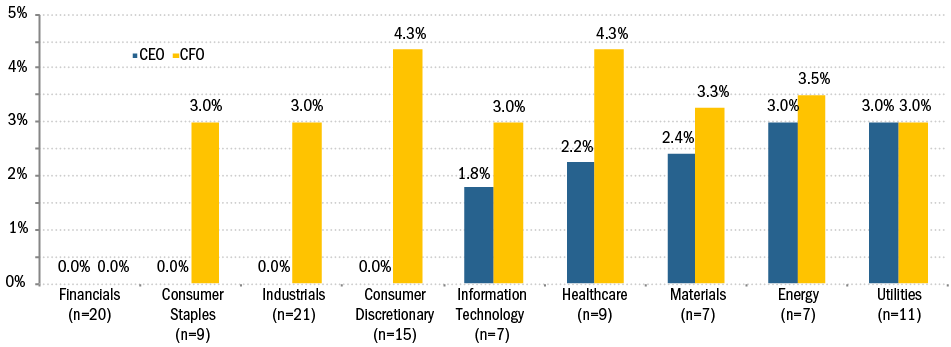
When analyzed by industry, median increases in salary for CEOs are generally less than 3%. Median salary increases to CFOs are much more robust, generally in the range of 3-4%. Median salary increases over 3% are seen for CFOs in the following industries: Consumer Discretionary, Energy, Healthcare, and Materials. The Financials industry is the only industry were the median change in salary was 0% for both CEOs and CFOs.
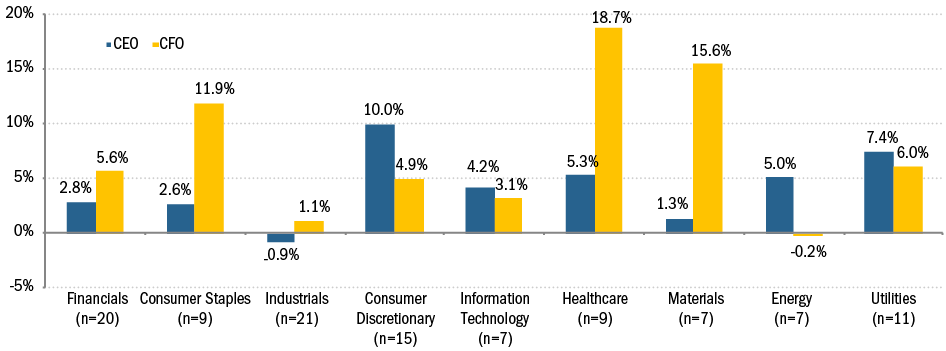
When we look at actual total direct compensation by industry, greater volatility is observed. The volatility in year-over-year changes is primarily driven by industry and company performance. Some of the largest increases in compensation levels are seen in Consumer Staples, Healthcare and Materials.
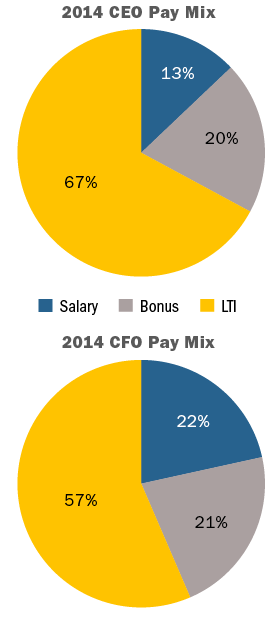
Target Pay Mix
The average total target compensation pay mix remained largely unchanged. At-risk pay continues to be more emphasized for CEOs than for CFOs.
Long-Term Incentive (LTI) Vehicle Prevalence and Mix
Equity mix and vehicles used for LTI awards remained fairly consistent for the past several years. The majority of companies continue to use two different vehicles to deliver long-term incentives to CEOs/CFOs and a quarter of companies studied use all three equity vehicles (time-based stock awards, awards under a performance plan, and stock options)
Performance plans account for roughly 50% of LTI awards, about 25% is delievered in stock options, and about 25% in time-vested restricted stock awards. The overall percentage of performance-based awards (performance plans and stock options) for both CEOs and CFOs continues to range between 75% – 80%.
|
LTI Mix |
||||
|
|
2013 |
2014 |
||
|
|
CEO |
CFO |
CEO |
CFO |
|
Stock Options |
27% |
27% |
26% |
25% |
|
Time Vested Restricted Stock |
17% |
22% |
21% |
26% |
|
Performance Plans |
56% |
51% |
53% |
49% |
Conclusion
In terms of performance, 2014 was a good year for our sample of companies with median total shareholder return of 15%, median revenue growth of 5% and median net income growth of 9%. We believe the 2014 pay changes were aligned with performance for the year. For CEOs, salary increases were modest, but increases in actual bonus and long-term incentives contributed to a median increase in actual total direct compensation of 3.2%. Pay progression opportunities for CFOs were even stronger, with a median increase of 7.8% in actual bonus and 4.2% in long-term incentives yielding a 5.2% median increase in actual total direct compensation.
In terms of compensation program design for senior executives, we saw relatively little change. The increase in annual target bonus opportunity for CFOs was noteworthy, but long-term incentives practices are similar to last year’s study. The increase in performance-based long-term incentives is significant and we expect this to remain the mainstream practice.
Sample Screening Methodology
Based on the screening criteria below, we arrived at a sample of 108 public companies with median 2014 revenue of $12.4B.
|
Revenue |
At least $5B in revenue for fiscal year 2014 |
|
Fiscal year-end |
Fiscal year-end between 9/1/2014 and 12/31/2014 |
|
Proxy Statement Filing Date |
Proxy statement filed before 3/31/2015 |
|
Tenure |
No change in CEO and CFO incumbents in the past three years |
|
Industry |
All industries have been considered for this analysis |
Highlights
- Median increase of 15% in total compensation for CEOs delivered through both above target bonus payouts and higher long-term incentive awards (“LTI”)
- More companies are paying above target bonuses for 2014 performance. 72% of companies had a payout at or above target versus 40% and 46% of companies in 2013 and 2012, respectively
- Companies with higher bonus payouts demonstrated correspondingly higher levels of financial performance, including stronger top-line growth and greater profitability
- Companies continue to shift a greater portion of total LTI into a performance-based vehicle although time-based stock options and restricted stock remain prevalent
- Performance-based long-term vehicles represent the largest portion of LTI with many companies incorporating TSR as a metric
Total Compensation
Among Early Filers with CEOs who held their position for at least two years (37 companies), actual total compensation in 2014 increased 15% from 2013. The increase in total pay was delivered mostly through the annual and long-term incentive awards, with median increases of 18% and 14% increases year over year, respectively.
|
Compensation Element |
% Increase at Median |
|
Base Salary |
1.5% |
|
Annual Incentive |
18% |
|
Total Cash |
9% |
|
Long-Term Incentive (LTI) |
14% |
|
Total Compensation |
15% |
Base Salary
Among the Early Filers, companies continue to provide modest salary increases to the NEOs. Salary increases for incumbent CEOs ranged from 0 – 5%. Approximately 50% of companies did not increase their CEO's salary in 2014.
Annual Incentive Compensation
2014 was a strong financial year for the Early Filers, reflected in 8.8% EPS growth at median and 15% TSR for the year. This resulted in higher annual incentive payouts compared to both 2013 and 2012. 72% of companies had a payout at or above target versus 40% and 46% of companies in 2013 and 2012, respectively.
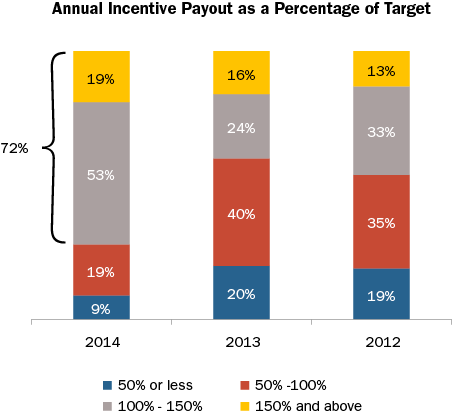
The companies that paid a bonus at or above target had stronger financial performance than both the S&P 500 and all Early Filers. Higher performance among companies with higher bonus payouts was evident in all three financial metrics examined, including Revenue growth, Pre-tax Income growth and EPS growth. For example, median EPS growth for these higher performers was 13.3% (versus 9.9% among the S&P 500 and 8.8% among all 50 Early Filers). Higher performance for companies with above target bonus payouts demonstrates that pay and performance is well-aligned. One-year TSR performance (as of February 2015) was similar across all groups.
|
Financial Metric |
Median 1-Yr Performance |
||
|
S&P 500 |
All Early Filers (n=50) |
Companies with at or above target payout (n=36) |
|
|
Revenue Growth |
5.2% |
5.7% |
6.4% |
|
Pre-Tax Income Growth |
8.3% |
6.2% |
9.7% |
|
EPS Growth |
9.9% |
8.8% |
13.3% |
|
TSR |
15.7% |
15.2% |
15.2% |
Median annual incentive payout as a percentage of target for all Early Filers was 111% in 2014 which was higher than the median in both 2013 and 2012.
|
Summary Statistics |
Annual Incentive Payout as a % of Target |
||
|
2014 |
2013 |
2012 |
|
|
75th Percentile |
136% |
116% |
130% |
|
Median |
111% |
94% |
100% |
|
25th Percentile |
99% |
75% |
72% |
Although 2014 was a strong year, companies are continually refining their annual incentive plan to ensure executive pay is aligned with performance. Among companies in our study, 34% made changes to the annual incentive plan with a majority of companies making changes to annual incentive metrics.
The chart below illustrates all changes companies made to their annual incentive plan:
|
Type of Change Reported |
Companies Reporting Changes (n = 17) |
|
|
# of Cos. |
% of Cos. |
|
|
Change in performance metrics used to fund awards |
12 |
71% |
|
Change in performance metric weighting / mix |
4 |
24% |
|
Increased target annual incentive award opportunity (CEO and/or CFO) |
4 |
24% |
|
Other |
4 |
24% |
Note: Percentages add to greater than 100% due to multiple changes by select companies.
Long-Term Incentive Compensation
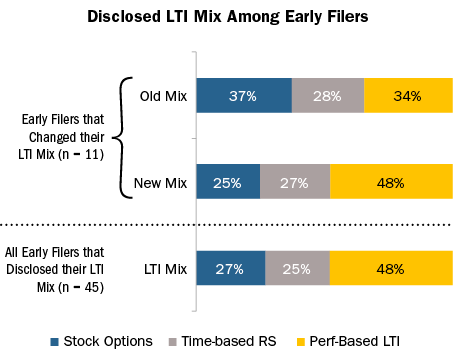
The use of time-based LTI (stock options and restricted stock) continues to be prevalent, yet performance-based LTI continues to play the strongest role in the overall LTI mix.
Approximately 50% of companies in our study made changes to their overall LTI program. Most changes involved the mix of vehicles, which continues the recent trend of increasing performance-based LTI and reducing the reliance on time-based long-term incentives. The table below indicates all changes made by the Early Filers:
|
Type of Change Reported |
Companies Reporting Changes (n = 26) |
|
|
# of Cos. |
% of Cos. |
|
|
Mix of LTI award vehicles |
11 |
42% |
|
Increased or reduced LTI award target opportunity level (CEO and/or CFO) |
8 |
31% |
|
Performance plan metric |
7 |
27% |
|
Add or eliminate LTI vehicle |
7 |
27% |
|
Vesting/performance period |
4 |
15% |
|
Other |
2 |
8% |
Note: Percentages add to greater than 100% due to multiple changes by select companies.
Among the companies that changed their LTI mix, most increased the emphasis on performance-based LTI while reducing stock option use. The portion of LTI awarded in the form of time-based restricted stock remained relatively unchanged. Overall, nearly 90% of companies use performance-based LTI, 74% use stock options and 62% use time-based restricted stock.
Among the Early Filers that grant performance-based LTI awards, approximately 60% use two or more metrics. The use of multiple metrics provides balance and rewards executives based on holistic performance.
Approximately two-third of companies use relative Total Shareholder Return ("TSR") as a performance metric. Companies incorporate TSR as a long-term incentive metric for multiple reasons including aligning with the shareholder experience, simplifying the goal-setting process and conforming to proxy advisory firms’ preference for TSR. Among the companies that use relative TSR as a standalone metric, it typically represents 25-50% of the total performance award. Some companies use financial performance (either absolute or relative) to fund the payout of the performance award and use relative TSR to modify the final payout, thereby incorporating it as an LTI metric but reducing its overall effect on payouts.
|
Weighting of TSR Metric in the LTI Plan (n = 28) |
Number of other LTI Metrics |
% of Companies |
|
25% |
1 – 2 |
11% |
|
50% |
1 |
29% |
|
Weighting not disclosed |
2 |
7% |
|
100% |
0 |
32% |
|
Modifier |
2 – 3 |
21% |
Say on Pay (SOP) Vote Results
In 2015, 98% of Early Filers that released SOP results this year received majority shareholder support; most companies (approximately 75%) received greater than 90% support. Compensation program design changes can and do improve Say on Pay results! Among the companies that made changes to either their annual or long-term incentive plan in 2014 (n = 29), 97% received majority shareholder support with approximately 70% receiving greater than 90% support. However, making a change to the incentive program design does not guarantee shareholder approval of the executive compensation program.
When fundamental problems with the compensation program exist – such as high pay levels or misalignment with performance – companies may fail the SOP vote. Additionally, poor SOP results can be attributed to shareholders expressing dissatisfaction with other aspects of the company’s business, its management or TSR performance.
Conclusion
2014 annual incentive payouts among the Early Filers were higher than 2013 which, when combined with the rise in LTI award levels, resulted in a 15% increase in total compensation. We saw a big increase in the number of companies with at or above target bonus payouts, as well as higher performance among these companies. Nearly 65% of companies use TSR as a long-term incentive metric, suggesting that companies are trying to enhance alignment between executive pay and shareholder experience.
Companies continue to make changes to their annual incentive and LTI plans, with a strong focus on enhancing the pay for performance relationship through modification of the annual incentive metrics and/or the long-term vehicle mix. Among companies that changed their LTI vehicle mix, they tended to increase the role of performance-based LTI. Our experience suggests these trends are consistent with the broader market practice. While changes to the incentive plan will likely lead to a favorable Say on Pay vote, companies should be aware of that other factors may affect the vote.