Our findings, summarized below, indicate that overall, increases in pay levels for both CFOs and CEOs have moved from double-digit figures in the 2009-2010 period to single-digit figures in the 2010-2011 period, suggesting pay actions that are more reflective of a stabilizing economy. Pay increases in both periods were higher for CFOs compared to CEOs, driven by higher increases in short-term compensation. On an absolute basis, CFO pay continues to be approximately one-third of CEO pay.
Study Results
Salaries
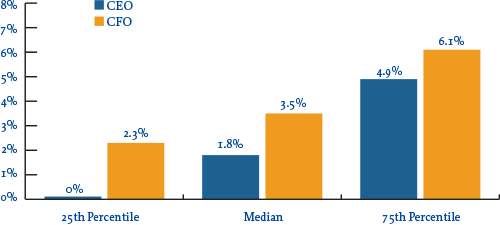
In 2011, 88% of CFOs received salary increases at a rate of 3.5% at median and 6.1% at the 75th percentile. In comparison, only 66% of CEOs received salary increases at lower levels (1.8% at median and 4.9% at the 75th percentile). The prevalence of salary increases for both CFOs and CEOs rose year-over-year, from 75% to 88% (CFOs) and from 56% to 66% (CEOs).
Salary Increase Prevalence |
||||
| 2009 – 2010 | 2010 – 2011 | |||
| No Increase | Increase | No Increase | Increase | |
| CEO |
43.8% |
56.3% |
34.4% |
65.6% |
| CFO |
25.0% |
75.0% |
12.5% |
87.5% |
2011 Salary Increases
Actual Pay Levels
Overall, actual total direct compensation (salary plus actual annual incentive plus the present value of long-term incentives) for both CFOs and CEOs continued to increase but at much lower rates in the 2010-2011 period compared to 2009-2010, as illustrated in the chart below. These lower, single-digit increases in pay levels are indicative of a stabilizing economy. The salary and actual bonus increase levels themselves continued to be higher for CFOs in the 2010-2011 period than for CEOs. Long-term incentives proved to be the biggest driver of pay increases from 2010 to 2011, however, rising by 10% for both CEOs and CFOs.
Median Percentage Change in Pay Components |
||||
| Pay Components | 2009 – 2010 | 2010 – 2011 | ||
| CEO | CFO | CEO | CFO | |
| Salary |
1.0% |
3.7% |
1.8% |
3.5% |
| Actual Bonus |
19.0% |
22.7% |
0.0% |
3.5% |
| Long-Term Incentives |
10.1% |
14.8% |
10.0% |
10.3% |
| Actual Total Direct Comp. |
14.4% |
20.0% |
3.6% |
7.5% |
Financial Performance (Median Levels) |
|||
| Year | Total Shareholder Return (as of 12/31) | 1-Year Revenue Growth | 1-Year Net Income Growth |
| 2009 |
31% |
-9% |
-7% |
| 2010 |
24% |
10% |
19% |
| 2011 |
5% |
9% |
13% |
While movement in pay among CFOs and CEOs was directionally similar, absolute CFO total direct compensation levels, on average, have been approximately 30% of CEO total direct compensation levels over the last three years.
Target Pay Mix
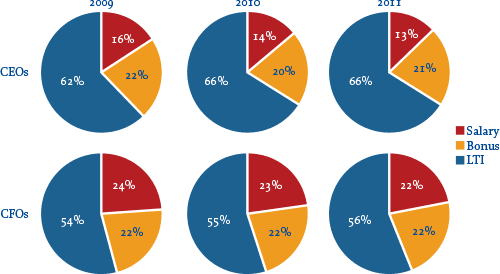
In terms of target compensation levels, the overall pay mix remained largely unchanged from 2009 to 2011, with a greater emphasis on at-risk pay for CEOs than for CFOs.
Long-Term Incentive (LTI) Vehicle Prevalence and Mix
The majority of companies continue to award LTI to both CEOs and CFOs using at least two incentive vehicles. The role of stock options has declined in the overall mix companies use to deliver LTI. And on average, performance-based LTI now comprises approximately 50% of LTI for CEOs and CFOs, an increase of approximately 10% over the past three years. Data shows 80% of CFOs and 85% of CEOs received some form of performance-based awards as part of their LTI program in 2011.
Number of LTI Vehicles Used in 2011 |
||
| % in Total | ||
| CEO | CFO | |
| 1 |
20% |
18% |
| 2 |
46% |
44% |
| 3 |
31% |
34% |
| Average |
2 |
2 |
LTI Mix |
||||||
| 2009 | 2010 | 2011 | ||||
| CEO | CFO | CEO | CFO | CEO | CFO | |
| Stock Options |
40% |
41% |
33% |
30% |
32% |
32% |
| Time Vested Restricted Stock |
19% |
21% |
20% |
23% |
17% |
22% |
| Perf. Based LTI |
40% |
38% |
48% |
47% |
51% |
46% |
Conclusion
In the last three years, trends in CFO pay have been directionally aligned with trends in CEO pay. While the rates of increases were higher for CFO’s 3 years ago, and have started to moderate compared to earlier years, trends for both positions indicate a pronounced linkage to performance, particularly through the long term incentive program.
While volatility in the economy may be stabilizing somewhat, we expect the performance linkages to remain strong for these two key positions. With the continued emphasis at the executive and board level on strong financial skills, talent and acumen, companies will continue to pay competitively for those in the CFO role.
This resulted in significant new reporting requirements for banks and other financial institutions with $1 billion or more in consolidated assets regarding incentive compensation arrangements for Tier 1, Tier 2 and Tier 3 Covered Employees.1,2
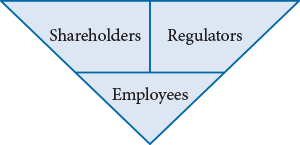
- The Federal Reserve Board (“FRB”) first proposed guidance on incentive compensation in 2009 that was adopted by all the federal banking agencies in 2010 (“Final Guidance”).
- As a result, the focus of compensation program design at large banking institutions expanded. Beyond pay-for-performance and attracting / retaining talent, the programs must provide a greater focus on appropriately balancing risk and rewards.
To “improve” practices and require conformance with the Sound Guidance, in late 2009 the FRB began a multi-disciplinary horizontal review of incentive compensation arrangements at 25 large complex banking organizations (“LCBOs”). This led to an iterative pay program design process, as regulators now need to “sign off” on compensation program design for all Covered Employees. Based on client experience and a review of 2012 LCBO proxy statements, we have identified key themes concerning what has been done to-date to move towards substantial conformance with FRB requirements.3
| Key Themes | |
| 1. | The Fed is highly involved in the compensation design process at large bank holding companies for a sizeable number of employees (ranging from senior executives to employees well below that level) |
| 2. | A majority of variable executive compensation is linked to long-term performance and risk outcomes; it is now typical that more than the required 50% of incentive pay (annual + long-term) be deferred over at least 3 years |
| 3. | Performance adjustments are now expected before and after the grant of incentive compensation, and the role of the Risk function and formal risk assessments in that process has increased |
| 4. | Long-term incentive goals must now balance business plan and shareholder goals (EPS, TSR, etc.) with risk-based ex-post performance features (capital goals, etc.) |
| 5. | It is majority practice to have stock ownership requirements for senior executives that go beyond a more traditional guideline (multiple of base or number of shares achieved within a certain number of years) |
| 6. | Clawback provisions go beyond what is required by Sarbanes-Oxley or expected under Dodd-Frank |
Overall Incentive Compensation: Annual and
Long-term
With the goal of “de-leveraging” incentive pay programs and placing more focus on long-term performance and risk outcomes, some LCBOs have re-balanced the pay mix for senior executives. This typically includes a combination of: 1) increasing base salaries; 2) reducing annual incentive award opportunities; 3) increasing the mandatory deferral rate for a portion of annual incentive awards.
To ensure alignment of compensation with long-term performance and risk outcomes, proposed regulations require that at least 50 percent of incentive compensation (annual + long-term) be deferred over a period of at least 3 years (ratable vesting is acceptable), for specific Tier 1 executives at covered financial institutions with total assets of at least $50 billion (minimum deferral under proposed regulations; Dodd-Frank §956).
| approx. (rounded) | % of Incentive Compensation Deferred Over At Least 3 Years (Actual Bonus + Grant Date LTI Value) |
|
| CEO | NEOs (avg.) | |
| 75th%ile | 80% | 75% |
| 50th%ile | 70% | 65% |
| 25th%ile | 65% | 60% |
Currently, the portion of incentive compensation deferred at LCBOs is substantial and exceeds the minimum guideline. Many of these companies have additional stock retention requirements after deferred compensation vests.
CAP Perspective: These high deferral rates reflect a meaningful shift from historic industry practice.
CAP Perspective: Near-term, medium-sized financial institutions are likely to migrate their practices towards increased deferral rates leading to a change in typical senior executive pay mix.
Regulators also require that the deferred amounts be subject to: “performance adjustment for losses (or other measures or aspects of performance) that are realized or become better known during the deferral period.” These risk (and performance) adjustments are expected prior to the grant of incentive compensation (ex-ante / upfront) as well as post-grant and prior to vesting (ex-post / look-back).
In terms of ex-ante adjustments, all but one LCBO (93 percent) disclosed in its most recent proxy statement an annual risk review prior to payment of incentive compensation that can modify payout. Most companies disclosed a highly discretionary process (more structure likely exists), while 20 percent specifically described use of a risk/compliance scorecard.
CAP Perspective: These new concepts / design will cascade down in organizations, and create additional work for cross-functional teams.
In terms of ex-post adjustments, companies are introducing formulaic and/or discretionary reduction features (see LTI discussion below).
CAP Perspective: The FRB does not recognize market-based (stock price) adjustments alone as an adequate form of risk-based performance adjustment.
Incentive Compensation: Annual Incentives
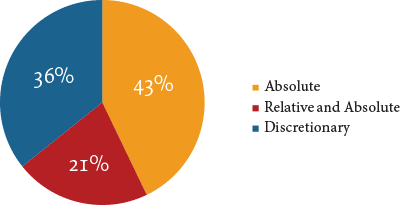
Measuring absolute (internal) performance against pre-established goals is the most common approach used by the LCBOs to determine bonus payments for senior executives. The goals are most often made up of multiple performance measures. The most prevalent metrics relate to profitability (for example, EPS), followed by return/efficiency metrics (for example, ROE).
Additionally, as a risk management technique, we observed that about 20 percent of LCBOs have reduced annual incentive plan upside leverage, by either reducing target opportunities or capping maximum payout opportunities.
Annual Incentive Plan Measurement
Relative vs. Absolute
CAP Perspective: Near-term, we expect large bank holding companies to add more structure to the annual incentive decision making process, including increased documentation and back-testing of decisions.
CAP Perspective: We also expect to see an increased use of risk-focused measures, such as use of a minimum capital level as a 162(m) funding requirement.
Incentive Compensation: Long-term Incentives
Most companies use two long-term incentive vehicles. Some form of long-term performance plan (LTPP; performance shares / cash) is the most widely used vehicle, followed by stock options. The most common LTPP performance period is 3 years, and the most common LTPP upside leverage is 150 percent of target.
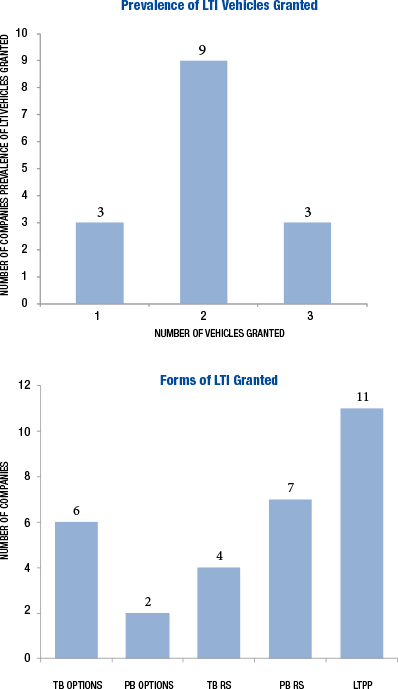
CAP Perspective: Stock options have been de-emphasized in the proportion of the long-term incentive award that they represent due to recent stock price volatility and outside criticisms.
CAP Perspective: Stock options are not seen as appropriately performance-based among regulators. There is concern that value can be realized based on macro economic conditions, rather than company-specific events/financials, particularly over a 10 year timeframe. Attaching some form of ex-post performance-based adjustment can provide risk-balancing features.
In addition to traditional long-term goals tied to the business plan, relative performance or stock price, companies have been adopting secondary performance conditions, in reaction to the Final Guidance, intended to significantly reduce or eliminate unvested deferred incentive payments (post grant, an ex-post adjustment) if a risk event were to occur. These adjustments are designed to be done on a formulaic basis, discretionary basis, or both.
| Select Examples | |
| PNC |
|
| Goldman Sachs |
|
| BNY Mellon |
|
When designing a long-term incentive program, it is also important for financial institutions to consider accounting implications.
CAP Perspective: Truly new designs are being implemented, and it seems that some may lead to variable accounting for equity vehicles. Awards may lack a true grant date, resulting in variable accounting, if a discretionary risk assessment subjects the awards to reduction up until vesting. This can lead to increased cost / volatility in expense and therefore create a reason to consider providing a portion of long-term incentive compensation through a cash-based vehicle.
Stock Ownership Requirements
While all of the LCBOs have some form of stock ownership requirement, most have requirements for senior executives that go beyond traditional ownership guidelines (multiple of base and/or number of shares that must be achieved within a certain number of years).
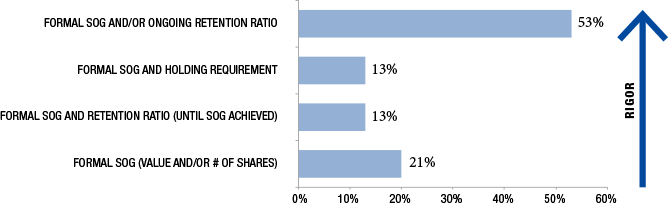
CAP Perspective: The most rigorous requirement for executives – an ongoing retention ratio – is most common.
CAP Perspective: Senior executive ownership standards in this industry exceed those typically found in the general industry.
Clawbacks
As most public companies await final SEC regulations, the horizontal review banks have begun to make comprehensive changes to their existing clawback policies. The horizontal review banks have a clawback provision that goes beyond what is required under Sarbanes-Oxley or Dodd-Frank legislation (SEC has not yet proposed rules). These clawback provisions are part of multiple programs and can impact different employee populations or pay elements for varying reasons.
CAP Perspective: Based on disclosed policies, it is noteworthy that “inattention to risk” is a triggering event among 40 percent of the horizontal review banks.
CAP Perspective: In our experience, most companies have yet to think through how they would implement a clawback of previously paid compensation, should one be triggered. This will likely be a complicated process, with a number of legal and tax considerations for both the employee and the company.
Conclusion
Compensation design and governance practices have been changing at LCBOs at an accelerated pace since the horizontal review process began and the Final Guidance was issued. Change will continue among these organizations, and will spread to other large (and smaller) financial institutions. While the regulations are focused on the largest banks ($50B+ in consolidated assets), the design practices discussed above will be increasingly relevant for financial institutions of all sizes.
There are now greater expectations for Board oversight, enhanced controls and related policies, and documentation for incentive plans and risk mitigation strategies. To comply, the Compensation Committee and a cross-functional senior management team must be fully involved, well-informed and possess an in-depth understanding of incentive arrangements for all Covered Employees.
Research assistance for this CAPFlash was provided by: Deep Patel, Devika Ray and Chelsea Carter.
1 These companies are required to disclose the structure of their incentive-based compensation arrangements to appropriate federal agencies.
2 As described in the Interagency Guidance, the full set of employees who may individually or collectively expose the firm to material amounts of risk are together referred to as “Covered Employees.”
3 16 LCBOs are U.S.-based. Our analysis focuses on these companies excluding Ally Financial (where the U.S. government remains the majority owner). Data found in proxy disclosures is most relevant to Tier 1 Covered Employees (senior executives).
Stronger Governance Practices
What We Found
In response to increased pressure from shareholders and proxy advisory firms, as well as recent Say on Pay legislation, companies continue to monitor their executive compensation programs. In the past, companies would re-evaluate their programs every 2-3 years. Given today’s intense scrutiny of executive compensation, we are seeing companies and compensation committees re-evaluate their programs annually. New governance standards include completing the annual risk assessment and implementing updated clawback policies. In addition, companies have removed excise tax-gross ups from change in control benefits and perquisites, continue to emphasize stock ownership guidelines and stock retention requirements, and have reduced supplemental retirement benefits.
Compensation Risk Disclosure
Clear and explicit disclosure of the compensation risk assessment process is becoming standard practice, especially after the recent economic downturn and passage of SEC rules on enhanced compensation disclosure. Of the 111 companies in our study, 105, or 95%, make some type of affirmative disclosure on risk assessment in the most recent proxy. Similar to 2009, none of the companies disclosed that their incentive programs create material adverse risks.
Most companies make their risk-related disclosure in the CD&A of the proxy statement, with the corporate governance section of the proxy statement ranking as the second most common place for this disclosure. The table below summarizes where risk disclosures were made:
| Section of the Proxy Statement with Compensation Risk Disclosure |
2010 | 2009 | ||
| % of Cos. | % of Cos. | |||
| No. of Cos. | n=105 | No. of Cos. | n=75 | |
| CD&A | 49 | 47% | 39 | 52% |
| Corporate Governance Section (Section 407) | 25 | 24% | 19 | 25% |
| CD&A and Corporate Governance Section (Section 407) | 14 | 13% | 7 | 9% |
| Separate Stand Alone Section | 11 | 10% | 8 | 11% |
| CD&A and Compensation Committee Report | 4 | 4% | 2 | 3% |
| Compensation Committee Report | 2 | 2% | n/a | n/a |
Responsibility for completing the risk assessment process varies by company. Of the companies disclosing a risk assessment, 35 companies (33%) had management and the compensation committee working together to conduct the assessment, while 17 companies (16%) reported that the compensation committee worked alone to conduct the assessment. One change we noted is that this year 95% of companies disclosed who conducted the risk assessment versus only 65% last year. The table below provides further detail on which groups were involved in the compensation risk review:
| Approach to Compensation Risk Reviews | 2010 | 2009 | ||
| % of Cos. | % of Cos. | |||
| No. of Cos. | n=105 | No. of Cos. | n=75 | |
| Management & Compensation Committee | 35 | 33% | 10 | 13% |
| Compensation Committee | 17 | 16% | 7 | 9% |
| Compensation Committee & Consultant | 15 | 14% | 9 | 12% |
| Management | 13 | 12% | 7 | 9% |
| Management, Compensation Committee & Consultant | 12 | 11% | 15 | 20% |
| Management & Consultant | 8 | 8% | 1 | 1% |
| Not Disclosed | 5 | 5% | 26 | 35% |
Clawbacks
Despite the SEC’s delay in proposing policies to recoup executive compensation under Dodd-Frank, companies have been proactively adopting clawback policies. Even though clawbacks are mandated by the SEC for all public company CEOs and CFOs under SOX and for the top 25 executives in TARP participants, companies have implemented their own clawbacks to obtain broader protection.
A significant majority of our research companies – 89 of 111 (80%) – maintain some form of clawback provision. For 2010, 17 of the 89 companies adopted a new clawback policy and 10 modified existing policies by expanding the type of compensation that can be recouped, the executives covered or the events that trigger a clawback. The majority of companies are awaiting final SEC regulations, however, before making comprehensive changes to update existing policies.
Similar to our findings in 2009, a financial restatement is required to trigger a clawback in nearly all cases (74 companies or 83% of those with a clawback). Further, 66 companies (74% of those with a clawback) disclosed that misconduct is a triggering event and 45 companies (51%) disclosed fraud as a trigger.
Based on our review of CD&A disclosures, companies with a clawback include the ability to clawback or recoup the following types of compensation: earned, exercised, outstanding, vested or unvested.
| Compensation Subject to Clawback | % of Cos. | |
| No. of Cos. | n=89 | |
| Prior annual incentive | 81 | 91% |
| Prior LTI | 79 | 89% |
| Future annual incentive | 20 | 22% |
| Future LTI | 14 | 16% |
Note: Percentages add up to greater than 100% due to multiple responses.
Of the type of compensation that is subject to a clawback, clawbacks of both cash and equity are equally prevalent.
While the majority of companies do not explicitly state who their clawback policy applies to, it is clear that coverage extends to the NEOs at 83 companies (93%).
A minority of companies (18 companies or 20%) indicate the time period which compensation can be recovered after a restatement. Of the 18 companies that disclosed a time frame, the most common is 1 year from the date of restatement and the range is 1-3 years.
It is apparent from reviewing CD&A disclosure that most companies are waiting for the SEC to rule before modifying their current policies. Companies will need to develop and implement a policy to provide for recovery of compensation that aligns final rules issued by the SEC. The proposed rules apply to both current and former executives and cover all incentive compensation within 3 years of a financial restatement (with or without intentional misconduct). It is unlikely that companies will make final modifications to their policies that apply to the 2012 proxy season, since the SEC is not expected to issue final rules until the first half of 2012.
Stock Ownership Requirement Changes
Companies continue to monitor their stock ownership requirements in order to align executives with shareholders. This year 25 companies (23%) initiated a change with respect to stock ownership or stock holding requirements. The most prevalent change was an increase in stock ownership guideline levels, with 12 of the 25 companies (48%) disclosing an increase. This is likely attributed to a recovery in the economy as well as stock prices, and increasing pressure from regulators and proxy advisory firms. Other common changes were 24% of companies added a new stock holding requirement and 20% modified or added a penalty for non-compliance. Further detail on changes made to executive stock ownership guidelines are below:
| Changes made to Executive Stock Ownership Guidelines | 2010 | 2009 | ||
| % of Cos. | % of Cos. | |||
| No. of Cos. | n=25 | No. of Cos. | n=17 | |
| Increased | 12 | 48% | 3 | 18% |
| Added holding requirement | 6 | 24% | n/a | n/a |
| Modified penalty for non-compliance | 5 | 20% | n/a | n/a |
| Changed to multiple of salary | 2 | 8% | n/a | n/a |
| Increased holding requirement | 2 | 8% | n/a | n/a |
| Decreased holding requirement | 2 | 8% | n/a | n/a |
| Newly adopted | 1 | 4% | 10 | 59% |
| Decreased | 1 | 4% | 1 | 6% |
| Adopted mandatory holding of shares through retirement | 1 | 4% | n/a | n/a |
Note: Percentages add up to greater than 100% due to multiple changes by several companies.
Stock Ownership Requirements Detail
For companies disclosing shares counted toward ownership requirements, it is interesting to note that one-third of companies count unvested restricted stock towards meeting the guidelines, since companies expect executives to vest in these shares. However, only 6% count vested/unexercised options and 5% count unearned performance shares since these shares are viewed as being subject to greater risk. See below for further detail:
| Shares Counting For Guideline Requirements | % of Cos. | |
| No. of Cos. | n=99 | |
| Shares directly owned | 55 | 56% |
| Unvested RS | 33 | 33% |
| Shares in 401(k) plan | 33 | 33% |
| Shares indirectly owned | 29 | 30% |
| Shares purchased on open market | 29 | 29% |
| Not disclosed | 29 | 29% |
| Deferred Compensation | 25 | 25% |
| Vested but unexercised options | 6 | 6% |
| Unearned performance shares | 5 | 5% |
| Unvested options | 1 | 1% |
Note: Percentages add up to greater than 100% due to multiple types of equity counted by various companies.
Among CEOs, most companies (82%) express their guidelines as a multiple of base salary and 17% of companies express their guidelines in fixed share amounts. The fixed share approach is more prevalent among financial services and technology companies.
The median guideline for all company CEOs in our study sample is a 5x multiple of base salary or a fixed share guideline of 150,000 shares. The median value of these guidelines is $6,700,000.
| CEO Stock Ownership Guidelines (n=99) |
Prevalence |
25th Percentile Level | Median Level | 75th Percentile Level |
| Multiple of Base | 82% | 5.0x | 5.0x | 6.0x |
| Fixed Share | 17% | 100,000 | 150,000 | 300,000 |
| Fixed Value | 1% | $5,000,000 | $5,000,000 | $5,000,000 |
| Total Value | – | $5,389,894 | $6,700,000 | $8,600,000 |
15% of companies disclose some type of penalty for non-compliance with stock ownership guidelines. The most common penalties disclosed include mandatory payment of a portion of the annual bonus in stock and requiring executives to hold shares after an option exercise or the vesting of stock awards.
Stock Holding Requirements Detail
Having stock holding or stock retention requirements in addition to stock ownership guidelines is a growing trend. In our sample of 111 companies, 30 companies (27%) disclose some type of stock holding requirement. Over half of the 30 companies have a stand-alone stock holding requirement. This type of requirement is most prevalent among financial services companies in place at 75% of financial services companies.
Most of these companies (46%) require executives to hold equity after vesting or exercise for 1 year. Holding shares until retirement (33%) is the second most prevalent holding period, although it is relatively rare. 70% of companies disclose that the equity to be held is the net after-tax shares retained by the executive after option exercise/equity vesting. See below for further detail:
| Definition of LTI subject to Hold | % of Cos. | |
| No. of Cos. | n=30 | |
| RS/RSUs | 25 | 83% |
| Options | 22 | 73% |
| Performance Shares | 12 | 40% |
| Net after tax shares | 21 | 70% |
Note: Percentages add up to
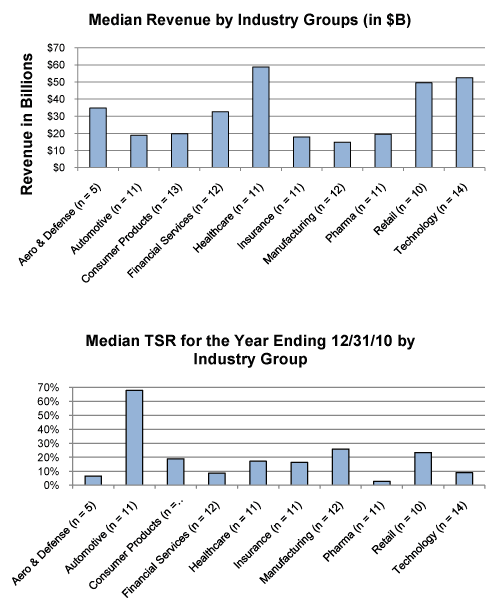
For the 111 company sample, median revenue was $27B, market capitalization was $30B and Total Shareholder Return (TSR) was 16% for 2010.
What We Found
Highlights of our research findings are below. Most companies did not make sweeping changes to their executive compensation programs. But many companies continued to refine annual and long-term incentive plans to strengthen the alignment between executive rewards and financial performance and to focus executives on the overall health of the organization.
Compensation Strategy Changes
Similar to 2009, most companies did not make significant changes to their compensation strategy. Financial Service firms were more likely to make changes to the strategy (e.g., increase at-risk pay) as they emerged from compensation restrictions imposed by TARP.
Peer Groups Used For Benchmarking
In 2010, companies continued to review and modify their peer group, although wholesale changes were not the norm. Approximately 40% of companies made some modification to their peer group by selecting peers that more closely aligned with their size and business mix. Pharmaceutical companies, in particular, continued to make changes to the peer group as industry consolidation continued.
Base Salary Actions
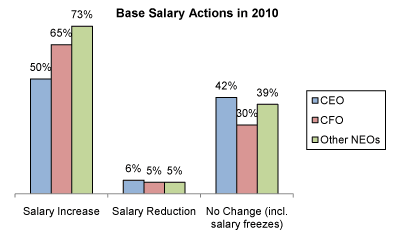
2010 saw the return of salary increases for senior executives with a majority of companies providing salary increases to Named Executive Officers (NEOs) in 2010 (vs. 20% in 2009) as the economy improved. Within the NEO ranks, companies provided increases more frequently to executives below the CEO as they focused on retaining top talent and remaining competitive with the market. Salary reductions were most prevalent in companies that emerged from TARP, as these companies reverted to a compensation mix that provides a greater emphasis on incentive-based pay. Fewer companies froze base salaries for NEOs in 2010; companies in the Consumer Goods, Retail and Technology industry groups were more likely to maintain salaries at 2009 levels.
Annual Incentive Plan Design
Approximately 50% of companies disclosed a change in 2010 or planned changes for 2011 to their annual incentive plan design. Companies continued to refine the metrics and weightings that determine plan funding and payout as pay for performance remains a major focus for companies. 26% of companies increased the target annual incentive opportunity for at least one NEO illustrating that companies are focusing on the competitive market given the improvements in the economy. Although changes to annual incentive plans vary by company, there continues to be an attempt to reward executives based on appropriate indicators of company success.
The chart below presents the reported AIP changes:
| % of Cos. Reporting Changes | |||
| Type of Change Reported in CD&A | No. of Cos. | 2010 (n = 57) | 2009 (n = 34) |
| Change in performance metrics used to fund awards | 19 | 33% | 44% |
| Change in performance metric weighting mix* | 10 | 18% | n/a |
| Increased target award opportunities | 15 | 26% | 26% |
| Adopted / amended annual incentive plan | 13 | 23% | 6% |
| Modified performance scale | 6 | 11% | n/a |
| Reduced maximum award payout leverage | 2 | 4% | 12% |
| Other changes | 9 | 16% | 9% |
Note: Percentages do not add up to 100% due to multiple responses.
* Not captured separately in 2009 and is included in preceding category.
Change in Performance Metrics
Of the 19 companies that made changes to performance metrics, most (10 companies) added metrics to the plan design. Additionally, 10 companies changed the weighting of the AIP metrics. In general, these changes were focused on basic company performance indicators such as profitability and cash flow. For example,
- Computer Sciences: Added free cash flow as a measure to emphasize the importance of liquidity and profitability
- Morgan Stanley: Added capital adequacy and credit rating measures to the metrics used to determine financial achievements
- Visteon: Added product quality and free cash flow as performance metrics
Many companies added cash flow as an annual incentive metric in 2010 indicating that in the wake of the recent economic downturn, companies are balancing profitability with liquidity.
Annual Incentive Plan Metrics
In 2010, the most common metrics used across all industry groups were revenue or revenue growth, EPS and cash flow. Cash flow was one of the three most common metrics in five industry groups (Automotive, Consumer Goods, Manufacturing, Pharmaceuticals and Technology). More than other industries, annual incentive metrics for insurance companies tend to focus on industry-specific measures. The most prevalent metrics in the Automotive industry are cash flow and return on assets (ROA) denoting a focus on company operating performance during the economic recovery.
The three most prevalent metrics for each industry group are detailed below:
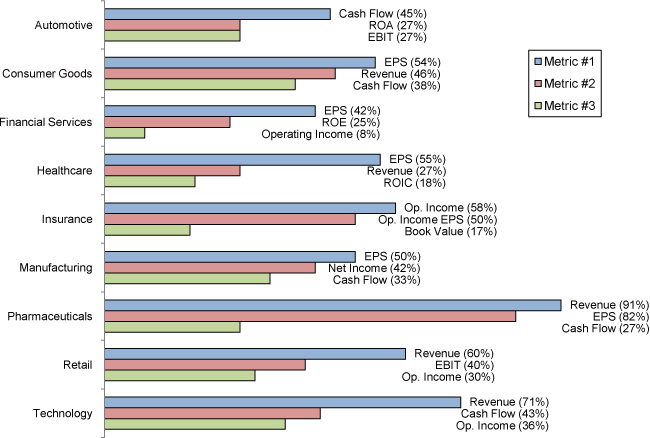
Note: Excludes Aerospace and Defense due to limited sample size (n = 5).
2010 Bonus Payout Details
Nearly all companies (95%) paid a bonus to an NEO for 2010. Most companies (90%) used financial performance to calculate the payout, although many of these companies (19%) also used discretion (positive and negative) to account for non-financial performance. Actual bonus payouts for CEOs on average were approximately 135% of the target incentive opportunity for 2010, indicating a rebound in financial performance in 2010 over 2009.
Long-Term Incentive Plan Design
A majority of companies (approximately 70%) reported making changes to their long-term incentive plan designs in 2010 or for 2011. Similar to the annual incentive plan changes, many companies (32%) reported changes to the performance metrics used to determine award payouts. 26% of companies reported changes to the LTI vehicle mix, with companies placing more emphasis on performance-based awards. This suggests that companies are focusing executives on longer-term goals. The table below outlines the reported changes:
| % of Cos. Reporting Changes | |||
| Type of Change Reported in CD&A | No. of Cos. | 2010 (n = 77) | 2009 (n = 60) |
| Changed long-term performance metric | 24 | 31% | 38% |
| Adopted / amended long-term incentive plan | 24 | 31% | n/a |
| Changed mix of LTI award vehicles | 20 | 26% | 55% |
| Added or eliminated LTI vehicle* | 22 | 29% | n/a |
| Changed LTI award opportunity level | 14 | 18% | 20% |
| Changed performance metrics/weighting | 6 | 8% | n/a |
| Other | 17 | 22% | 35% |
Note: Percentages do not add up to 100% due to multiple responses.
* Not captured separately in 2009 and is included in preceding category.
Long-Term Award Mix
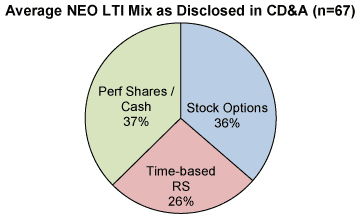
From companies making changes to their LTI award mix, a majority (60%) disclosed that they increased the emphasis on performance by shifting a portion of total LTI value from time-based awards (options and restricted stock) to performance-based vehicles. On average, companies are providing approximately 25% of the total LTI awarded to NEOs in time-based restricted stock with the remaining value equally split between performance-based LTI and stock options.
| % of Cos. Reporting Changes | |||
| Type of Change Reported in CD&A | No. of Cos. | 2010 (n = 20) | 2009 (n = 33) |
| Greater emphasis on performance-based awards | 12 | 60% | 55% |
| Reduced emphasis on time-based restricted stock | 7 | 35% | n/a |
| Reduced emphasis on stock options | 5 | 25% | n/a |
| Other | 5 | 25% | 45% |
Long-Term Incentive Prevalence
Although companies making a change indicated they are placing a greater emphasis on performance-based awards, equity awards with time-based vesting continue to be prevalent. The prevalence of stock options and restricted stock with time-based vesting remained relatively flat in 2010, with 74% and 65% of companies using these vehicles, respectively.
Below is the breakdown of overall LTI vehicle prevalence for NEOs in 2010 vs. 2009:
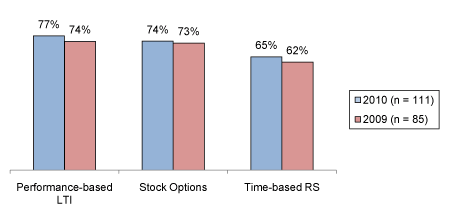
Note: Percentages do not add up to 100% due to multiple responses.
Companies typically grant multiple LTI vehicles to NEOs to offer a balanced program with different performance metrics and time horizons. Most companies (77%) grant two or three award vehicles to provide LTI to executives.
Performance-Based LTI Metrics
For companies using performance-based LTI, TSR (38%) and EPS (35%) continue to be the most prevalent metrics. More companies are incorporating return on capital or return on equity as a metric in 2010 to increase the focus on longer term health/stability and the quality of earnings. The use of revenue and cash flow remained relatively flat year over year.
The chart below displays the prevalence of LTI metrics for performance-based awards in 2010 and 2009:
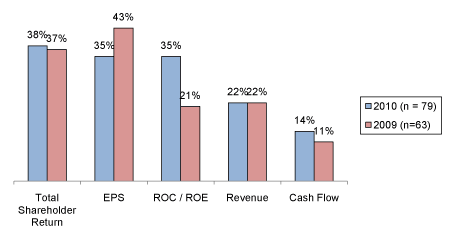
Note: Percentages do not add up to 100% due to multiple responses.
Treatment of Dividend Equivalents
Approximately 40% of companies that grant restricted stock (either time-based or performance-based) and 20% of companies that grant performance shares / units disclose that they pay dividend equivalents to executive officers. Companies typically pay dividends when the shares have vested or are earned.
Conclusions
2010 saw changes to annual and long-term incentive plan design in response to the rebounding economy, greater shareholder scrutiny, as a result of say on pay, and an attempt to further align pay and performance. With the economy on the rebound companies provided more frequent salary increases to NEOs in 2010 and were less likely to freeze base salaries. Companies modified incentive plan metrics, focusing on both company profitability and cash flow. The executive LTI mix continues to shift, with companies reporting more emphasis on performance-based awards. We expect to see companies continue to refine pay programs overall with the objective of strengthening pay and performance linkages and transparency.
To determine if this trend is continuing, Compensation Advisory Partners conducted a study to determine how CFO pay has changed over the last three years and how the year-over-year trends in compensation compare to trends in CEO pay. The study analyzes executive pay data disclosed by early proxy filers and includes 55 US public companies with revenues ranging from $1 billion to $150 billion, with median revenues of $10 billion. Only companies with the same incumbent CEO and CFO from 2008 to 2010 were included in order to focus on year-over-year changes for an individual. Financial services firms were excluded from the study as this industry, in particular, saw the emergence of several atypical compensation arrangements and special awards that were both temporary and unique to the financial services industry.
Our findings, summarized below, indicate that CFO pay is generally moving at the same rate as CEO pay. Salaries are increasing at a slightly faster rate for CFOs but incentive compensation, both annual and long-term, is moving at the same rate for CFOs and CEOs, illustrating that incentive levels are tied to company results. For 2010, incentives are up for both CFOs and CEOs, reflective of a slowly rebounding economy.
Study Results
Salaries
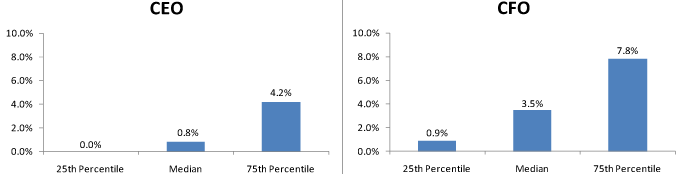
In 2010, 78% of CFOs received salary increases at a rate of 3.5% at median and 7.8% at the 75th percentile. In comparison, only 55% of CEOs received salary increases at lower levels (0.8% at median and 4.2% at the 75th percentile). The prevalence of no salary increases also rose among CEOs from 40% in the 2008-2009 period to 46% in the 2009-2010 period while for CFOs, the prevalence of no salary increases decreased to 22% in the 2009-2010 period versus 31% in the 2008-2009 period.
Salary Increase Prevalence
| 2008-2009 | 2009-2010 | |||
| No Increase | Increase | No Increase | Increase | |
| CEO | 40.0% | 60.0% | 45.5% | 54.5% |
| CFO | 30.9% | 69.1% | 21.8% | 78.2% |
2010 Salary Increases
Actual Pay Levels
Overall, actual total direct compensation (salary plus actual annual incentive plus the present value of long-term incentives) for both CFOs and CEOs slightly declined in 2009 and subsequently rebounded in 2010, as illustrated by the chart below. CFO pay fell at a slightly higher rate in 2009 and increased at a higher rate in 2010 compared to CEO pay. The rise in 2010 pay levels was primarily due to increases in incentive (performance-based) compensation. Bonuses increased by approximately 16% and LTI increased by 14% – 19%. These increases in incentive compensation are most likely reflective of the recovering economy, improvements in company financial performance and rebounding stock prices.
Median Percentage Change in Pay Components
| 2008-2009 | 2009-2010 | |||
| CEO | CFO | CEO | CFO | |
| Salary | 0.7% | 2.0% | 0.8% | 3.5% |
| Actual Bonus | -3.1% | 3.5% | 16.3% | 15.6% |
| Long-Term Incentives | -2.4% | -5.7% | 13.7% | 18.6% |
| Actual Total Direct Comp. | -4.7% | -5.2% | 18.3% | 23.3% |
Financial Performance (Median Levels)
| Year | Total Shareholder Return (as of 12/31) | 1-Year Revenue Growth | 1-Year Revenue Growth |
| 2008 | -32% | 8% | 2% |
| 2009 | 26% | -8% | -6% |
| 2010 | 21% | 9% | 19% |
While movement in pay among CFOs and CEOs was directionally similar, on average, CFO actual total direct compensation was generally 30 – 35% of CEO actual total direct compensation over the last three years.
Target Pay Mix
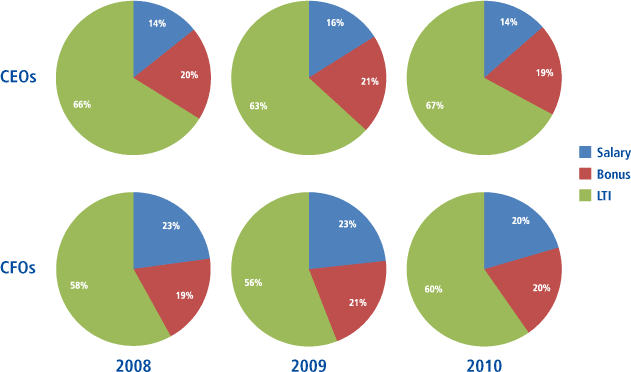
When considering compensation at target levels, the pay mix remained largely unchanged from 2008 to 2010, with a greater emphasis on at-risk pay for CEOs than for CFOs. The pay mix for CFOs slightly shifted towards incentive-based compensation (from 77% in 2008 to 80% in 2010) showing that the pay mix for CFOs is moving closer to that of CEOs.
Long-Term Incentive (LTI) Vehicle Prevalence
The majority of companies awarded LTI to both CEOs and CFOs using at least two vehicles. The prevalence of stock options in the LTI mix declined over the 3-year period while the prevalence of performance-based awards increased. Overall, 83% of CFOs and 85% of CEOs received some form of performance-based awards as part of their LTI program in 2010.
Number of LTI Vehicles Used in 2010
| % in Total | ||
| CEO | CFO | |
| 1 | 13% | 15% |
| 2 | 61% | 54% |
| 3 | 26% | 31% |
| Average | 2 | 2 |
Long-term Incentive Mix
The majority of LTI continues to be delivered in the form of stock options and performance-based LTI, with less emphasis on restricted stock.
LTI Mix
| 2008 | 2009 | 2010 | ||||
| CEO | CFO | CEO | CFO | CEO | CFO | |
| Stock Options | 44% | 41% | 39% | 39% | 34% | 31% |
| Time Vested Restricted Stock | 16% | 22% | 17% | 20% | 17% | 20% |
| Perf. Based LTI | 40% | 37% | 43% | 41% | 49% | 48% |
Conclusion
In the last two years, trends in CFO pay have been directionally aligned with trends in CEO pay. The target pay mix for CFOs has slightly increased the emphasis on incentive compensation relative to fixed compensation, moving closer to the pay mix of CEOs. Salaries are increasing at a faster rate for CFOs but incentive compensation is increasing at about the same pace for both CFOs and CEOs, indicating a link to company performance results, and emphasizing that the role of the CFO continues to be important. We expect companies to continue to ensure that they have the right skill set in the CFO role and develop compensation programs that attract and motivate key talent.
Please contact us at (212) 921-9350 if you have any questions about the issues discussed above or would like to discuss your own executive compensation issues. You can access our website at www.capartners.com for more information on executive compensation.
Seventy companies were invited to participate in the survey and nineteen completed the full survey. Several companies that did not participate expressed interest, but said that they were too early in the decision-making process to respond.
We asked seven questions in the survey. Here is what we found:
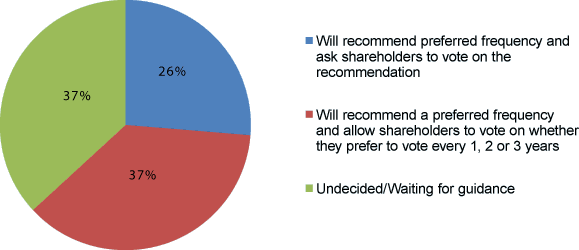
1) Dodd-Frank mandates that companies must solicit a non-binding advisory Say-on-Pay vote from shareholders at least once every three years. Do you anticipate your Board recommending that shareholders approve a specific (preferred) frequency for Say-on-Pay or will you allow shareholders to decide by voting?
The new legislation requires companies to hold a non-binding advisory vote on their executive compensation at least once every three years and to give shareholders the opportunity to vote on the frequency of the Say-on-Pay vote at least every six years. The legislation does not specify the method for the frequency vote (e.g., give shareholders the full range of choices without a recommendation, recommend a preferred frequency but let shareholders pick from the full list, or give the shareholders a yes/no vote on a frequency recommended by management and Board).
The survey results indicate that companies are fairly evenly split between recommending a preferred approach but allowing shareholders to vote on the range of choices (37%) and asking shareholders to vote yes/no on a specific frequency (26%). The remainder of the sample (37%) is undecided or waiting for guidance.
Recommending a Say-on-Pay Vote Frequency to Shareholders
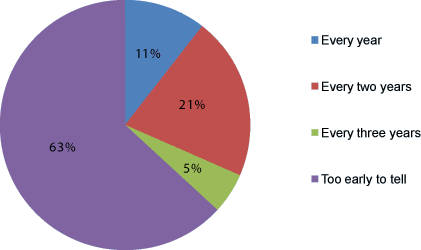
2) If you are going to recommend a preferred frequency to shareholders for Say-on-Pay voting, what do you expect to recommend?
Most companies (63%) say it is too early to tell which frequency they will recommend. Of those that did specify a time period, two years was the most common (21%). But keep in mind that this represents four companies. Given discussions we are having with clients, we would not be surprised if one or three years becomes the more common approach when companies finally implement Say-on Pay.
Choosing a Say-on-Pay Vote Frequency
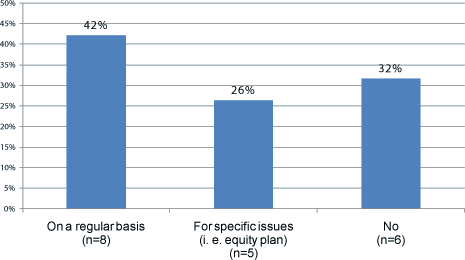
3) Does your company currently engage in active dialogue with your 10 largest shareholders at least once a year on your Company’s executive compensation practices?
Even absent Say-on-Pay, we believe engaging in open and meaningful dialogue with large shareholders is a best practice and can provide insights and avoid surprises. 42% of companies say they currently engage in active dialogue with their shareholders and 26% do so for specific issues (e.g., approval of a new equity plan).
Dialogue with Largest Shareholders
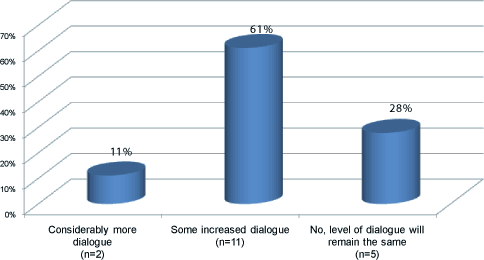
4) Do you anticipate increasing dialogue with your largest shareholders, relative to your executive compensation practices, as a result of the legislation?
We believe companies will increasingly engage their shareholders in dialogue to gain greater insight from them on their views on executive compensation, since this is more informative than a yes/no vote on the full executive compensation program. This is supported by the survey which finds that 70% of respondents expect to increase dialogue with shareholders to at least some degree.
Increasing Dialogue with Largest Shareholders
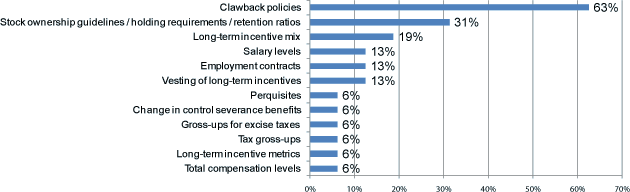
5) Do you anticipate making meaningful changes to any of your executive compensation practices/programs as a result of the Say-on-Pay requirements?
The most commonly anticipated change to executive compensation programs is clawbacks, which is a requirement of the new legislation (63%). Just under one-third of companies anticipate changing their stock ownership and holding requirements. While ownership requirements have been very common, holding requirements (where an executive must hold all or a portion of net shares realized from option exercise (net of taxes and exercise price) and vested equity (net of taxes)) for a specified period time has been an emerging trend. Many more companies may begin to adopt this practice as they try to provide for greater alignment between executives and shareholders.
Anticipated Changes to Executive Compensation Programs*
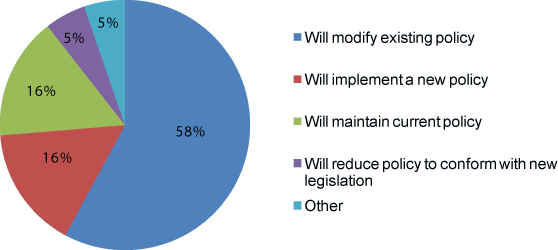
6) Do you anticipate changing or implementing a clawback policy?
Many companies implemented or enhanced their clawback policies in the recent past; however, the new legislation specifies that the period covered span 3 years. Many companies (58%) must adjust their policy to comply with the new requirements.
Clawback Policy
7) Do you anticipate changing or implementing hedging policies?
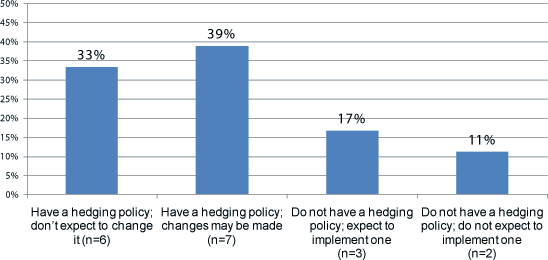
Unlike the clawback requirement, the new legislation does not require a company to implement a hedging policy; however, a company must disclose if it does not have such a policy. 33% of companies currently have a hedging policy and will leave it unchanged. 56% of companies will either implement a policy or anticipate reviewing or changing their current policy. Only 11% state they do not have a hedging policy and do not anticipate implementing one. These companies will have to disclose that they do not have a hedging policy and this may be a negative for shareholders.
Hedging Policy
We hope you find these early findings helpful. Since the SEC will be providing guidance and there is a lot of uncertainty, where companies land on these issues is something of a moving target. Some of the key steps we believe companies should take in the interim include:
- Discussing the implications of the legislation with their Compensation Committee
- Forming a working team to develop a response, including: Human Resources/Compensation, Legal, Investor Relations, outside consultant and legal counsel
- Engaging in dialogues with large institutional shareholders
If you would like to participate in our CAPFlash survey topics going forward, please feel free to sign up at https://www.capartners.com/signup-surveys
* Responses add to more than 100% due to multiple responses by company
***
Please contact us at (212) 921-9350 if you have any questions about the issues discussed above or would like to discuss your own executive compensation issues. You can access our website at www.capartners.com for more information on executive compensation.
What We Found
In response to continued focus on executive compensation and recently enacted legislation, many companies are strengthening governance and other pay practices. The most significant change is the assessment and identification of any material risks arising from compensation programs, required by the SEC for all public companies for the first time in 2010. We also see widespread use of clawbacks, continuing focus on reducing perquisites, executive benefits and eliminating tax gross-ups on perks. Companies are reducing supplemental retirement benefits and continue to emphasize stock ownership guidelines and stock retention requirements.
Compensation Risk Disclosure
The review of material risk arising from compensation programs is an important process, initially required for TARP companies and now required for all public companies by the SEC. Of the 85 companies in our study, 75 companies or 88% make some type of affirmative disclosure related to their assessment of risk in the compensation program. While some companies disclose changes that were made to the compensation programs to discourage risk, none of the companies in our study indicate that their programs can create material adverse risks. The large number of companies including affirmative disclosure in proxy statements is striking, since the disclosure is not required under current rules. Of the 10 companies that did not address compensation risk in their proxy statements, 5 or 50% filed their proxy statements prior to the publication of the SEC’s final disclosure rules in December 2009.
Most of the companies make their risk-related disclosures in the CD&A, with the next most common disclosure being in Section 407, the corporate governance section of the proxy statement. The table below summarizes where risk disclosures were made:
| Section of the Proxy Statement with Compensation Risk Disclosure | No. of Cos. | % of Cos. (n = 75) |
| CD&A | 39 | 52% |
| Section 407 | 19 | 25% |
| CD&A and Section 407 | 7 | 9% |
| Comp Committee Report or Comp Committee Report and CD&A | 2 | 3% |
| Separate Stand Alone Section | 8 | 11% |
The type of disclosure varies significantly, ranging from an in-depth description of the process and key safeguards to just one sentence indicating that the company’s programs do not encourage excessive risk-taking. 71% of the companies that make risk-related disclosures indicate that a formal risk review was conducted and comment on their assessment. Among these companies, the most common approach to the risk review is collaboration between the Compensation Committee, management and the Committee’s independent consultant (20%). The table below summarizes the different approaches used:
| Approach to Compensation Risk Reviews | No. of Cos. | % of Cos. (n = 75) |
| Compensation Committee, Committee’s Consultant and Management | 15 | 20% |
| Compensation Committee and Management | 10 | 13% |
| Compensation Committee and Committee’s Consultant | 9 | 12% |
| Compensation Committee | 7 | 9% |
| Management | 7 | 9% |
| Management and Management’s Consultant | 1 | 1% |
| Not Disclosed | 26 | 35% |
29% of the companies do not describe the risk assessment process and only comment on the results of their assessment of the compensation program. A majority of the companies (84%) describe safeguards that are in place to reduce risk-taking. Such safeguards often include:
- Balanced mix of short and long-term pay
- Use of multiple performance metrics
- Vesting requirements for equity vehicles
- Incentive plan caps
- Clawback policies
- Stock ownership requirements
- Committee discretion and oversight
Clawbacks
The use of clawbacks has increased dramatically in the past few years as a result of SOX and TARP regulations. The policies help alleviate shareholder concerns over managing risk and are viewed as stronger corporate governance. Clawbacks are currently mandated by the SEC for all public company CEOs and CFOs under SOX, for the top 25 executives for participants under TARP, and going forward for executive officers at all public companies as part of the Wall Street Reform and Consumer Protection Act of 2010.
Reflecting broad market trends, a significant majority of our research companies—68 of 85 companies or 80%—maintain some form of clawback provision. For 2009 and 2010, 5 of the 68 companies put a new policy in place and 16 modified existing policies, by expanding the type of compensation that can be recouped, the events that trigger a clawback, or the executives covered.
A financial restatement is required in nearly all cases. Further, 48 companies (71% of those with a clawback) disclose that fraud or misconduct are triggering events. Twelve companies (18%) disclose a non-compete/non-solicitation/confidentiality violation as a trigger, and three include improper ‘risk analysis’ as a trigger.
Based on our review of CD&A disclosures, companies with a clawback include the ability to clawback or recoup the following types of compensation: earned, exercised, outstanding, vested or unvested.
| Compensation Covered in Clawback Policies | No. of Cos. | % of Cos. (n = 68) |
| Incentive compensation (cash or equity) | 40 | 59% |
| Annual incentives only | 5 | 17% |
| Equity incentives only | 5 | 17% |
| Deferred cash | 4 | 6% |
| Severance benefits | 1 | 2% |
| 401k plan (company contributions) | 1 | 2% |
| Future compensation | 7 | 10% |
| Company discretion regarding type of compensation to recoup | 10 | 15% |
Note: Percentages add up to greater than 100% due to multiple responses.
Of interest, examples of some of the less common provisions we found include:
- IBM: Expanded clawback provisions by amending the Excess 401(k) Plus Plan to allow the clawback of Company contributions made after March 2010
- JP Morgan: Failure to identify, raise, or assess, in a timely manner as reasonably expected, risks and/or concerns with respect to risks material to the Firm or its activities, leads to recovery of equity awards for Operating/LOB Management Committee members
- McDonalds: Awards under the severance plan can be recovered if the participant engages in willful fraud that causes harm to the company or is intended to manipulate the performance measures that determine award payouts
- Progressive: Limits recoupment to excess bonus payments as a result of incorrect financial results to the extent that the recovery exceeds the lesser of 5% of the bonus paid or $20,000
In many cases, it is difficult to determine precisely who the clawback policy applies to. Where such disclosure is clear, we note that 17 companies cover all executives in the recovery of any ‘unearned’ compensation, regardless of whether the individuals directly caused any inaccuracy leading to a recovery.
A minority of companies tier their clawback policies, with certain parameters applying to Named Executive Officers, and other parameters applying to a broader ‘executive’ group. In some cases, clawback provisions in long-term incentive awards relate broadly to all eligible award participants.
Many companies did not indicate the time period within which compensation can be recovered after a restatement. Of the 17 cos. that did disclose a time frame for the clawback, the most common is 1 year from the date of restatement, and the range is 1 – 5 years. Three companies indicate that there is no time limit.
Since clawback policies are required by the Wall Street Reform and Consumer Protection Act of 2010 that was recently signed into law, companies will need to review and adopt provisions that align with the new legislation. The law applies to current and former executives who received incentive compensation during the 3 years before the restatement date, with employee misconduct not required as a trigger. SEC guidance is pending.
Stock Ownership Requirements
Stock ownership requirements continue to be an important tool for aligning executives with longer-term shareholder value. The majority of companies have stock ownership guidelines for their executives, typically expressed as a multiple of salary. While less common, many companies also have stock holding requirements where executives must hold a percentage of net shares from stock option exercises or vesting of restricted shares for a period of time. Within our sample, 17 companies, or 20% made changes to their stock ownership requirements. The most significant change among the companies in the study was the adoption or implementation of more restrictive stock holding requirements. Other changes, such as eliminating or extending the compliance time frame, suspending or decreasing ownership guidelines and changing to a fixed number of shares are responses to the volatility in the stock market.
| Type of Change Reported in 2010 CD&A | No. of Cos. | % of Cos. (n = 17) |
| Newly Adopted/More Restrictive Stock Holding Requirements | 8 | 47% |
| Eliminated/Extended Compliance Timeframe | 4 | 24% |
| Increased Stock Ownership Guidelines | 3 | 18% |
| Newly Adopted Stock Ownership Guidelines | 2 | 12% |
| Suspended Ownership Guidelines | 2 | 12% |
| Decreased Stock Ownership Guideline | 1 | 6% |
| Changed Stock Ownership Guideline from Multiple of Salary to Fixed Share Guideline | 1 | 6% |
Note: Percentages add up to greater than 100% due to multiple responses.
Perquisites
Companies continued to reduce perquisites in 2009, building on a trend that has been evident for several years. 16 of 85 companies or 19% of the sample made a change to perquisite programs. A number of companies also eliminated tax gross-ups on perquisites, responding to widespread criticism of this practice.
| Type of Change Reported in 2010 CD&A | No. of Cos. | % of Cos. (n = 16) |
| Reduced perks | 11 | 68% |
| Eliminated tax gross-ups on perks | 10 | 63% |
Note: Percentages add up to greater than 100% due to multiple responses.
The most common reduction in perquisites – seen at 6 of 11 companies (38%) that reduced perquisites—involved curbs on personal use of corporate planes by senior executives. Examples include:
- Eli Lilly: No longer allows executive officers to use company planes for travel to outside board meetings
- Genworth Financial: In 2009, suspended all incidental personal use of corporate aircraft
- MetLife: CEO is no longer required to use the company plane for personal travel
- Morgan Stanley: CEO entered into an aircraft time-sharing agreement with the Company and has since fully reimbursed the Company for the cost of his personal use of the Company aircraft up to the maximum amount permitted by federal aviation regulations
- PNC Financial: Required certain executives to pay for all personal trips on corporate aircraft
- Sara Lee: Terminated all use of its corporate aircraft
Severance And Change In Control Benefits
Given the economic and governance climate, change in control severance benefits have garnered a great deal of attention in recent years from shareholders, advisory groups and the media. In response, program changes have gained traction.
14 of our 85 research companies, or 16%, disclosed changes for 2009/2010 in most recent proxy CD&As consistent with what we are seeing in the broad market:
| Severance and CIC Program Changes | No. of Cos. | % of Cos. (n = 14) |
| Removed excise tax gross up feature – For current participants – For future participants (new hires/ promotions) |
6 2 4 |
43% |
| Changed equity vesting from single to double trigger | 3 | 21% |
| Reduced overall severance and CIC benefits | 2 | 14% |
| Changed definition of pay (bonus) for severance calculation | 2 | 14% |
| Reduced number of eligible participants | 1 | 7% |
| Eliminated executive CIC agreements, introduced exec severance plan | 1 | 7% |
| Increased excise tax cutback threshold above IRS limit | 1 | 7% |
| Eliminated pension supplement | 1 | 7% |
| Reduced benefit continuation period | 1 | 7% |
| Adopted new CIC plan | 1 | 7% |
Note: Percentages add up to greater than 100% due to multiple responses.
Program changes in 8 companies impact current participants and in 6 companies changes apply to new participants only. Five of the 14 companies making changes are in the pharma industry and three are in health care.
Executive Retirement Benefits
Several companies—9 of 85 or 11% of our sample—made changes to executive retirement benefit plans. The most common approach was to reduce supplemental retirement benefits. This might involve closing SERPs to new participants, freezing future benefit accruals or modifying or capping the formula used to calculate benefits.
| Type of Change Reported in 2010 CD&A | No. of Cos. | % of Cos. (n = 9) |
| Froze DB SERP benefits | 4 | 44% |
| Scaled back DB SERP benefits | 2 | 22% |
| Enhanced supplemental DC benefits | 2 | 22% |
| Added retiree medical coverage | 1 | 11% |
Note: Changes to qualified plans available to all employees are not captured here.
Conclusions
In 2009 and 2010, companies continue to reevaluate – and modify – pay and governance practices. Risk assessment disclosure represents the biggest expansion in disclosure requirements. Another trend that emerged is the widespread use of clawbacks. Meanwhile, reductions in perks, change in control severance benefits, and executive retirement benefits, elimination of tax gross-ups, and enhanced stock ownership guidelines continue trends that have been evident for several years. These are all shareholder friendly developments that should improve the alignment between executive compensation and shareholders. We expect companies to continue to re-examine their programs as shareholders continue to demand good governance practices.
***
Please contact us at (212) 921-9350 if you have any questions about the issues discussed above or would like to discuss your own executive compensation issues. You can access our website at www.capartners.com for more information on executive compensation.