- Going forward, a Say on Pay vote will be an annual event at most companies
- A simple majority should not be considered a passing grade
- Companies with stronger performance generally received higher levels of shareholder support
- Say on Pay voting has already been a catalyst for change
As background, on January 25, 2011, the SEC issued final rules implementing Section 951 of the Dodd-Frank Wall Street Reform and Consumer Protection Act (“Dodd-Frank”), which generally provides shareholders of US public companies with the right to cast three types of advisory votes related to executive compensation:
- A vote to approve the compensation of the Named Executive Officers (NEOs), effective for shareholder meetings occurring on or after January 21, 2011;
- A vote on the frequency with which shareholders should be entitled to cast Say on Pay votes (every one, two or three years), effective for shareholder meetings occurring on or after January 21, 2011; and
- A vote on golden parachute arrangements for NEOs related to a sale, consolidation or merger, effective April 25, 2011.
Say on Pay Frequency Vote Results (2011 Proxy Season)
An annual vote frequency has emerged as the clear shareholder preference. Among 93% of S&P 500 companies reporting vote results, a majority of shareholders supported annual Say on Pay vote frequency. This differs from vote recommendations, where only 68% of the companies had recommended an annual vote.
Company Recommendation (n=455)
| Vote Frequency | # of Companies | % of Companies |
| Annual | 310 | 68% |
| Bienniel | 13 | 3% |
| Triennial | 111 | 24% |
| No Recommendation | 21 | 5% |
Vote Results: Received Majority Shareholder Support (n=438)
| Vote Frequency | # of Companies | % of Companies |
| Annual | 409 | 93% |
| Bienniel | 1 | 0% |
| Triennial | 21 | 5% |
| None (only plurality)1 | 7 | 2% |
The strong support for annual votes is not a surprise. 39 institutional investors, representing more than $830 billion in assets, issued a public call for companies and investors to support annual advisory votes on executive compensation in 2011 proxy statements. Similarly, a number of major mutual funds have also indicated support for annual Say on Pay votes, and ISS’ policy recommends that shareholders support annual votes (Glass Lewis has indicated a similar preference).2
CAP Comment: Following the frequency vote, the SEC rules mandate disclosure of how often the company will hold future Say on Pay votes, generally through an 8-K. Issuers must also provide proxy-based disclosure of the current frequency of Say on Pay votes and when the next scheduled Say on Pay vote will occur.
CAP Comment: When companies conduct their Say on Pay vote in line with the frequency preferred by a majority of shareholders, they may exclude shareholder frequency proposals from the proxy for six years.
Say on Pay Vote Results (2011 Proxy Season)
Say on Pay resolutions received majority shareholder support at all but eight S&P 500 companies, with average support of 89% (most companies received greater than 80% support for their NEO pay program).3
| %inFavor | #of Companies | %of Companies | Average1-Yr TSR @12/31/10 | A “threshold” for acceptable passage rates seems to have emerged; to-date, results indicate this threshold is around 80% shareholder support. |
| 90%-100% | 274 | 62% | 25.2% | |
| 80%-90% | 73 | 17% | 24.3% | |
| 70%-80% | 43 | 10% | 16.5% | |
| 50%-70% | 40 | 9% | 7.4% | |
| 0%-50% | 8 | 2% | 9.6% |
As shown above, companies with stronger TSR on a 1-year basis generally received a higher level of support from shareholders on their executive pay programs.
CAP Comment: While a company does not “fail” its Say on Pay vote unless a majority of shareholders vote against the compensation program, many companies have received 90+% shareholder support and an “acceptable” shareholder support threshold has emerged around 80%. Below this level of support, we have found that there often is a notable level of shareholder discontent that should be carefully reviewed.
CAP Comment: While these votes are non-binding, we expect that most companies will carefully evaluate their vote results, taking some action if there is low shareholder support (not just in the limited cases where a majority of shareholders did not support the company’s executive compensation program).
CAP Comment: The final SEC rules require additional disclosure in the CD&A regarding whether, and if so how, companies have considered the results of the most recent Say on Pay vote.
CAP Comment: As a result of the Dodd-Frank legislation, the SEC will eventually adopt rules requiring proxy-based disclosure of the pay-for-performance relationship at each U.S. public company (rules currently schedule to be adopted during 2012).
The eight companies where a majority of shareholders did not support the executive compensation program, and the Say on Pay vote results for these companies, are:
| Company | 1-Yr TSR | % Votes in Favor |
| Hewlett-Packard | -17.7% | 48.2% |
| Freeport-McMoran Copper & Gold | 52.6% | 45.5% |
| Jacobs Engineering | 21.9% | 44.8% |
| Masco Corp. | -6.1% | 44.6% |
| Nabors Industries | 7.2% | 42.5% |
| Janus Capital Group | -3.2% | 40.1% |
| Constellation Energy Group | -10.3% | 38.0% |
| Stanley Black and Decker | 32.7% | 38.0% |
Impact of Proxy Advisor Recommendations
On average, shareholder support for Say on Pay votes was considerably lower when ISS recommended an “Against” vote to shareholders.4,5
|
|
|||||||||||||||||||||
CAP Comment: Where ISS recommended an “Against” vote for Say on Pay, 90% of companies received less than the 80% percent shareholder support threshold discussed above.
As shown below, companies that received an “Against” vote recommendation from ISS generally had lower TSR.
| ISS Vote Recommendation | # Companies that Passed | # Companies that Failed | Total | Average 1-Yr TSR @ 12/31/10 |
| For | 377 | 0 | 377 | 24.3% |
| Against | 53 | 8 | 61 | 10.3% |
| Total | 430 | 8 | 438 | 22.5% |
CAP Comment: Of the 438 companies reporting vote results, to-date, ISS recommended an “Against” vote for Say on Pay at 61 S&P 500 companies (14%). Only 8 of the 61 companies (13%) did not receive majority support for their Named Executive Officer compensation program.
Responding to Proxy Advisor Recommendations
Some notable companies took additional steps related to executive compensation during this proxy season, filing supplementary soliciting materials and/or making last minute modifications to their CEO pay program. Select examples include: General Electric, Disney, ExxonMobil, Johnson & Johnson, Hewlett-Packard, Lockheed Martin, and Northern Trust. While these filings were generally in reaction to negative vote recommendations from shareholder advisory services such as ISS, ExxonMobil went a step further by filing supplementary materials (essentially an executive pay brochure) on the same day as the proxy. ExxonMobil still received a negative vote recommendation from ISS, and later filed additional soliciting material rebutting ISS’ vote recommendation.
Conclusion
During the 2011 proxy season, a clear shareholder preference for annual Say on Pay votes emerged. In terms of the actual Say on Pay vote, an 80% threshold emerged as an “acceptable” level of shareholder support, a significantly higher hurdle than simple a pass / fail test.
Say on Pay has already been a catalyst for change. Companies are more willing to address controversial pay practices than they were a year earlier. Disclosure of executive compensation in proxy statements has evolved, and the influence of proxy/shareholder advisory services (such as ISS) has increased.
Looking forward, companies will need to carefully evaluate their Say on Pay vote result from the 2011 proxy season, and determine how to best incorporate any findings into planning for 2012.
1 None of the three frequency options (annual, biennial, or triennial) received majority support (greater than 50%).
2 For additional detail, see 12/5/10 CAPFlash: “ISS 2011 Policy Updates – Here Comes Say on Pay.”
3 Outside of the S&P 500, an additional 29 companies did not receive majority shareholder support for their NEO compensation program.
4 ISS refers to Institutional Shareholder Services, an influential proxy advisory service. Source of vote recommendations was ISS Voting Analytics.
5 Sample = 434 companies that filed vote results to-date.
The proposed rules are generally consistent with expectations and reflect a straight-forward application of Dodd-Frank. Much of the implementation of this aspect of Dodd-Frank will actually be accomplished through the listing standards adopted by the national securities exchanges, subject to approval by the SEC. For the most part, where there was ambiguity in how to interpret Dodd-Frank’s language, the SEC has passed the responsibility for interpretation on to the national securities exchanges or has let the Dodd-Frank language stand, but solicited comments on whether further clarification is necessary.
The SEC is soliciting comments on a number of aspects of the proposed rules, with a deadline for any comments of April 29, 2011. Below is a summary of the key provisions of the proposed rules based on a review of the full text and accompanying press release. We also provide our own comments on some of the key areas where the SEC is seeking input.
Listing Standards and Compensation Committee Independence
One of the objectives of Dodd-Frank was to ensure the independence of the Compensation Committee. To promote this objective, Dodd-Frank requires that national securities exchanges adopt listing standards to address the following issues:
- Require that Compensation Committee members be independent. Factors that need to be considered in assessing independence include:
- Sources of compensation of a director, including any consulting, advisory or compensatory fee paid by the company to such member of the board of directors
- Whether a member of the board of directors of a company is affiliated with the company, a subsidiary of the company, or an affiliate of a subsidiary of the company
- CAP Comment: The SEC is seeking comments on aspects of this rule including whether they should require minimum independence standards for all exchanges beyond consideration of the two factors above and whether the standards should be based on current relationships only or have a “look back” period. It will be interesting to see if the listing standards converge to a consistent standard or if slight differences remain
- Authority and Funding of the Compensation Committee – Listing standards need to indicate that the Compensation Committee has the authority to obtain a compensation adviser, is directly responsible for the adviser and must be appropriately funded to pay for the adviser
- CAP Comment: This aspect of the rule is more straightforward, but the SEC is seeking comments on technical aspects related to use of legal advisers including the definition of an “independent legal counsel” and the potential need for clarification around the use of in-house legal counsel or the company’s outside counsel. In addition, they are seeking comments on what the typical administrative expenses for Compensation Committees are and whether a provision requiring funding of such expenses would be helpful
- Compensation Adviser Selection: Listing standards must state that the Compensation Committee may select a compensation consultant, legal counsel or other adviser only after considering the following five factors:
- Other services provided to the company by the adviser
- Compensation adviser fees from company as a % of total fees
- Compensation consulting firm’s conflict of interest policies and procedures
- Business or personal relationships between compensation adviser and members of the Compensation Committee
- Compensation adviser’s ownership of company stock
- CAP Comment: In the proposed rules, the SEC did not choose to expand the number of factors to be considered beyond the original five specified in Dodd-Frank. The SEC is soliciting comment on the competitive neutrality of the five factors, potential additions to the factors to consider, and multiple issues for potential clarification (e.g., does adviser refer to the firm or individual providing services?, should there be specific tests/thresholds applied to the five factors?)
- Exemptions: The proposed rules require the exchanges to exempt the following five categories of companies from the Compensation Committee independence requirements:
- Controlled companies
- Limited partnerships
- Companies in bankruptcy proceedings
- Open-end management investment companies
- Foreign private issuers that disclose in annual report why they do not have an independent Compensation Committee
- Note: The proposed rules would authorize exchanges to exempt certain types of relationships or classes of companies from the independence requirements, subject to SEC approval
- CAP Comment: The SEC is soliciting comments on whether certain types of companies (e.g., smaller reporting companies, recent IPOs) should be exempt from the rules or provided with additional time to comply
Compensation Conflicts of Interest Disclosure
The proposed rules will build on the existing disclosure requirements but also require additional disclosure about whether:
- The Compensation Committee has retained or obtained the advice of a Compensation Consultant
- The work of the compensation consultant has raised any conflict of interest, and, if so, the nature of the conflict and how the conflict is being addressed
- The proposed rules would eliminate the current disclosure exception for services that are limited to consulting on broad-based plans and the provision of non-customized benchmark data, but retain the current fee disclosure requirements, including the exemptions from those requirements
- CAP Comment: The SEC is soliciting comments on key aspects of this issue, including whether or not they should attempt to clarify what a “conflict of interest” that must be disclosed is. Another area where they are seeking input is on whether any information related to the five factors under consideration needs to be disclosed
Conclusion
For most of these rules, the impact will be through the new listing standards for the national securities exchanges rather than directly through the SEC’s regulations. For larger companies, Compensation Committee member independence will likely be a non-issue as most already have Compensation Committees made up of all independent directors and it is unlikely that the new listing standards will make the independence requirements significantly more stringent.
On adviser independence, we expect that the outcome will be that companies will likely operate within the general guidance provided by the five factors. Companies will need to develop a process to conduct a review of the five factors and come to their own conclusions about whether or not there is a conflict of interest. Companies may choose to say they evaluated the principles and determined the adviser to be independent. Other may go into more elaborate detail about the process and determination similar to the way companies have addressed the disclosure of risk assessment in compensation.
In addition, the SEC has provided an updated timeline for implementation of other key aspects of the Dodd-Frank legislation related to executive compensation, likely providing companies with additional time to comply with some of the potentially challenging aspects of the legislation.
Highlights of the Final Rules on Say on Pay and Say on Golden Parachutes
Under the Final Rules, the Effective Date for compliance with Say on Pay and the Say on Pay Frequency vote is listed as 60 days following publication in the Federal Register; however, companies that have not yet filed their 2011 proxy statements should comply with the Final Rules.
Advisory Vote on Say on Pay
As in the proposed rules, the final rules require companies to have a Say on Pay Vote in any proxy for an annual meeting after January 21, 2011 and to have additional votes at least once every three years. A key change in the final rules is that smaller issuers (i.e., public companies with less than $75 million in public equity float) have been provided with a two-year exemption from the Say on Pay and Say on Pay frequency votes. Consistent with the Proposed Rules, companies operating under TARP do not need to conduct the Say on Pay frequency vote until they have repaid TARP funds.
The Proposed Rules indicated that in future CD&A disclosure, companies would need to discuss how their compensation policies and decisions have been influenced by past Say on Pay votes. In the Final Rules, this has been clarified to specify that the mandatory disclosure is only for the most recent Say on Pay vote and that disclosure on earlier Say on Pay votes is only necessary to the extent material.
Aside from the above changes, most of the other changes from the Proposed Rules to the Final Rules are technical clarifications (e.g., clarify that the requirement is to have a vote once every three calendar years vs. by the third anniversary of the most recent Say on Pay vote). In addition, the SEC confirmed in the Final Rules that the Say on Pay Proposal and the Say on Pay Frequency Proposal do not trigger a preliminary proxy filing.
Vote on Frequency of Say on Pay Votes
The Final rules on the frequency of Say on Pay votes confirm that shareholders will have to be provided with four choices on frequency:
- Every year
- Every two years
- Every three years
- Abstain
Under the Proposed Rules, companies were required to disclose the frequency with which the company expects to conduct future Say on Pay votes and how it relates to the results of the shareholder vote in the 10-Q or 10-K covering the period in which the shareholder advisory vote occurred. The Final Rules have made a modification to provide companies with more time. Instead of disclosure in a 10-Q or 10-K, they will be required to disclose the frequency of future Say on Pay votes in a new required 8-K disclosure (as an amendment to the prior 8-K filings disclosing the preliminary and final results of the shareholder votes on frequency). The new 8-K will be due no later than 150 calendar days after the date of the vote and no later than 60 days before its next annual proxy meeting filing is due.
In the Proposed Rules, separate shareholder proposals on Say on Pay or Say on Pay frequency could be excluded from the proxy statement provided that the company’s policy was consistent with plurality of votes cast in the most recent vote. The Final Rules strengthened the standard to allow separate Say on Pay or Say on Pay Frequency proposals to be excluded only if the company adopts a Say on Pay frequency consistent with the majority of shareholders. As a result, in cases where no majority emerges in the Say on Pay Frequency vote, separate proposals on Say on Pay and Say on Pay Frequency will not be able to be excluded.
Finally, consistent with the Proposed Rules, companies participating in TARP (which are required to conduct a Say on Pay vote annually) will not be required to conduct a vote on the frequency of the Say on Pay vote until the shareholder meeting immediately following the repayment of TARP funds.
Highlights of the Guidance on Say on Parachutes
The SEC’s Final Rules for new enhanced disclosure of golden parachute payments and an advisory vote on parachute payments closely comply with the Proposed Rules. One key change in the Final Rules is that the effective date is established for merger filings on or after April 25, 2011. It should also be noted that there is no small company exception for the disclosure of golden parachute payments and advisory vote on parachute payments.
Disclosure of Golden Parachute Payments
Consistent with the Proposed Rules, the Final Rules will require tabular disclosure of the following elements related to Golden Parachute payments for each Named Executive Officer:
- Cash severance payments
- Dollar value of accelerated stock awards, in-the-money value of options accelerated, and payments to cancel stock or options
- Pension and deferred compensation enhancements
- Perks and benefits
- Tax reimbursement and gross-up payments
- Other
- Total
A change from the Proposed Rules is that in the Final Rules, for elements that are based on the transaction stock price, the value will be based on the consideration per share in the transaction (where applicable) or the average closing day price for the 5 days immediately following the announcement of the transaction.
Say on Golden Parachute Payments
Consistent with the Proposed Rules, the Final Rules require a separate non-binding shareholder advisory vote on golden parachute compensation, to the extent not previously subject to a prior general Say on Pay vote. In order to ensure that parachute payments are subject to the general Say on Pay vote, companies will have to disclose golden parachute compensation in their proxy statements with the new tabular disclosure and enhanced narrative disclosure of golden parachute payments. In addition, if any changes are made to the golden parachute payments following the most recent vote, the company will have to hold a subsequent vote on golden parachutes. It should be noted that in the Final Rules, the SEC has specified that an additional vote will not be required if the changes to golden parachute payments decrease the value of the parachute payments.
SEC Timing Updates
In order to fully implement Dodd-Frank, the SEC needs to develop rules governing several aspects of the legislation impacting executive compensation. Based on a recent status update from the SEC, the anticipated timing of when rules will be issued has been pushed back in many cases. The table below provides a summary of the current status.
| Proposed Rules | Adopt Final Rules | |
| Compensation Committee and Advisor Independence | January-March, 2011 | April – July, 2011 |
| Disclosure of pay-for-performance, pay ratios, and hedging by employees and directors |
August – December, 2011 | TBD |
| Clawbacks | August – December, 2011 |
TBD |
Based on the updated schedule, it is not clear that many of these items will be implemented in time for the 2012 proxy statements for calendar fiscal year end companies.
Conclusion
The Final Rules are largely consistent with the Proposed Rules. Most companies are already well on their way in the process of putting together their Say on Pay proposals and Say on Pay frequency recommendations and the Final Rules should not have much of an impact on their decision making.
The Final Rules covering increased disclosure of Golden Parachute Payments and Say on Golden Parachutes are largely consistent with the Proposed Rules. We expect that most companies will not adopt the enhanced disclosure of Golden Parachute Payments, as they are likely to have to conduct an additional shareholder vote on Golden Parachute Payments at the time of a transaction that triggers payments in any case.
The delay in the SEC’s schedule will likely be welcomed by companies, so long as it results in a delay for implementation beyond the 2012 proxy season for the new pay-for-performance and pay ratio disclosure. Given the potential challenges in implementing the these aspects of Dodd-Frank, we expect that it would be very difficult for calendar year companies to comply in their 2012 proxy statements, unless final rules were provided before the end of 2011.
Please contact us at (212) 921-9350 if you have any questions about the issues discussed above or would like to discuss your own executive compensation issues. You can access our website at www.capartners.com for more information on executive compensation.
The SEC announced its adoption of the rules on March 3rd. Seven other government regulators are expected to adopt substantially similar provisions, which will cover most financial institutions with assets greater than $1 billion.
The proposed rules will be effective six months after their adoption by all regulators and following a 45-day comment period. Current estimates are that the rules will go into effect sometime in late 2011. Compensation currently being determined for 2010 performance and long-term incentive awards being made now or this spring are unaffected. However, most affected institutions have not previously been subject to this level of review, therefore the process of complying and assessing the impact of the rules on compensation plan design needs to begin now.
Key Provisions
The new proposed rules:
- prohibit most financial institutions in excess of $1 billion in assets from providing incentive compensation arrangements that could encourage inappropriate risk-taking;
- prohibit any incentive arrangement or feature that is excessive or could lead to a material loss;
- require larger institutions whose assets exceed $50 billion to defer 50% of the incentive compensation of executive officers (and select individuals) over a three-year period;
- provide for additional annual reporting for all institutions over $1 billion to their respective regulators on how their incentive plans for executives and identified other individuals are structured to prevent material loss and excessive compensation;
- disclose the policies and procedures in place to monitor and evaluate these arrangements.
Covered Person
Executive officers including senior corporate executives and the heads of major business units, directors, principal shareholders and other individuals whose activities may expose the institution to significant risk.
Definition of Compensation and Excessive Compensation
Compensation includes all direct and indirect payments, fees, and benefits received including those under employment contracts or agreements, in the form of cash or non-cash. It also includes perquisites, stock options, post-employment benefits and any other compensatory arrangement.
Excessive compensation includes amounts that are determined to be unreasonable or disproportionate to the amount, quality and scope of services performed.
Board of Directors’ Role
The Board of Directors, or a designated Committee of the Board, is expected to actively oversee the institution’s incentive arrangements for covered employees, including executives. For larger institutions, the Committee will also need to identify individuals who may expose the company to material risk. In support of strong corporate governance the board’s (or committee) responsibilities would include:
- determining employees other than executive officers in their purview;
- reviewing and approving goals and payments;
- ensuring the alignment of goals with the institution’s overall risk tolerance;
- evaluating appropriate performance periods;
- ensuring risk adjustment of awards as appropriate.
In addition, the Committee would receive data and analyses sufficient to determine whether the arrangements are in compliance and performing in accordance with their terms.
Compensation Standards
The rule reiterates three key standards/ principles for sound compensation practices from earlier Banking Agency Guidance and the Financial Stability Board for determining whether an incentive arrangement is in compliance with the rule.
The incentive arrangement must:
- balance risk and financial rewards;
- be compatible with effective controls and risk management;
- be supported by strong corporate governance.
Deferral of Annual Incentive Compensation (Large Institutions)
The proposal mandates the deferral of 50% of incentive compensation for executive officers (and select individuals) over a three-year period. Incentive compensation is broadly defined in the proposal and would likely cover most forms of compensation other than base salary and salary-related benefits (e.g., employer contributions to a 401(k))
The deferrals may vest on a pro-rata basis, but no more than 1/3 per year. In order to recognize that an annual performance period may be too short a time to recognize the impact of actions taken, the deferred amounts are also subject to adjustment based on actual loss or other aspects of performance that are better evaluated over a longer period.
This provision places the US in closer alignment, but with greater flexibility, with the actions of the UK Financial Stability Authority (FSA) and EU remuneration guidelines.
Annual Reporting
An annual report, filed within ninety days of the financial year, must be made to the appropriate regulator. This report discloses the structure and features of incentive compensation arrangements for covered persons in a manner sufficient to determine whether the plan(s) incents behavior that could contribute to a material financial loss or provide for excessive compensation. The guidance provides that the form of the report is expected to be a clear, succinct narrative description of the plans. Further, it requires disclosure of the policies and procedures put in place to monitor/evaluate incentive plans as well as any changes made since the last report.
Impact of the Proposed Rule on Incentive Compensation
The rule reiterates principles that have been disseminated by multiple regulators since the financial crisis. The focus remains on minimizing risk to the institution and the financial system. The inclusion of all financial institutions over $1B provides for a broader level of compensation supervision than we have seen to date, creating more complexity for smaller institutions likely lacking the infrastructure and governance larger institutions have of necessity put in place. For public companies, recent SEC requirements on risk disclosure have likely started the process and raised Board awareness.
Smaller Institutions
For institutions who have not undergone risk assessments by their regulators or were not CPP (Capital Purchase Plan) participants, the rules will require a thorough review of existing incentive arrangements relative to the principles identified. This assessment would extend to plans that cover employees other than executives, and contain potential for material loss. In addition, the institution will need to develop (with the participation of its Board, or appropriate committee) policies and procedures for monitoring and approving plans that include:
- Significant involvement by risk management in the incentive plan process;
- An assessment of plan features to ensure that they minimize risk;
- A review of payouts to confirm that they are not excessive.
Larger Institutions
Larger institutions have had significant interaction with regulators over the last two years, either as CPP participants or through regulatory reviews which have included incentive compensation. Much of what is required in the proposed rules is similar to the guidance they have received. The requirement for a mandatory deferral of compensation for larger institutions is new.
While initially targeted at executives, individuals and/or groups who may expose the institution to losses, it is unclear how deep this policy will be extended. Companies that have undergone regulatory review have difficulty in clearly defining or segregating individuals and groups who are in a position to expose the institution to risk from other positions within their organization. This may have the unintended consequence of leading to the greater use of deferrals throughout institutions.
Additionally, the design of deferral features, allowing for risk adjustment due to material loss or changes in performance that can be linked to actions directly taken by these individuals, is more complex than it appears. The proposal suggests that adjustments can be determined quantitatively or subjectively. It is likely that Compensation Committees will prefer quantitative criteria but will also retain some judgment. Other suggestions from the regulators (not required) for minimizing the potential for loss include lengthening performance periods overall, reducing reliance on annual incentives and de-levering incentive awards at higher levels of performance.
The guidance makes no distinction between how companies structure incentive compensation. For example, many Wall Street firms have a compensation model that delivers total compensation (salary plus incentive compensation) for a year based on performance in that year. The incentive compensation is delivered to executives in a mix of fixed annual cash bonus and equity (e.g., stock options, restricted stock). Other financial services companies have a different compensation model where annual cash bonuses are based on annual performance, but the amount of equity-based compensation provided to executives is not necessarily dependent on annual performance. The proposed rules seem to have been designed with the Wall Street incentive compensation model in mind.
The rule does not mandate the form of a deferral – a departure from UK and European regulations that are more prescriptive. A variety of incentive programs utilized today don’t fit neatly into a “bonus deferral” and questions will be posed about how to apply the proposal to these forms of compensation. Some include:
- Stock options – does a three or four year vesting period meet the deferral requirement if the executive exercises no more than 1/3 per year of the award by the third anniversary of grant?
- Performance-based restricted stock – does a three-year cliff vest on the shares, assuming performance is met, substitute for the three-year deferral requirement?
- Performance shares or units – does the award need to be held post the three-year performance period to allow for a performance adjustment?
Boards and Committees that have been heavily involved in risk assessments over the last two years, will see the rules as confirmation of their oversight of compensation for all employees and a significant expansion of their charter. These additional responsibilities will require support from management and corporate functions – particularly risk, finance and human resources in order to meet the greater demands.
Please contact us at (212) 921-9350 if you have any questions about the issues discussed above or would like to discuss your own executive compensation issues. You can access our website at www.capartners.com for more information on executive compensation.
- Modified burn rate policy
- Recommendation for annual Say on Pay vote frequency
- Modified definition of “egregious” pay practices
- No longer accepting future commitments to revise practices as a means to prevent or reverse a negative vote recommendation
- A policy for vote recommendations on Say on Golden Parachutes
Changes in Equity Compensation Plan Burn Rate Policy
As a means of limiting the impact of market volatility on its equity burn rate analysis, ISS decided to limit “year-to-year changes possible in allowable [burn rate] caps” (important as ISS uses its burn rate cap to assess a company’s use of equity relative to industry peers) to no more than two percentage points.
Later this month, ISS plans to publish the related (updated) industry-specific burn rate table that will be used to determine its equity plan approval (or additional share request) vote recommendations.
Say on Pay Vote Frequency
Under the recent Dodd-Frank legislation, companies are required to provide shareholders with a non-binding choice on the frequency of a non-binding Say on Pay vote, with the options being every 1, 2, or 3 years. ISS is strongly advocating annual Say on Pay votes; ISS believes that annual Say on Pay votes provide for the “most consistent and clear communication channel for shareholder concerns about companies’ executive pay programs.”
Therefore, if a company plans to recommend / support a non-annual vote frequency, we recommend that the company’s management (possibly with the assistance of their outside advisors) reach out to major shareholders as their proxy filing is prepared. This is important to do ahead of time as ISS has a policy to recommend Withhold or Against votes for the entire Board of Directors if the Board fails to act on a shareholder proposal that received approval by a majority of the shares outstanding. That said, it is remains to be seen how this policy will apply to companies that do not comply with the voting preferences of the plurality of shareholders for Say on Pay frequency. This is an issue that will likely receive attention from ISS in the future.
Individual Problematic Pay Practices / Negative Say on Pay Recommendations
ISS highlighted specific problematic pay practices that it views as particularly egregious and may independently, “by themselves, [be] sufficiently problematic to warrant Withhold or Against votes in most circumstances.” These “egregious” pay practices include:
- Repricing or replacing underwater stock options / SARs without shareholder approval (including cash buyouts and voluntary surrender of underwater options)
- Excessive perquisites or tax gross-ups, including any gross-up related to a secular trust or restricted stock vesting
- New or extended agreements that provide for:
- CIC (Change in Control) payments exceeding 3x base salary and average/target/most recent bonus
- CIC severance payments without involuntary job loss or substantial diminution of duties (“single” or “modified single” triggers)
- CIC payments with excise tax gross-ups (including “modified” gross-up)
Companies with these “egregious” practices can generally expect:
- Against vote recommendations for Say on Pay
- Against / Withhold recommendations on Compensation Committee members:
- In egregious situations (ISS does not define what this is)
- When no Say on Pay vote is on the ballot (potentially an argument for annual Say on Pay votes)
- When Board has failed to respond to concerns from prior Say on Pay votes
- Against equity incentive plan proposal if excessive non-performance-based equity awards are major contributors for pay-for-performance misalignment.
ISS also states that agreements with evergreen provisions will receive “particular scrutiny,” possibly because they provide an avenue for grandfathering “egregious” pay practices indefinitely. What is somewhat unclear is that despite the above mentioned policy update, ISS continues to state that it will continue to evaluate programs on a case-by-case basis in the context of a company’s overall pay program and historic pay actions, including other problematic pay practices cited in the past.
In all likelihood, a result of this policy update will be more companies receiving negative vote recommendations from ISS. Therefore, if companies plan to maintain or add any of these compensation program features, it is especially important that they proactively initiate dialogue with their largest shareholders to provide the rationale for why these pay practices are in shareholders’ interests.
Future Commitments / Negative Recommendations
ISS says that it will no longer accept “future commitments on problematic pay practices as a way of preventing or reversing a negative vote recommendation,” with the associated rationale that its policies are widely available and have been well known for some time. ISS also goes a step further in critiquing the corporate governance process, by stating that companies need to spend more time considering a “cure” for such practices.
There are, however, some exceptions to this policy. ISS states that exceptions now include:
- Pay-for-performance and burn rate commitments
- Plan language related to certain equity grant practices (e.g., liberal CIC definition)
Criteria for Recommendations on Say on Golden Parachutes
ISS’ policy is to take a case-by-case approach regarding recommendations for the vote on golden parachute compensation. The vote recommendation will be consistent with ISS’ pre-existing policies on problematic pay practices related to severance packages. Specific features identified as potentially leading to an Against vote include:
- Recently adopted or materially amended agreements that include excise tax gross-up provisions (since prior annual meeting)
- Recently adopted or materially amended agreements that include modified single triggers (since prior annual meeting)
- Single trigger payments that will happen immediately upon a change in control, including cash payment and such items as the acceleration of performance-based equity despite the failure to achieve performance measures
- Single trigger vesting of equity based on a definition of change in control that requires only shareholder approval of the transaction (rather than consummation)
- Potentially excessive severance payments
- Recent amendments or other changes that may make packages so attractive as to influence merger agreements that may not be in the best interests of shareholders
- In the case of a substantial gross-up from pre-existing/grandfathered contract: the element that triggered the gross-up (i.e., option mega-grants at low point in stock price, unusual or outsized payments in cash or equity made or negotiated prior to the merger)
- The company’s assertion that a proposed transaction is conditioned on shareholder approval of the golden parachute advisory vote. ISS would view this as problematic from a corporate governance perspective
ISS indicated that in cases where the golden parachute vote is incorporated into the overall Say on Pay vote for the company, ISS may place a heavier weight on golden parachute compensation in determining its vote recommendations for Say on Pay. In our view, the new guideline is largely consistent with ISS’ existing policies on severance compensation and should not present problems for companies that have moved to address their change-in-control severance practices.
Conclusions
Due to ISS’ level of influence, it is important for companies / Committee members to be aware of its policies. If ISS voting recommendations strongly influence a company’s shareholder base, those companies should regularly review their programs against ISS policies and educate their directors on the impact of the policies, so as to not be surprised by an ISS voting recommendation.
Further, Say on Pay will receive a lot of attention during the upcoming proxy season, and ISS has expressed a clear preference for annual votes. If companies do not provide for an annual Say on Pay vote, ISS will likely use Against or Withhold vote recommendations on director elections as its means to express dissatisfaction with compensation programs.
***
Please contact us at (212) 921-9350 if you have any questions about the issues discussed above or would like to discuss your own executive compensation issues. You can access our website at www.capartners.com for more information on executive compensation.
The timing of the final rules may create challenges for companies with shareholder meetings the first quarter of 2011, as Say on Pay is required for all proxy statements filed for annual meetings after January 21, 2011. For companies with annual meetings after January 21, 2011, but before the final rules are issued, the proposed rules will have to serve as the final guidance for developing their Say on Pay proposals.
Highlights of the Guidance on Say on Pay
The proposed rules contain some good news for companies, as the SEC confirmed that the new advisory votes on Say on Pay and Say on Pay frequency will not trigger the filing of a preliminary proxy statement. The SEC also directed that broker discretionary voting of uninstructed shares is not permitted for Say on Pay or Say on Pay frequency votes. Below are highlights of the proposed rules for the Say on Pay and Say on Pay Frequency votes.
Advisory Vote on Say on Pay
The SEC guidance does not specify a form for the language of the Say on Pay vote resolution. However, the proposed rules state that the resolution should indicate that the vote is advisory only and that the vote will cover all aspects of executive compensation for the Named Executive Officers of the company as disclosed in the CD&A, compensation tables and accompanying narrative. Compensation of directors and the risk assessment of the compensation programs for all employees are not intended to be included in the Say on Pay vote. In future CD&A disclosure, companies will need to discuss how their compensation policies and decisions have been influenced by past Say on Pay votes.
Vote on Frequency of Say on Pay Votes
The SEC guidance on the frequency of Say on Pay votes confirms that shareholders will have to be provided with four choices on frequency:
- Every year
- Every two years
- Every three years
- Abstain
While companies are required to provide shareholders with all four of the above choices, the proposed rules do not preclude the company from stating its preference among the alternatives. In the proposed rules, the SEC also confirmed that the vote on the frequency of the Say on Pay vote is advisory in nature and not binding on the company. That is, if a company’s stated frequency preference does not win the plurality of votes, the company can still go ahead and conduct the Say on Pay vote with its preferred frequency.
However, as proposed, the rules will require companies to disclose in the 10-Q or 10-K immediately following the Say on Pay vote whether the company expects to conduct future Say on Pay votes with the frequency selected by the plurality of shareholder votes. Separate shareholder proposals on Say on Pay or Say on Pay frequency may be excluded from the proxy statement provided that the company’s policy is consistent with plurality of votes cast in the most recent vote. Given the above, companies may have a strong incentive to structure the frequency of their Say on Pay votes in accordance with shareholder preferences.
The SEC recognizes that a vote with four choices will raise implementation challenges for companies, as shareholder voting typically follows a yes/no voting format. However, based on the way the Dodd-Frank rules were written, there was little room to interpret the rules as providing for anything other than four choices.
Finally, companies participating in TARP (which are required to conduct a Say on Pay vote annually) will not be required to conduct a vote on the frequency of the Say on Pay vote until the shareholder meeting immediately following the repayment of TARP funds.
Highlights of the Guidance on Say on Parachutes
The SEC’s proposed rules for new enhanced disclosure of golden parachute payments and an advisory vote on parachute payments state that the rules will be effective for proxy or consent solicitations to approve mergers or other transactions after the effective date of SEC amendment to disclosure rules (expected in the first quarter of 2011). This timing is later than expected and is helpful to companies as the new disclosure rules may be challenging to implement.
Disclosure of Golden Parachute Payments
In response to Dodd-Frank’s requirement of disclosure of golden parachute compensation in a “clear and simple form”, the proposed rules will require a new compensation table covering golden parachute compensation to NEOs, including the following elements for each named executive officer:
- Cash severance payments
- Dollar value of accelerated stock awards, in-the-money value of options accelerated, and payments to cancel stock or options
- Pension and deferred compensation enhancements
- Perks and benefits
- Tax reimbursement and gross-up payments
- Other
- Total
Footnotes to the table will require disclosure of what payments are single trigger (triggered by change in control only) and double trigger (triggered by a change in control and termination of employment). In the tabular disclosure, equity will need to be valued based on the stock price as of the last practicable date before the proxy filing. The table will be accompanied by narrative disclosure of the timing of the payments and any conditions that would apply to payments, including covenants (e.g., non-compete, non-solicitation).
Say on Golden Parachute Payments
The new rules require a separate non-binding shareholder advisory vote on golden parachute compensation, to the extent not previously subject to a prior general Say on Pay vote. In order to ensure that parachute payments are subject to the general Say on Pay vote, companies will have to disclose golden parachute compensation in their proxy statements with the new tabular disclosure and enhanced narrative disclosure of golden parachute payments.
It is not clear whether companies will decide to adopt the new disclosure in their proxy statements to ensure that they are subject to the general Say on Pay vote. While there will be some additional disclosure burden involved in providing the new tabular disclosure, many companies are already providing tabular disclosure of termination payments in their annual proxy statements. For these companies, it may be a simple extension of their current disclosure to comply with the new requirements. In any case, disclosure in compliance with the new rules will be required in the merger proxy statement.
Conclusion
The proposed rules have provided adequate clarity for companies to begin developing their Say on Pay and Say on Pay frequency resolutions. While the SEC is seeking comment on a number of aspects of the proposed rules, we expect the final rules to be largely consistent with the proposed rules. In developing the Say on Pay frequency resolution, we expect that most companies will state a preference for the frequency of the vote. Immediately following the passage of Dodd-Frank, our sense was that most companies would prefer biennial or triennial Say on Pay vote frequency; however, based on our discussions with clients we are seeing a trend toward a preference for an annual vote frequency.
The proposed rules for the Say on Golden Parachutes increase the disclosure requirements for companies, but will likely improve the quality of the disclosure from a shareholder’s perspective. It will be interesting to see whether companies choose to voluntarily adopt the new disclosure requirements for golden parachute compensation in annual proxy statements to ensure that golden parachute compensation is subject to the general Say on Pay vote.
Seventy companies were invited to participate in the survey and nineteen completed the full survey. Several companies that did not participate expressed interest, but said that they were too early in the decision-making process to respond.
We asked seven questions in the survey. Here is what we found:
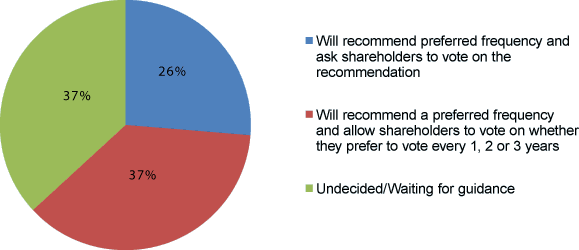
1) Dodd-Frank mandates that companies must solicit a non-binding advisory Say-on-Pay vote from shareholders at least once every three years. Do you anticipate your Board recommending that shareholders approve a specific (preferred) frequency for Say-on-Pay or will you allow shareholders to decide by voting?
The new legislation requires companies to hold a non-binding advisory vote on their executive compensation at least once every three years and to give shareholders the opportunity to vote on the frequency of the Say-on-Pay vote at least every six years. The legislation does not specify the method for the frequency vote (e.g., give shareholders the full range of choices without a recommendation, recommend a preferred frequency but let shareholders pick from the full list, or give the shareholders a yes/no vote on a frequency recommended by management and Board).
The survey results indicate that companies are fairly evenly split between recommending a preferred approach but allowing shareholders to vote on the range of choices (37%) and asking shareholders to vote yes/no on a specific frequency (26%). The remainder of the sample (37%) is undecided or waiting for guidance.
Recommending a Say-on-Pay Vote Frequency to Shareholders
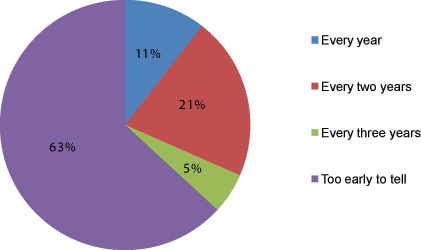
2) If you are going to recommend a preferred frequency to shareholders for Say-on-Pay voting, what do you expect to recommend?
Most companies (63%) say it is too early to tell which frequency they will recommend. Of those that did specify a time period, two years was the most common (21%). But keep in mind that this represents four companies. Given discussions we are having with clients, we would not be surprised if one or three years becomes the more common approach when companies finally implement Say-on Pay.
Choosing a Say-on-Pay Vote Frequency
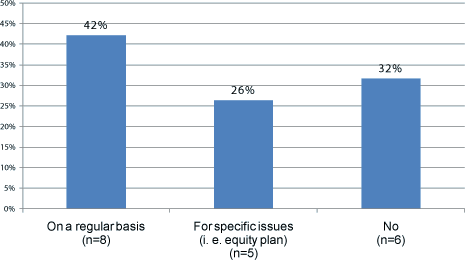
3) Does your company currently engage in active dialogue with your 10 largest shareholders at least once a year on your Company’s executive compensation practices?
Even absent Say-on-Pay, we believe engaging in open and meaningful dialogue with large shareholders is a best practice and can provide insights and avoid surprises. 42% of companies say they currently engage in active dialogue with their shareholders and 26% do so for specific issues (e.g., approval of a new equity plan).
Dialogue with Largest Shareholders
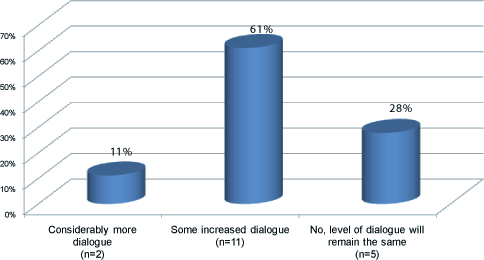
4) Do you anticipate increasing dialogue with your largest shareholders, relative to your executive compensation practices, as a result of the legislation?
We believe companies will increasingly engage their shareholders in dialogue to gain greater insight from them on their views on executive compensation, since this is more informative than a yes/no vote on the full executive compensation program. This is supported by the survey which finds that 70% of respondents expect to increase dialogue with shareholders to at least some degree.
Increasing Dialogue with Largest Shareholders
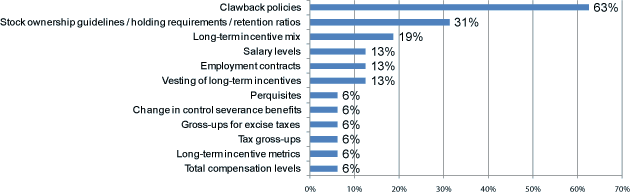
5) Do you anticipate making meaningful changes to any of your executive compensation practices/programs as a result of the Say-on-Pay requirements?
The most commonly anticipated change to executive compensation programs is clawbacks, which is a requirement of the new legislation (63%). Just under one-third of companies anticipate changing their stock ownership and holding requirements. While ownership requirements have been very common, holding requirements (where an executive must hold all or a portion of net shares realized from option exercise (net of taxes and exercise price) and vested equity (net of taxes)) for a specified period time has been an emerging trend. Many more companies may begin to adopt this practice as they try to provide for greater alignment between executives and shareholders.
Anticipated Changes to Executive Compensation Programs*
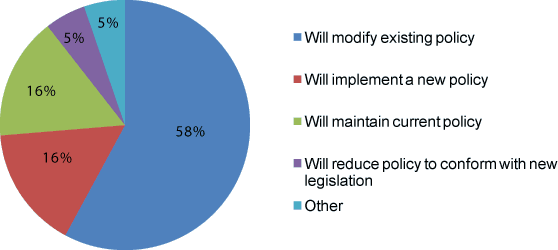
6) Do you anticipate changing or implementing a clawback policy?
Many companies implemented or enhanced their clawback policies in the recent past; however, the new legislation specifies that the period covered span 3 years. Many companies (58%) must adjust their policy to comply with the new requirements.
Clawback Policy
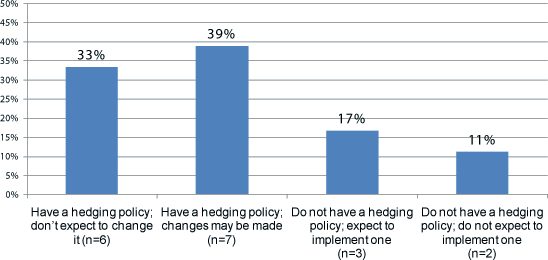
7) Do you anticipate changing or implementing hedging policies?
Unlike the clawback requirement, the new legislation does not require a company to implement a hedging policy; however, a company must disclose if it does not have such a policy. 33% of companies currently have a hedging policy and will leave it unchanged. 56% of companies will either implement a policy or anticipate reviewing or changing their current policy. Only 11% state they do not have a hedging policy and do not anticipate implementing one. These companies will have to disclose that they do not have a hedging policy and this may be a negative for shareholders.
Hedging Policy
We hope you find these early findings helpful. Since the SEC will be providing guidance and there is a lot of uncertainty, where companies land on these issues is something of a moving target. Some of the key steps we believe companies should take in the interim include:
- Discussing the implications of the legislation with their Compensation Committee
- Forming a working team to develop a response, including: Human Resources/Compensation, Legal, Investor Relations, outside consultant and legal counsel
- Engaging in dialogues with large institutional shareholders
If you would like to participate in our CAPFlash survey topics going forward, please feel free to sign up at https://www.capartners.com/signup-surveys
* Responses add to more than 100% due to multiple responses by company
***
Please contact us at (212) 921-9350 if you have any questions about the issues discussed above or would like to discuss your own executive compensation issues. You can access our website at www.capartners.com for more information on executive compensation.