Underlying the Federal Reserve’s input to financial institutions is a legitimate concern about the potential for incentives to take on excessive risk. From our interactions with clients and observing the practices of the industry as a whole, there is no doubt that financial services firms have made significant progress addressing risk in a much more comprehensive way, with cross-functional teams addressing a wide variety/forms of organizational risk. Much of the work that financial services firms have done initially has less to do with compensation and has been primarily focused on understanding the nature of the risks in their organizations and developing robust processes to effectively control and monitor risk.
While financial services companies have made great strides in improving risk management, they have not been let off the hook by regulators when it comes to compensation design. Instead, over the past three years, as risk management processes have vastly improved, the Federal Reserve has become progressively more detailed in the compensation-related input they provide to regulated institutions. The Federal Reserve has provided guidance to companies on specific areas of executive compensation calling for some of the following types of changes, beyond the mandated deferral of compensation for the most senior executives (Tier 1 covered employees):
- Include Risk Review in Annual Incentive Design: Pressure to include some form of a formal risk review at the individual and company-wide level in annual incentive decisions [Early Principle]. This has been accomplished through the development of enterprise risk frameworks that monitor company-wide risk and individual evaluations that heavily weight individual activities that could promote negative risk outcomes in the assessment.
- Performance-Based Vesting of Long-term Incentives: The Federal Reserve expects companies to be able to affect the initial grant size, and even more importantly, the amount that ultimately vests (even down to zero) based on these risk assessments of the individual and/or the company.
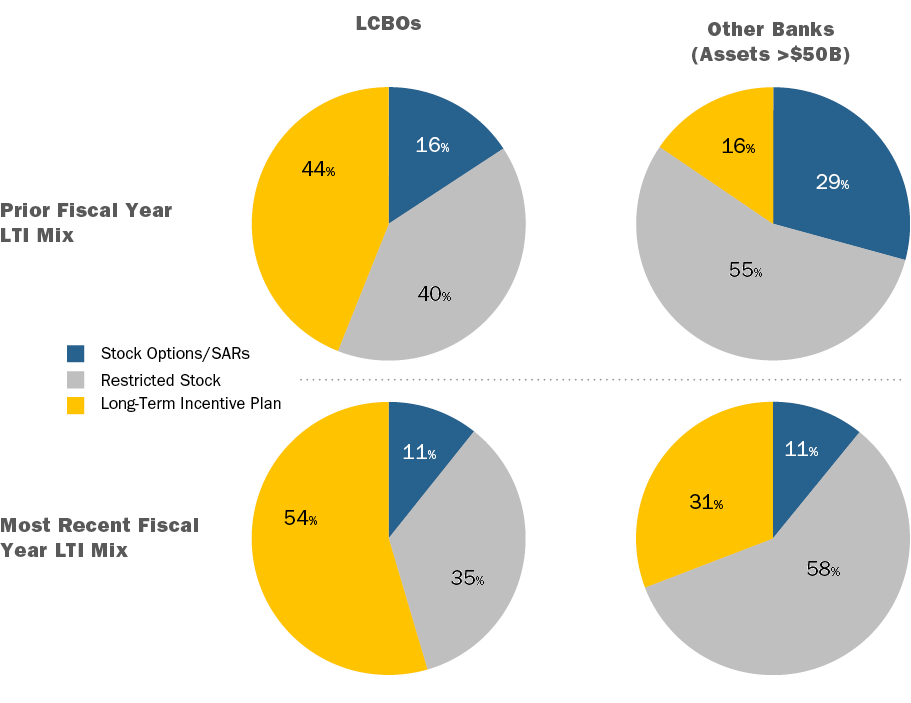
- Reduce Use of Stock Options: The Federal Reserve has long been concerned that the asymmetrical nature of stock options can create incentives for employees to take on excessive risk and therefore has encouraged companies to eliminate, or at a minimum, reduce stock options as a percentage of total incentive compensation.
- Reduce Incentive Plan Upside Leverage (Annual and Long-term Incentive Plans): Companies with plans that stipulate a specified maximum award have been directed to reduce incentive plan leverage from the historical industry and broader market standard maximum incentive opportunity of 200% of target to 125%-150% of target.
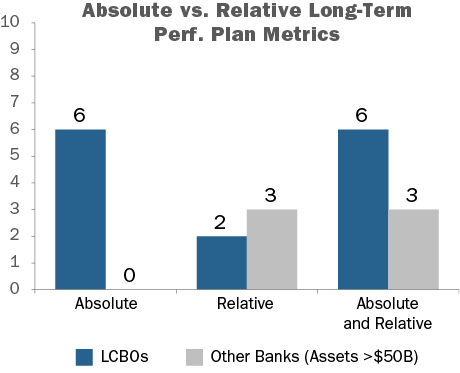
- Reduce or Eliminate Relative Performance Measures: The Federal Reserve is concerned that relative measures may reward companies for under-performance and could lead companies to take on excessive risk to “chase after” leading performers. They prefer absolute performance objectives that are more easily communicated to executives.
Methodology and Findings
CAP reviewed the 2012 and 2013 proxy statements of the 23 publicly-traded financial services companies1 that were included as part of the Federal Reserve’s horizontal review of incentive compensation. Our analysis looked for year-over-year changes in compensation structure, annual and long-term incentive design, performance-based vesting, recoupment policies, stock ownership guidelines, and retention requirements.
It should be noted that not all banks with assets >$50 billion have fully disclosed the changes to their compensation programs, because some of these institutions are in an earlier stage of the process of interaction with the Federal Reserve. For them, 2013 will be an active year for the evolution of their executive compensation programs.
The most significant findings are among the LCBOs since they have been undergoing the review process for a longer period of time. Among these companies, we have seen a great deal of year-over-year change, with many adopting the features discussed above; however, management and Compensation Committees also recognize that the Federal Reserve is one of multiple constituencies that they need to address in compensation design. While the Federal Reserve is actively involved, shareholders also have expectations and an ability to express these views through Say on Pay votes and other constituencies who are active as well (e.g., employees, retirees, shareholder advisory groups). As a result, companies are more adamant about retaining aspects of the compensation program design (e.g., relative performance metrics in performance share plans, stock options, incentive plan upside opportunity at or above 150% of target) to address the views of these groups.
Compensation Structure
Financial services firms generally operate under two main types of compensation structures. The first approach is an “investment banking” style of compensation model (e.g., Bank of America, Goldman Sachs, JPMorgan Chase). Under this approach, each year a total incentive is determined based on a review of the prior year’s performance. The total incentive is delivered to executives as a mix of annual cash incentive and long-term incentives. In the past the long-term incentive piece was often delivered as time-vested restricted stock and potentially stock options, but this mix has changed over time.
The second approach is a more traditional compensation model common across most other industries, where the annual incentive is based on the prior year’s performance and the long-term incentive grant is viewed as a separate decision, with the target long-term compensation opportunity based on future performance and the grant value is independent of prior year performance.
A recent development over the past two years is that companies that have historically used either the investment banking structure or the more traditional structure have moved to adopt a hybrid approach where the annual incentive is determined based on prior year performance and delivered in a mix of current cash and/or deferred equity/cash and a separate long-term incentive is also provided:
- Morgan Stanley: Moved from an investment banking style to have two separate incentives: 1) annual incentive delivered through a mix of deferred cash and stock options, 2) long-term incentive delivered as a performance LTIP
- Citigroup: Maintains an investment banking structure, but this year added a performance scorecard approach to determine size of incentive compensation and changed delivery to 40% annual cash, 30% deferred stock, 30% performance share units
- BNY Mellon: Historically used a more traditional pay model approach and has shifted its performance scorecard to determine a larger portion of overall incentive compensation. Seventy percent of the total incentive is delivered in a mix of cash and restricted stock, with the remaining thirty percent of total incentive in a performance share plan.
Risk Adjustment in Annual Incentive
All companies now include corporate and individual risk assessments in the process for determining the size of annual incentive pools and individual awards. Frequently these adjustments are intended to provide an ability for the Compensation Committee to apply negative discretion to reduce or eliminate the annual incentive payout if the company or an executive is found to have incurred a material negative risk event or to cover any individual who has failed to demonstrate adequate sensitivity to risk or the firm as a whole had subpar risk results. Both recoupment and/or clawback policies are now widespread.
Incentive Plan Upside Leverage
An area where the Federal Reserve appears to be surprisingly prescriptive is in encouraging companies to reduce incentive plan upside opportunities. From a compensation perspective, this runs counter to designs that are preferred by shareholders who expect a strong pay-for-performance program. The Federal Reserve is opposed to formulaic plans that can lead to substantial payouts when performance is strong, but does not necessarily understand that discretionary plans can lead to comparable payouts. A potentially unintended consequence of this point of view is to encourage companies to reduce the transparency of incentive plan design leading to reduced line-of-sight for executives. An important tenet of compensation theory is that executives have a clear understanding of the process and approach that will be used to determine their incentive. Given the Federal Reserve’s preference for discretion, the relationship between performance results and incentive payouts may be weakened, particularly at higher performance levels. Again, regulatory guidance may lead to a major misalignment with shareholders.
Shareholders also prefer incentive plans with direct linkage between payouts and pre-established performance objectives. They are concerned that discretion is frequently used to the advantage of executives and at the expense of shareholders. However, recognizing the concerns of the Federal Reserve, firms have reduced the maximum opportunity from 200% of target (a broad industry company standard) to 150% or 125% of target so they can continue to address shareholder desires for a more formulaic structure while mitigating Federal Reserve concerns about leverage.
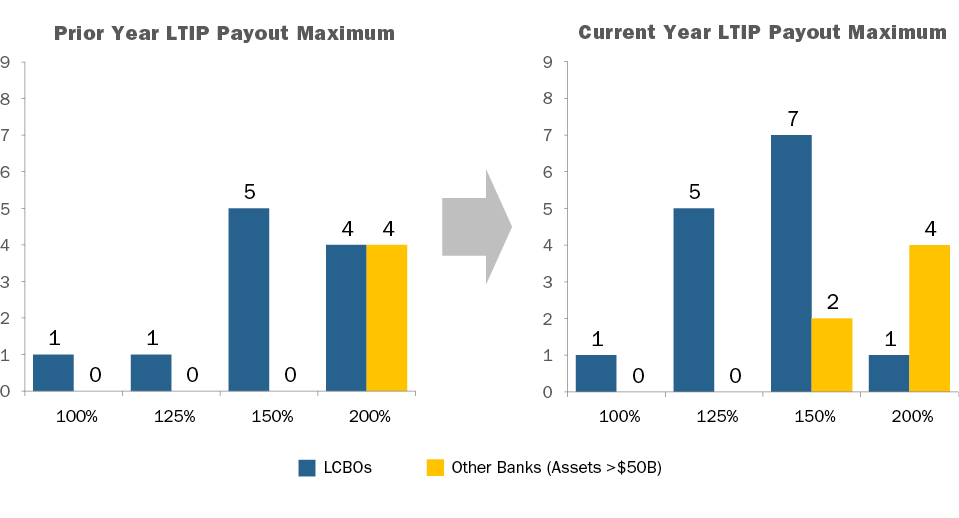
Other potential unintended consequences we may see in the future are: 1) an increase in the value assigned to target incentive opportunities to provide more motivation (and compensation) to executives, thereby increasing pay at lower performance levels, or 2) a move toward a more discretionary determination of incentive payouts to avoid the need to establish a target/maximum incentive opportunity. Neither of these approaches is particularly attractive from a shareholder perspective since both are less performance-based.
Reduce/Eliminate Use of Relative Measures
The Federal Reserve believes that relative performance measures may provide the wrong incentives to management teams. The rationale appears to be based on three concerns:
- Relative performance measures do not communicate a clear goal to management teams, as the performance objective is a moving target, based not only on the firm’s performance, but also on the performance of its peers
- Performance can be strong on a relative basis, but be poor on an absolute basis (for example, the best performing banks in 2008 and 2009 were still poor performers on an absolute basis)
- If a firm falls behind its peers, they may have incentives to take on excessive risk in an attempt to “catch up” with the competition
Benchmarking/indexing is common in many business areas (e.g., investment performance, financial performance, etc.) that do not relate, necessarily, to pay. Historically, shareholders and other external constituents have pushed for more companies to use relative performance measures as they are viewed as a “truer” measure of company performance that is less subject to “sandbagging” by management or the influence of market or other external factors (all boats rise…). In addition, shareholder advisors rely heavily on relative performance comparisons in making Say on Pay vote recommendations.
Based on our analysis, this is an area where companies have been reluctant to make a shift. About 60% of the companies that we analyzed continue to use relative performance measures as part of their long-term incentive design. It is a fairly even mix between relative TSR and relative Return on Equity, with a few companies using other financial metrics. The majority of companies now combine the relative measures with an absolute financial performance measure, most typically Return on Equity to provide the appropriate risk-balancing the Federal Reserve has been seeking.
Reduced Use of Stock Options
To state it plainly, the Federal Reserve does not like stock options as an incentive vehicle. Its concerns are similar to those raised by other critics of stock options in the past. Stock options may encourage executives to take on additional risk to increase the stock price, but do not focus management on avoiding decreases in the stock price. From a shareholder perspective, stock options have historically been an attractive vehicle because executives only receive value when the stock price appreciates. Many Compensation Committee members also like that stock options do not require the negotiation of goal setting associated with long-term performance plans. When used in combination with ownership guidelines and post-exercise holding requirements, many of the concerns with options can be addressed.
Most companies in the financial services industry have recently reduced or eliminated the use of stock options (eliminated by Bank of America, BNY Mellon, Citigroup, Discover Financial, Goldman Sachs, PNC, Regions, and Wells Fargo; reduced by BB&T, Comerica, Fifth Third, Huntington Bancshares, KeyCorp, Northern Trust, and US Bancorp). We expect this trend to continue. Stock options have largely been replaced by performance shares. While the Federal Reserve tends to like time-vested restricted stock, shareholders are not enamored by the vehicle as it is often viewed as a form of semi-guaranteed (i.e., non-performance-based) compensation.
Performance–Based Vesting of Long-term Incentives
As part of the Federal Reserve’s original guidance, they required deferral of at least 50% of incentive compensation for Tier 1 executives, and strongly encouraged that deferred compensation be subject to potential reduction (company-wide or individually) if performance was poor in subsequent periods. This is an area where substantially all banks have responded with recoupment and clawback policies effective in 2012 or 2013.
Companies have added adjustments to long-term incentives in a few ways:
- Added a risk-based vesting measure to what would otherwise be a time-vested award of stock options or restricted stock. Typically a threshold level of performance is required for each year of the vesting period. Measures include a threshold level of Return on Equity, Tier 1 Capital, Return on Assets, Credit Rating, or avoiding a loss
- Added a discretionary assessment of whether or not executives took inappropriate risks that could potentially lead to a material loss for the company and subject deferred compensation to a potential reduction or elimination based on this assessment
- A combination of a quantitative threshold (e.g., a loss, or a return below a threshold level) that triggers a qualitative review that could lead to a reduction or elimination of outstanding deferred awards
Stock Ownership Guidelines and Retention
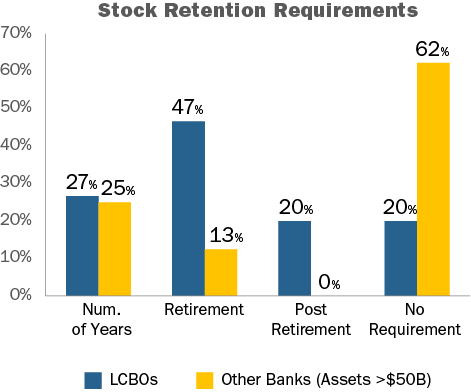
While the Federal Reserve has not mandated ownership guidelines or requirements for executives to hold on to shares post-exercise of stock options or post-vesting of other vehicles, a number of companies within the financial services industry have implemented rigorous share retention requirements. Shareholder advisory groups and shareholder activists have been pushing the idea of requiring that shares be held to retirement or post-retirement. In most industries, there has been little movement in response. Among the financial services firms we reviewed, several require holding for at least one year post-vesting of shares or exercise of stock options, and nearly 50% of LCBOs have a requirement that executives hold a portion (typically 50%) of net after-tax shares to retirement. A few firms require that shares be held post-vest or exercise for one year following retirement.
Though this is not a specific requirement of the Federal Reserve, we suspect that companies feel that required share retention to retirement encourages executives to focus on preserving the long-term value of shares and provides a strong “risk-balancing” feature sought by the Federal Reserve to the overall program.
Conclusions
For financial institutions subject to review by the Federal Reserve, compensation programs will continue to evolve over the coming years. It has taken some time for the regulators to develop points of view on compensation programs, and we anticipate that their perspective of what constitutes “substantial conformance” with their guidelines will continue to evolve. One area of concern is ensuring that in addressing appropriate and important concerns about risk, companies are not forced to dilute their pay-for-performance relationship and alignment of executive compensation with shareholder outcomes.
We believe companies will continue to engage with the Federal Reserve in dialogue around pay-for-performance, shareholder expectations and the “overall” structure of their plans vs. any single design feature. It is possible that with ongoing engagement with the regional Federal Reserve Banks and the Federal Reserve Board that the banks (collectively) will be able to share some of their perspectives and use their actual experience, sensitivity analysis and back-testing to provide a better understanding of the risks and the mitigating features underlying their compensation programs. It is our hope that this engagement will allow companies to strike the appropriate balance between pay-for-performance, alignment with shareholders and the Federal Reserve’s valid concerns about managing and averting unnecessary risk.
1 Companies reviewed include American Express, Bank of America, BNY Mellon, Citigroup, Capital One Financial, Discover Financial Services, Goldman Sachs, JPMorgan Chase, Morgan Stanley, Northern Trust, PNC, State Street, SunTrust Bank, US Bancorp, Wells Fargo, BB&T, Comerica, Fifth Third, Huntington Bancshares, KeyCorp, M&T Bank, Regions and Zions Bancorp.
- §953, §955: Rules regarding disclosure of pay-for-performance, pay ratios, and hedging by employees and directors
- §954: Rules regarding recovery of executive compensation (clawback policies)
- Previously, the SEC had planned on proposing rules for these provisions between January and June 2012 and to finalize rules between July and December of 2012
Conclusion
Elimination of the timeline reflects the delays in SEC rule-making. As a result, we expect that these provisions will not apply during the 2013 proxy season and there is significant uncertainty about when rules will be proposed. This would push implementation of the pay-for-performance and pay ratio disclosure aspects of Dodd-Frank to the 2014 proxy season. The timing delay is due, in part, to other more pressing regulatory issues (e.g., the JOBS Act).
2013 will still be a busy year for both management and Compensation Committees due to Dodd-Frank. We expect annual Say on Pay (Dodd-Frank §951) votes to continue to demand significant attention. In addition, Committee and advisor independence standards (Dodd-Frank §952) were recently issued by the SEC and we should soon see listing standards governing independence proposed by the major exchanges.
Please contact us at (212) 921-9350 if you have any questions about the issues discussed above or would like to discuss your own executive compensation issues. You can access our website at www.capartners.com for more information on executive compensation.
- In addition to the five factors (listed later) that must be considered when assessing a compensation adviser’s independence originally included in the Dodd-Frank legislation and the proposed rules, the committee must also consider any relationships the adviser may have with an executive officer (proposed rules only required assessment of relationships with committee members)
- The proposed rules only addressed the independence of the members of the Compensation Committee; however, the final rules also specify that the requirements apply to all Board members who are acting in a fashion similar to the Compensation Committee
- This may be of particular relevance when significant compensation decisions are made by the full board. Companies will need to be cognizant of what Directors may or may not vote on specific compensation issues.
Timing for Implementation
The new rules and amendments will take effect 30 days after publication in the Federal Register. The stock exchanges have 90 days from the date the rules are effective to propose listing standards and one year from the date of effectiveness to have final rules in place. In addition, companies must be in compliance with the new required disclosure regarding the use of a compensation consultant (including whether the work of the compensation consultant has raised any conflicts of interest and if so, how the conflict is being addressed) for the proxy material for any annual meeting at which directors are elected on or after January 1, 2013.
In the section below, we provide a brief summary of highlights of the adopted rules.
Committee Independence
The listing standards must require that each member of a company’s compensation committee be independent. The definition of independent is left to each of the exchanges to define, but needs to consider relevant factors, including:
- A director’s source of income, including any compensatory arrangement with the company
- Whether a director is affiliated with the company or any related entity
The rules do provide the exchanges flexibility to exempt particular relationships from the independence requirement, as deemed appropriate by the exchanges, if warranted by relevant factors (e.g., size of company).
Compensation Advisers
The final regulations also direct the exchanges to establish listing standards related to compensation advisers (e.g., consultants, legal counsel, etc.), they specify the following:
- Each compensation committee must have the authority, in its sole discretion, to obtain the advice of compensation advisers
- Before selecting any compensation adviser, the compensation committee must take into consideration specific factors identified by the Commission that affect the independence of compensation advisers, though there are no specific thresholds or tests specified. The six factors are:
- Does the adviser’s firm provide any other services to the company
- The fees received by the adviser as a percent of the adviser’s total revenue
- The policies and procedures the adviser firm has in place to prevent conflicts of interest
- Any business or personal relationship between an advisor and the compensation committee
- Whether the adviser owns stock in the company
- Any business or personal relationship between the adviser and executive officers
- The compensation committee must be directly responsible for the appointment, compensation and oversight of the work of the advisers
- Sufficient funding must be provided to pay the adviser
Note the rules do not limit the exchanges from adding additional criteria to the assessment of adviser independence. It is also worth pointing out that the adopted rules do not require Committee’s to use an independent adviser, but only to assess the independence of the adviser. The adopted rules also clarify that in using the advice of in-house legal counsel, the Committee does not have to consider the independence factors.
Disclosure of Consultant Independence and Conflicts of Interest
As mentioned earlier, for any consultant that played a role in determining or recommending the amount or form of executive and director compensation and whose work has raised any conflict of interest, the companies will be required to disclose the nature of the conflict of interest and what the company did to address the conflict. This disclosure does not eliminate any of the currently required disclosure regarding executive compensation consultants (e.g., identify consultant, state whether consultant was engaged directly by the compensation committee, describe the nature and scope of the engagement and instructions given to the consultant, and fee disclosure if the consultant provided additional fees greater than $120,000)
Conclusion
The adopted rules adhere closely to the original language of the Dodd-Frank legislation and to the proposed rules. The next step in the process of implementation will be in the exchanges’ development of the listing standards. The adopted rules provide the exchanges with a good degree of flexibility in how they will define independence and the factors to consider in assessing independence. It will be interesting to see if they do much beyond what is laid out in the adopted rules to clarify the rules.
Say on Pay Update
2012 marks the second year of mandatory Say on Pay voting. In 2011, the SEC issued final rules implementing Section 951 of the Dodd-Frank Wall Street Reform and Consumer Protection Act (“Dodd-Frank”). Dodd-Frank provides shareholders of US public companies with the right to cast three types of advisory votes related to executive compensation:
- A vote to approve the compensation of the Named Executive Officers (NEOs), effective for shareholder meetings occurring on or after January 21, 2011;
- A vote on the frequency with which shareholders should be entitled to cast Say on Pay votes (every one, two or three years), effective for shareholder meetings occurring on or after January 21, 2011; and
- A vote on golden parachute arrangements for NEOs related to a sale, consolidation or merger, effective April 25, 2011.
CAP Comment: While these votes are non-binding, we see evidence that companies carefully evaluate their vote results, taking some action if there is low shareholder support for the company’s executive compensation program. In 2011, a consensus developed that a low pass rate was a concern.
Say on Pay Vote Results Among the S+P 500
So far this season, Say on Pay resolutions received majority shareholder support at all but seven S&P 500 companies.1 The seven companies where a majority of shareholders did not support the executive compensation program were International Game Technology, Citigroup, Cooper Industries PLC, Mylan, NRG Energy, Pitney Bowes and Simon Property Group.
Comparison of year-to-date results for 2012 to 2011 results shows a consistent pattern. We found that the median vote in support of a Say on Pay resolution is 93.7% s in 2012. This is almost identical to the 93.2% median support level that we observed last year.
2011 and 2012 Say on Pay Vote Results
|
% in Favor |
# of Companies in 2012 |
% of Companies in 2012 |
% of Companies in 2011 |
|
90% – 100% |
200 |
69% |
63% |
|
80% – 90% |
42 |
14% |
17% |
|
70% – 80% |
17 |
6% |
10% |
|
50% – 70% |
26 |
9% |
9% |
|
0% – 50% |
7 |
2% |
2% |
CAP Comment: While a company does not “fail” its Say on Pay vote unless a majority of shareholders vote against the compensation program, most companies have received 90+% shareholder support and an “acceptable” shareholder support threshold has emerged around 70% – 80%. ISS identified 70% as a minimum acceptable level of support, while Glass Lewis prefers 75%. Among institutions, CalSTRS and Black Rock identified 75% and 80%, respectively.
Notably, all of the S&P 500 companies that failed Say on Pay in 2011 that have completed their 2012 Say on Pay votes, have received passing grades from shareholders. Some of these companies have made significant changes to pay programs. In addition, management teams at these companies have devoted considerable effort to shareholder outreach and engagement to better understand the issues that may be creating concerns.
|
Company |
% Support Received in 2012 Say on Pay Vote |
Modifications Made to Compensation Program |
|
Hewlett-Packard |
77% |
|
|
Jacobs Engineering |
96% |
|
|
Masco Corp. |
95% |
|
|
Stanley Black & Decker |
93% |
|
CAP Comment: SEC disclosure rules require additional disclosure in the CD&A regarding whether, and if so how, companies have considered the results of the most recent Say on Pay vote.
Several factors impact Say on Pay Voting results. We have observed a clear link between voting outcomes and company performance as measured by Total Shareholder Return (“TSR”). Not surprisingly, companies that enjoy high levels of shareholder support tend to perform better. Companies with lower performance tend to receive lower shareholder support.
TSR vs. Say on Pay Vote Results
|
% in Favor |
Average 1-Yr TSR @ 12/31/11 Prior to 2012 Annual Meetings |
Average 1-Yr TSR @ 12/31/10 Prior to 2011 Annual Meetings |
|
90% – 100% |
3.4% |
24.5% |
|
80% – 90% |
-5.3% |
24.1% |
|
70% – 80% |
-7.6% |
17.3% |
|
50% – 70% |
-5.8% |
8.0% |
|
0% – 50% |
-5.9% |
9.6% |
The recommendations of the proxy advisory services also have an impact. For example, when ISS recommends an “Against” vote on Say on Pay, the voting outcome is normally low. To date in 2012, we found that companies receiving a “For” recommendation from ISS had average shareholder support of 93%. In contrast, companies receiving an “Against” recommendation from ISS had average shareholder support of only 60%.
Among companies where ISS recommended “Against” the Say on Pay proposal, 93% received less than 80% support.
|
Companies Receiving “Against” Vote Recommendation |
||
|
% in Favor |
# of Companies |
% of Companies |
|
90% – 100% |
0 |
0% |
|
80% – 90% |
3 |
7% |
|
< 80% |
38 |
93% |
Given the growing influence of the proxy advisory firms, more and more companies are pushing back. Many companies have been proactive during this proxy season, with more than 50 firms filing supplementary soliciting materials. Prominent examples include Qualcom and Disney. Companies provide additional soliciting material to rebut the vote recommendations of the proxy advisory firms. While the supplemental materials do not impact the recommendation of the proxy advisory firms, they are positive in terms of investor outreach. Arguments over the appropriateness of peer groups selected by the proxy advisory firms are relatively common. In addition, a number of companies have adopted the proxy summary concept to direct attention to key messages, highlight the proposals that shareholders will be voting on and supplement the pay orientated disclosure provided in the CD&A.
Say on Pay Frequency Vote Results
An annual vote frequency emerged as the clear shareholder preference in 2011. Among S&P 500 companies reporting vote results, a majority of shareholders supported an annual frequency at 94% of companies. This differs from vote recommendations, with only 70% of the companies recommending an annual vote.
|
Board Recommendation for Vote Frequency |
# of Companies |
|
Frequency Receiving Majority Shareholder Support |
% of Companies |
|
Annual |
70% |
|
Annual |
94% |
|
Biennial |
3% |
|
Biennial |
0% |
|
Triennial |
23% |
|
Triennial |
5% |
|
No Recommendation |
4% |
|
None (only plurality) |
1% |
The strong support for annual votes is not a surprise. 39 institutional investors, representing more than $830 billion in assets, issued a public call for companies and investors to support annual advisory votes on executive compensation in 2011 proxy statements. Similarly, a number of major mutual funds, as well as ISS and Glass Lewis, have indicated support for annual Say on Pay votes.
CAP Comment: Over time, we expect the prevalence of annual Say on Pay voting to increase.
CAP Comment: Following the frequency vote, the SEC rules mandate disclosure through an 8-K of how often the company will hold future Say on Pay votes. Issuers must also provide proxy-based disclosure of the current frequency of Say on Pay votes and when the next scheduled Say on Pay vote will occur.
CAP Comment: For companies that conduct Say on Pay vote frequency in line with the preference of a majority of shareholders, shareholder frequency proposals can be excluded from the proxy for six years.
Conclusion
Last year many questioned what level of shareholder support should be viewed as “acceptable.” Based on experience to date, the acceptable “threshold” will be around 80% support, a higher hurdle than simply a pass / fail test. This is somewhat higher than the minimums identified by ISS and Glass Lewis, and should be sufficient to avoid undue scrutiny of the compensation program.
Going forward, a Say on Pay vote will be an annual event at most companies. Our experience indicates that Sayon Pay voting has been a catalyst for change, and certain themes have emerged:
- Companies with stronger performance generally receive higher levels of shareholder support;
- Negative vote recommendations from the shareholder advisory firms will likely reduce the vote below the “acceptable” level and companies will need to campaign to obtain a positive voting outcome;
- Many companies have increased dialogue with their largest investors by engaging early;
- Say on Pay proposals include supporting statements;
- Use of executive summaries in the Compensation Discussion and Analysis (CD&A) of the proxy statement is commonplace; and
- Use of a proxy summary or potentially filing supplemental material to rebut negative voting recommendations should be considered.
1 Outside of the S&P 500, an additional 22 companies did not receive majority shareholder support for their NEO compensation program as of 5/25/2012: Actuant Corporation, Argo Group International, Cenveo, Charles River Laboratories, Chemed Corporation, Community Health Systems, Comstock Resources, First California Financial, FirstMerit Corp., Gentiva Health Services, Hercules Offshore, Infinera Corporation, KB Home, Knight Capital Group, Manitowoc Company, OM Group, Palomar Medical Tech., Phoenix Companies, Sterling Bancorp, The Ryland Group, Tower Group, and Viad Corp.
This resulted in significant new reporting requirements for banks and other financial institutions with $1 billion or more in consolidated assets regarding incentive compensation arrangements for Tier 1, Tier 2 and Tier 3 Covered Employees.1,2
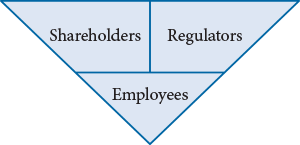
- The Federal Reserve Board (“FRB”) first proposed guidance on incentive compensation in 2009 that was adopted by all the federal banking agencies in 2010 (“Final Guidance”).
- As a result, the focus of compensation program design at large banking institutions expanded. Beyond pay-for-performance and attracting / retaining talent, the programs must provide a greater focus on appropriately balancing risk and rewards.
To “improve” practices and require conformance with the Sound Guidance, in late 2009 the FRB began a multi-disciplinary horizontal review of incentive compensation arrangements at 25 large complex banking organizations (“LCBOs”). This led to an iterative pay program design process, as regulators now need to “sign off” on compensation program design for all Covered Employees. Based on client experience and a review of 2012 LCBO proxy statements, we have identified key themes concerning what has been done to-date to move towards substantial conformance with FRB requirements.3
| Key Themes | |
| 1. | The Fed is highly involved in the compensation design process at large bank holding companies for a sizeable number of employees (ranging from senior executives to employees well below that level) |
| 2. | A majority of variable executive compensation is linked to long-term performance and risk outcomes; it is now typical that more than the required 50% of incentive pay (annual + long-term) be deferred over at least 3 years |
| 3. | Performance adjustments are now expected before and after the grant of incentive compensation, and the role of the Risk function and formal risk assessments in that process has increased |
| 4. | Long-term incentive goals must now balance business plan and shareholder goals (EPS, TSR, etc.) with risk-based ex-post performance features (capital goals, etc.) |
| 5. | It is majority practice to have stock ownership requirements for senior executives that go beyond a more traditional guideline (multiple of base or number of shares achieved within a certain number of years) |
| 6. | Clawback provisions go beyond what is required by Sarbanes-Oxley or expected under Dodd-Frank |
Overall Incentive Compensation: Annual and
Long-term
With the goal of “de-leveraging” incentive pay programs and placing more focus on long-term performance and risk outcomes, some LCBOs have re-balanced the pay mix for senior executives. This typically includes a combination of: 1) increasing base salaries; 2) reducing annual incentive award opportunities; 3) increasing the mandatory deferral rate for a portion of annual incentive awards.
To ensure alignment of compensation with long-term performance and risk outcomes, proposed regulations require that at least 50 percent of incentive compensation (annual + long-term) be deferred over a period of at least 3 years (ratable vesting is acceptable), for specific Tier 1 executives at covered financial institutions with total assets of at least $50 billion (minimum deferral under proposed regulations; Dodd-Frank §956).
| approx. (rounded) | % of Incentive Compensation Deferred Over At Least 3 Years (Actual Bonus + Grant Date LTI Value) |
|
| CEO | NEOs (avg.) | |
| 75th%ile | 80% | 75% |
| 50th%ile | 70% | 65% |
| 25th%ile | 65% | 60% |
Currently, the portion of incentive compensation deferred at LCBOs is substantial and exceeds the minimum guideline. Many of these companies have additional stock retention requirements after deferred compensation vests.
CAP Perspective: These high deferral rates reflect a meaningful shift from historic industry practice.
CAP Perspective: Near-term, medium-sized financial institutions are likely to migrate their practices towards increased deferral rates leading to a change in typical senior executive pay mix.
Regulators also require that the deferred amounts be subject to: “performance adjustment for losses (or other measures or aspects of performance) that are realized or become better known during the deferral period.” These risk (and performance) adjustments are expected prior to the grant of incentive compensation (ex-ante / upfront) as well as post-grant and prior to vesting (ex-post / look-back).
In terms of ex-ante adjustments, all but one LCBO (93 percent) disclosed in its most recent proxy statement an annual risk review prior to payment of incentive compensation that can modify payout. Most companies disclosed a highly discretionary process (more structure likely exists), while 20 percent specifically described use of a risk/compliance scorecard.
CAP Perspective: These new concepts / design will cascade down in organizations, and create additional work for cross-functional teams.
In terms of ex-post adjustments, companies are introducing formulaic and/or discretionary reduction features (see LTI discussion below).
CAP Perspective: The FRB does not recognize market-based (stock price) adjustments alone as an adequate form of risk-based performance adjustment.
Incentive Compensation: Annual Incentives
Measuring absolute (internal) performance against pre-established goals is the most common approach used by the LCBOs to determine bonus payments for senior executives. The goals are most often made up of multiple performance measures. The most prevalent metrics relate to profitability (for example, EPS), followed by return/efficiency metrics (for example, ROE).
Additionally, as a risk management technique, we observed that about 20 percent of LCBOs have reduced annual incentive plan upside leverage, by either reducing target opportunities or capping maximum payout opportunities.
Annual Incentive Plan Measurement
Relative vs. Absolute
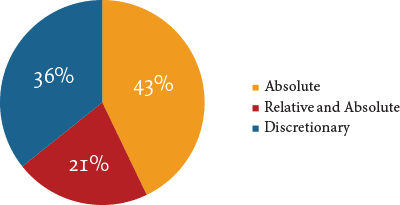
CAP Perspective: Near-term, we expect large bank holding companies to add more structure to the annual incentive decision making process, including increased documentation and back-testing of decisions.
CAP Perspective: We also expect to see an increased use of risk-focused measures, such as use of a minimum capital level as a 162(m) funding requirement.
Incentive Compensation: Long-term Incentives
Most companies use two long-term incentive vehicles. Some form of long-term performance plan (LTPP; performance shares / cash) is the most widely used vehicle, followed by stock options. The most common LTPP performance period is 3 years, and the most common LTPP upside leverage is 150 percent of target.
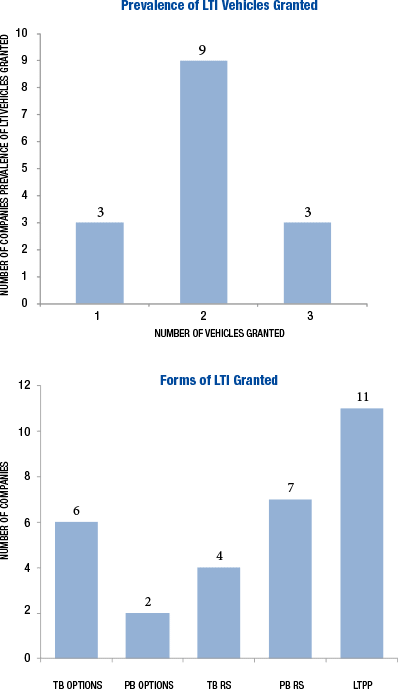
CAP Perspective: Stock options have been de-emphasized in the proportion of the long-term incentive award that they represent due to recent stock price volatility and outside criticisms.
CAP Perspective: Stock options are not seen as appropriately performance-based among regulators. There is concern that value can be realized based on macro economic conditions, rather than company-specific events/financials, particularly over a 10 year timeframe. Attaching some form of ex-post performance-based adjustment can provide risk-balancing features.
In addition to traditional long-term goals tied to the business plan, relative performance or stock price, companies have been adopting secondary performance conditions, in reaction to the Final Guidance, intended to significantly reduce or eliminate unvested deferred incentive payments (post grant, an ex-post adjustment) if a risk event were to occur. These adjustments are designed to be done on a formulaic basis, discretionary basis, or both.
| Select Examples | |
| PNC |
|
| Goldman Sachs |
|
| BNY Mellon |
|
When designing a long-term incentive program, it is also important for financial institutions to consider accounting implications.
CAP Perspective: Truly new designs are being implemented, and it seems that some may lead to variable accounting for equity vehicles. Awards may lack a true grant date, resulting in variable accounting, if a discretionary risk assessment subjects the awards to reduction up until vesting. This can lead to increased cost / volatility in expense and therefore create a reason to consider providing a portion of long-term incentive compensation through a cash-based vehicle.
Stock Ownership Requirements
While all of the LCBOs have some form of stock ownership requirement, most have requirements for senior executives that go beyond traditional ownership guidelines (multiple of base and/or number of shares that must be achieved within a certain number of years).
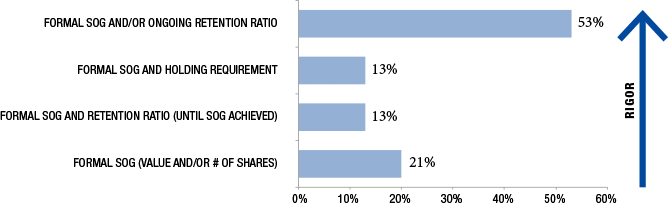
CAP Perspective: The most rigorous requirement for executives – an ongoing retention ratio – is most common.
CAP Perspective: Senior executive ownership standards in this industry exceed those typically found in the general industry.
Clawbacks
As most public companies await final SEC regulations, the horizontal review banks have begun to make comprehensive changes to their existing clawback policies. The horizontal review banks have a clawback provision that goes beyond what is required under Sarbanes-Oxley or Dodd-Frank legislation (SEC has not yet proposed rules). These clawback provisions are part of multiple programs and can impact different employee populations or pay elements for varying reasons.
CAP Perspective: Based on disclosed policies, it is noteworthy that “inattention to risk” is a triggering event among 40 percent of the horizontal review banks.
CAP Perspective: In our experience, most companies have yet to think through how they would implement a clawback of previously paid compensation, should one be triggered. This will likely be a complicated process, with a number of legal and tax considerations for both the employee and the company.
Conclusion
Compensation design and governance practices have been changing at LCBOs at an accelerated pace since the horizontal review process began and the Final Guidance was issued. Change will continue among these organizations, and will spread to other large (and smaller) financial institutions. While the regulations are focused on the largest banks ($50B+ in consolidated assets), the design practices discussed above will be increasingly relevant for financial institutions of all sizes.
There are now greater expectations for Board oversight, enhanced controls and related policies, and documentation for incentive plans and risk mitigation strategies. To comply, the Compensation Committee and a cross-functional senior management team must be fully involved, well-informed and possess an in-depth understanding of incentive arrangements for all Covered Employees.
Research assistance for this CAPFlash was provided by: Deep Patel, Devika Ray and Chelsea Carter.
1 These companies are required to disclose the structure of their incentive-based compensation arrangements to appropriate federal agencies.
2 As described in the Interagency Guidance, the full set of employees who may individually or collectively expose the firm to material amounts of risk are together referred to as “Covered Employees.”
3 16 LCBOs are U.S.-based. Our analysis focuses on these companies excluding Ally Financial (where the U.S. government remains the majority owner). Data found in proxy disclosures is most relevant to Tier 1 Covered Employees (senior executives).
New SEC Compensation-Related Rulemaking Schedule
As background, for Dodd-Frank to be implemented the SEC needs to develop rules governing several aspects of the legislation impacting executive compensation. The list below provides a summary of the current planned timing of when rules will be issued.
January – June 2012 (Planned)
- §952: Adopt exchange listing standards regarding compensation committee independence and factors affecting compensation adviser independence; adopt disclosure rules regarding compensation consultant conflicts
- §953, §955: Propose rules regarding disclosure of pay-for-performance, pay ratios, and hedging by employees and directors
- §954: Propose rules regarding recovery of executive compensation (clawback policies)
July – December 2012 (Planned)
- §952: Report to Congress on study and review of the use of compensation consultants and the effects of such use
- §953, §955: Adopt rules regarding disclosure of pay-for-performance, pay ratios, and hedging by employees and directors
- §954: Adopt rules regarding recovery of executive compensation (clawback policies)
Conclusion
The delay in the SEC’s rulemaking schedule pushes implementation of the pay-for-performance and pay ratio disclosure aspects of Dodd-Frank to the 2013 proxy season. However, 2012 will likely still be a busy year for both management and compensation committees in implementing new aspects of Dodd-Frank as final rules become available. The implementation of Say on Pay votes in 2011 (Dodd-Frank §951) has already been a catalyst for change, and we expect many of the new rules to lead to meaningful changes to executive compensation programs in 2012-13, including those related to governance and disclosure.
The body of the report is structured around two overarching principles of the guidance with four subtopics under each principle. Below is a brief overview of the key observations by Topic Area.
Balancing Incentives at Large Banking Organizations
- Topic 1: Risk Adjustment and Performance Measures: Most firms have made progress in incorporating risk adjustment into performance measurement
- Federal Reserve highlighted assessing a capital charge against internal profit measures to reflect liquidity risk as a “leading edge” performance measurement practice
- Where firms use qualitative approaches, the report indicated that developing appropriate policies and procedures to guide judgmental adjustments of incentive compensation awards was an area where further work was needed
- Topic 2: Deferred Incentive Compensation: Most companies are requiring deferral of a significant portion of their incentive compensation, particularly for senior executives
- Federal Reserve wants to ensure that performance-based deferrals adjust for risk outcomes, either quantitatively or through well defined judgment
- In a footnote, the report indicated that a trigger of reducing the amount of deferred compensation that vests if the firm or a business unit has a net loss could be an appropriate adjustment
- Topic 3: Other Methods that Promote Balanced Risk-Taking Incentives: Report discussed using multi-year backward looking performance measurement and reduced sensitivity to movement above and below plan. Discussion was less robust than other sections of the report
- Topic 4: Covered Employees: Most firms have gone through the process of identifying covered employees, but the Federal Reserve’s view is that some firms need to strengthen the process and cited an overreliance on materiality thresholds as a common area of weakness
- Risk-Management, Controls and Corporate Governance
- Topic 5: Risk-Management and Control Personnel and the Design of Incentive Arrangements: Most firms have moved to incorporate risk management personnel into the incentive compensation design and review process and should continue to increase their participation in the process over time
- Topic 6: Incentive Compensation for Staff in Risk-Management and Control Roles: Most firms have substantially complied with the Federal Reserve guidance by delinking incentive compensation for these professionals from business unit incentive pools and focusing their compensation on their own activities
- Topic 7: Practices Promoting Reliability: This is an area where the Federal Reserve sees a need for a significant amount of work by all organizations in the horizontal review on an ongoing basis
- Conduct internal reviews and audits of compliance with well developed policies and procedures
- Undertake “backtesting”/monitoring of compensation programs to ensure that incentive compensation outcomes are consistent with the original intent of the design
- Topic 8: Strong Corporate Governance: Firms in the horizontal review have generally made good progress in ensuring that their Compensation Committees review the relationship between incentive compensation and risk more broadly. This will be an area of continued development over time
Conclusion
The Federal Reserve’s horizontal review indicates that firms have made significant progress in implementing the interagency guidance on incentive compensation practices; however, areas where additional work is required remain for full compliance to be achieved. In addition, the Federal Reserve recognizes that many of the compensation programs and processes being put in place are new and will need to be monitored and refined over time to ensure effectiveness in balancing risk and financial results.